Science
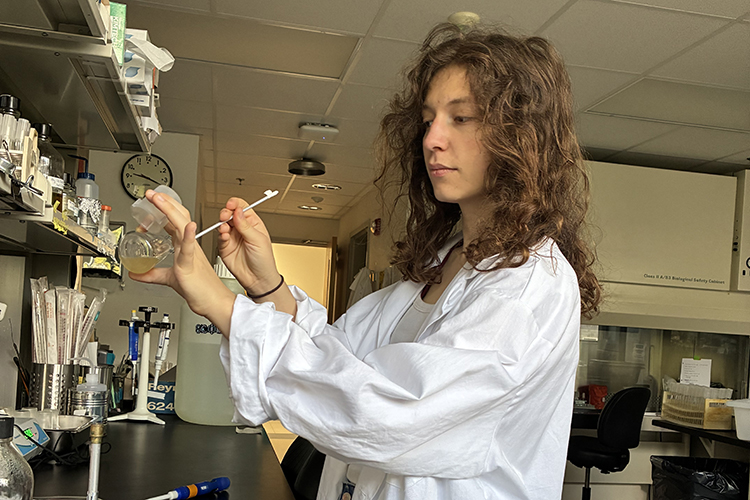
Recent UWM grad sees the value of persistence

Nick Nelson began college as a mechanical engineering major, but soon realized it wasn’t for him. Not long after, he found university and career path that better suited his interests.
UWM researcher reconstructs ancient landscapes from the Midwest to Mars

Libby Ives earned her PhD in geosciences at UWM. Now she studies ancient landscapes to uncover new insights about a planet’s environment.
UWM professor wins award for gravitational science work

Patrick Brady, director of the Leonard E. Parker Center for Gravitation, Cosmology and Astrophysics, was given the American Physical Society’s 2026 Richard A. Isaacson Award in Gravitational-Wave Science, announced Wednesday.
UWM physics major is a budding star with an eye on the night sky

Ben Lorenz studies ripples in space called gravitational waves. The research could help shed light on the origins of the universe.
A cosmic mystery: Astronomers find object flashing in both radio waves and X-rays

UWM Professor David Kaplan and graduate student Akash Anumarlapudi are part of an international team that made a startling discovery about a new type of cosmic phenomenon.
Planetarium hosting eclipse event, teaching 4,300 MPS students this spring
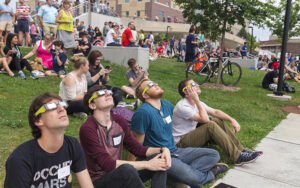
On Monday, the UWM planetarium will host a viewing party. And all this semester, it will host third-graders to learn about space and the solar system.
UWM alum works to uncover building blocks of the universe at SNOLAB
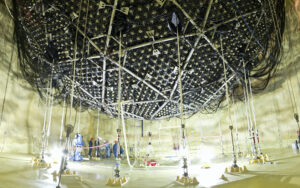
Jodi Cooley is executive director of the huge underground research facility in Canada where scientists from around the world are working on experiments to help better understand the building blocks of the universe.
Citizen scientists can now also use their brains to help find new pulsars
Citizen scientists have provided important help to astronomers exploring the heavens, and now they are invited to take a more hands-on role.
NASA scientist to discuss the women who made space discoveries on Sept. 26

Michelle Thaller will speak at UWM about how discoveries made by largely overlooked women led to our current understanding of dead stars, dark matter and the end of everything.
Scientists turn exotic stars into a galaxy-sized detector of gravitational waves
UWM researchers played an important role as part of an international team that made a scientific breakthrough that could tell us more than ever before about how the very early universe formed.