Graduate study in mechanical engineering at UWM’s College of Engineering & Applied Science prepares you to lead innovation, advance knowledge, and solve complex engineering challenges.
At UWM, graduate students work closely with faculty on impactful research in areas such as advanced manufacturing and materials, energy and sustainability, robotics and controls, fluids and computational modeling, and health-related engineering. You’ll gain deep technical expertise while contributing to projects with real-world applications and industry relevance.
UWM offers a collaborative research environment where graduate students are mentored, not lost in the crowd. You’ll have access to modern laboratories, interdisciplinary research centers, and partnerships with industry, healthcare, and government organizations—creating pathways to funded research, internships, and career advancement.
Located in Milwaukee, UWM connects you to a strong regional and national engineering network. Graduates are well prepared for careers in industry, research and development, national laboratories, and academia, as well as for entrepreneurial ventures.
Whether you are seeking advanced technical specialization, research leadership, or a pathway to a PhD, graduate study in mechanical engineering at UWM provides the expertise, experience, and professional connections to move your career forward.
Assistantship decisions are made by the academic departments only after an applicant has been accepted to the program.
Mechanical Engineering Research Labs
The team at the Center for Sustainable Electrical Energy Systems (SEES) is exploring methods to make electric power systems more sustainable, cost-effective, and secure through research on energy storage, microgrid systems, and renewable energy sources.
The Connected Systems Institute (CSI) accelerates innovation by bringing together industry and academic researcher to facilitate digital transformation for small and medium-sized manufacturers, ultimately developing an educational curriculum to better prepare the workforce of the future.
In the Energy Storage Research Laboratory the focus is on fundamental electrochemical research, seeking new materials and understanding reaction mechanisms in the areas of renewable energy, sensor and water treatment.
The Industrial Training and Assessment Center (ITAC) is a U.S. Department of Energy supported program dedicated to helping small and medium-sized manufacturers and wastewater treatment plants minimize their energy costs through efficient use of resources
The Machine Shop is a hands-on facility with state-of-the-art manual and computer-assisted equipment and machine tools used by faculty, students, and members of industry.
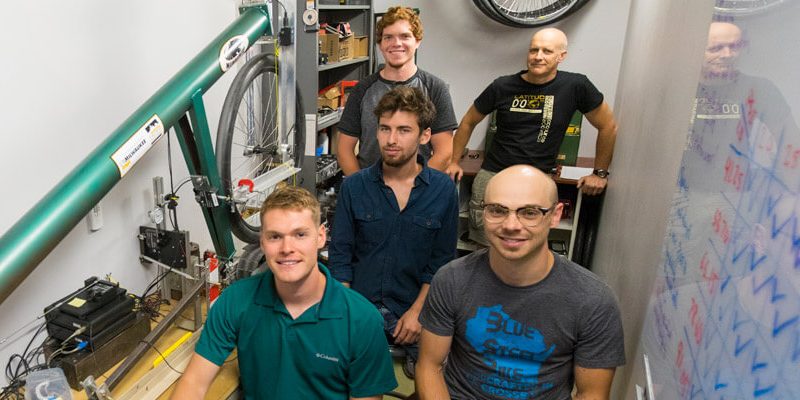
The Bicycle and Motorcycle Engineering Research Laboratory helps manufacturers around the world to make their two and three-wheeled vehicles safer and more efficient. They offer students the opportunity to collaborate with manufacturers in designing and building test equipment, collecting and analyzing data, formulating mathematical models, and building prototypes.
AIAA is the largest aerospace professional society in the world, and its members help make the world safer, more connected, more accessible, and more prosperous.
American Society of Mechanical Engineers
ASME promotes knowledge of the theory and practice of mechanical engineering, and offers the opportunity to participate in activities that promote a professional awareness of mechanical engineering.
Prototyping Club
PC provides students the tools, knowledge, and support to develop an idea into an invention.
Society of Automotive Engineers
SAE provides members an opportunity to gain insight into the engineering profession by offering hands on engineering experience through student design competitions like the BAJA vehicle challenge, monthly meetings with engineering professionals, and local industry tours.
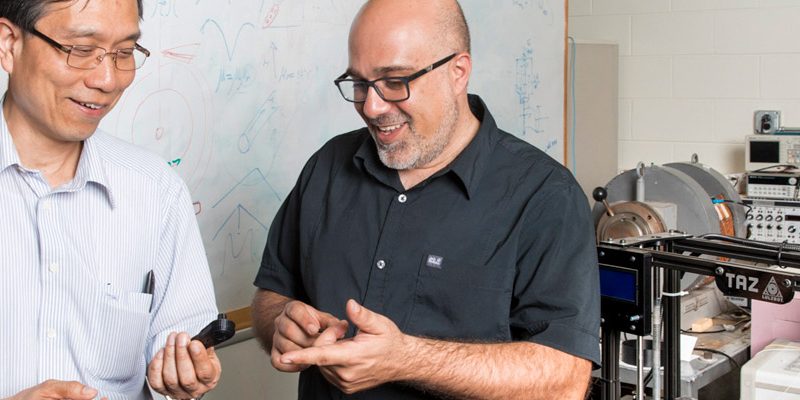
Habib Rahman, professor and chair, mechanical engineering, and Inga Wang, professor, occupational therapy, science & technology, worked together to test the iTbot, a portable, assistive robotic arm, that allows stroke patients to receive physical therapy without leaving their homes. The arm-based platform that Rahman is developing has advantages for both patients and therapists. (Photo by Troye Fox)