Science & Technology
UWM-sponsored Lake Sturgeon Bowl celebrates its 20th year
The quiz competition has raised knowledge of and spurred interest in freshwater and ocean science among high school students across the Midwest.
NANOGrav finds first hints of low-frequency gravitational wave background
A group of UWM researchers is part of the collaboration of scientists that used 13 years of data to find what could be the first direct detection of low-frequency gravitational waves.
State launches dashboard for COVID-19 data found in sewage
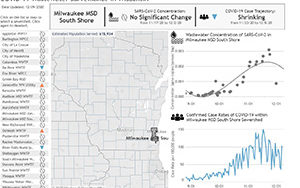
The statewide surveillance project is a collaboration between UWM’s School of Freshwater Sciences, the Wisconsin Department of Health Services and the Wisconsin State Lab of Hygiene.
UWM astronomer helps discover extrasolar ‘space weather’
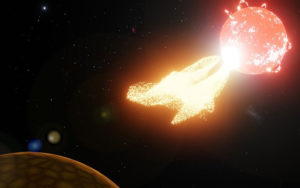
If you wanted to look for life on planets around stars other than our sun, known as exoplanets, you would first locate the ones in the “Goldilocks zone.” That’s the area – not too close, not too far – at just the right distance from a star where a planet might have liquid water.
UWM physicists to work with Argonne National Lab on a breakthrough battery material
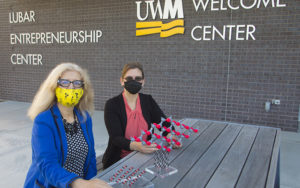
The U.S. Department of Energy recently awarded funding to a startup launched by two UWM professors for a collaboration with the Argonne National Laboratory in suburban Chicago on research that will help their company commercialize the material.
New maps show what lies beneath the water in the Milwaukee harbor
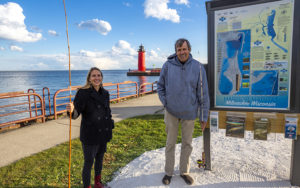
The maps are guiding current restoration efforts that could help get the city’s harbor removed from the U.S. Environmental Protection Agency’s list of “areas of concern” and stimulate the local economy.
Building a better briquette: Conservation students study charcoal production in Kenya
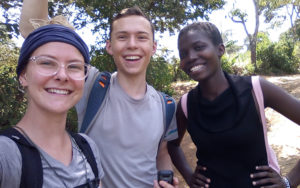
In Kenya, a country where one in four people lacks access to electricity, charcoal is a staple fuel source. It’s light, small, easy to store, burns longer and hotter than wood, and is nearly smokeless. It’s also speeding up the country’s deforestation.
UWM engineer awarded funding to build a ‘smart’ robotic assistive arm
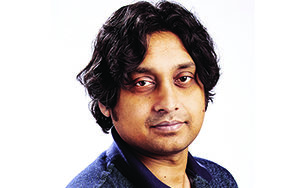
Mohammad “Habib” Rahman has been awarded a three-year, $1.49 million grant for research on a robotic assistive arm that would allow users to feed themselves, open doors, pick up an object and perform other activities that are essential for independence.
New technique makes movies of molecular machines at work
Researchers, including four at UWM, have developed a method of making three-dimensional “molecular movies,” using an imaging technique called single-particle cryo-electron microscopy.
LIGO and Virgo detect most massive gravitational-wave source yet
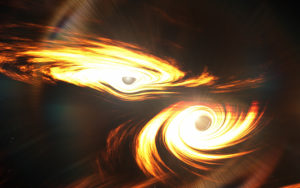
Researchers have detected a signal from what may be the most massive black hole merger yet observed in gravitational waves, an event that created a behemoth 142 times that of the sun.