UWM’s 10 largest research grants for 2018

A research university runs on federal grant funding. UWM had $58 million in research expenditures in fiscal year 2018, with more than half coming from federal agencies.
News from the University of Wisconsin-Milwaukee
A research university runs on federal grant funding. UWM had $58 million in research expenditures in fiscal year 2018, with more than half coming from federal agencies.
National Science Foundation’s Science and Technology Center includes researchers from nine institutions, including UWM. NSF has just renewed $22.5 million funding forBioXFEL so members will continue work they began in 2013.
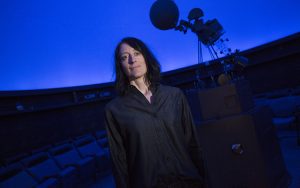
Dawn Erb, an associate professor of physics at UWM, led a team whose study could shed light on how galaxies form stars and grow.
The UWM team sent plasmids up on a rocket to discover how cosmic radiation affects DNA. The results were surprising.
UWM’s David Kaplan is part of a research team that has shown that yet another prediction by Albert Einstein 100 years ago holds up, even in some extreme conditions in deep space.
The LIGO observations of gravitational wave over the past two years were groundbreaking. Now, UWM astronomers plan to build off that work by employing a new tool to decode more mysteries of the sky.
UWM physicists played important roles in the first-ever observation of the explosive collision of neutron stars. The explosion created gravitational waves, but for the first time astronomers observed light from the same source.
The research has the potential to fundamentally advance our understanding of biological processes inside cells. UWM physicists developed algorithms to reconstruct sequential images of viruses too small to photograph.
UWM physicists are working to help physicians by accurately pinpointing fetal conception.
UWM is leading an effort to turn 54 pulsars into a massive observational array.