EnQuest: Global software engineering company promotes UWM’s girls-only engineering camp
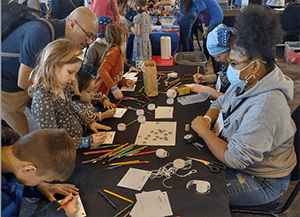
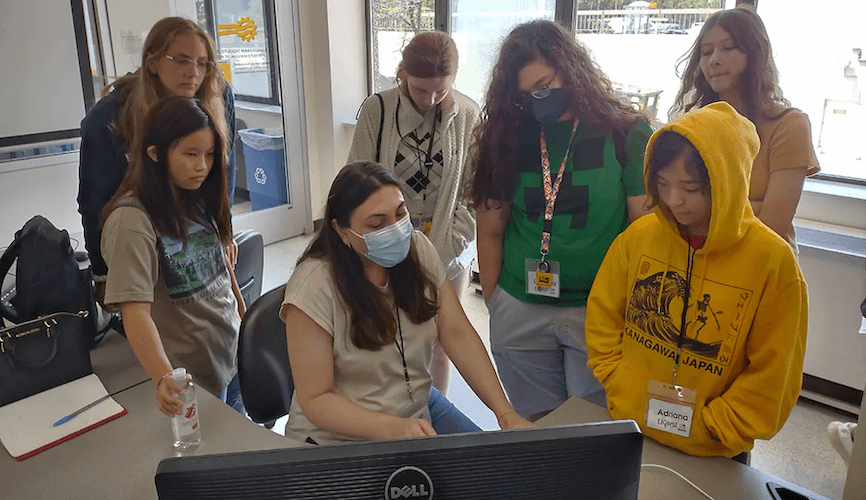
UWM’s all-girls engineering camp recently caught the attention of Ansys, a software company that employs 6,000 people worldwide.
In January, Ansys ran a story about the program, called EnQuest, which has addressed the gender ratio in STEM for 12 years. It is offered each summer through UWM’s College of Engineering & Applied Science.
Last summer, the girls completed a computer-modeling activity that improved their understanding of brain aneurysms, or strokes.
17 mechanical engineering grad students earn ME Graduate Research Achievement Awards
The Mechanical Engineering Department presented 17 students with Graduate Student Research Achievement Awards in January. The awards recognize students’ research accomplishments in 2021-2022, with publishing in journals being the main criterion.
Congratulations to the following students and their faculty advisors:
Ahmad Issam Hamad Abdelhadi; Advisor: Ryo Amano Mohamad Ahmed Abdelazim Abousabae; Advisor: Ryo Amano Saif Al Hamad; Advisor: Ryo Amano Md Assad-Uz-Zaman; Advisor: Habib Rahman Omar Habash; Advisor: Ryo Amano Muhammad Istiaque Haider; Advisor: Nathan Salowitz Md Enamul Haque; Advisor: Habib Rahman Abul Borkot Md Rafiqul Hasan; Advisor: Krishna Pillai Jaime Hernandez; Advisor: Habib Rahman Md Mahafuzur Rahaman Khan; Advisor: Habib Rahman Elias Jose Munoz Montenegro; Advisor: Ryo Amano Dantong Qiu; Advisor: Deyang Qu Md Mahbubur Rahman; Advisor: Habib Rahman Walaa Hussein Ahmad Saadeh; Advisor: Ryo Amano Abdel Rahman Salem; Advisor: Ryo Amano Javier Dario Sanjuan De Caro; Advisor: Habib Rahman Asif Al Zubayer Swapnil; Advisor: Habib Rahman
24 CEAS student athletes named to 2022 Horizon League Honor Roll
Kat Van Booven, Industrial EngineeringNick Gilhaus, Mechanical EngineeringLauren Lietzke, MS EngineeringRaul Medina (left), Industrial EngineeringMason Schoof, Civil & Environmental Engineering
Congratulations to the 24 students from our college who were among the 157 UWM student athletes on the 2022 Horizon League Fall Academic Honor Roll. Each has earned at least a 3.2 GPA in engineering or computer science while participating in at least one collegiate-level sport during the most recent season. Our students represented nine different sports last semester.
It takes a special kind of student to make this happen. These high-achieving students know how to balance the demands of the classroom and team sports and we are proud of their commitment to hard work, time management, athleticism, and academics. Congratulations!
Alumnus Jeff Kautzer named winner of the 2022 GE Edison Award for GE HealthCare
Congratulations to Jeff Kautzer (MS Electrical Engineering ’83, BS Electrical Engineering ’81), a long-time adjunct instructor in Electrical Engineering and Computer Science at UWM and chief electrical engineer, GM Imaging Hardware Platforms, at GE HealthCare.
Kautzer, who holds 30 patents, recently received the 2022 GE Edison Award for career contributions at GE HealthCare. The award, named after Thomas Edison, recognizes the technical excellence, customer impact and organizational citizenship of GE employees.
At GE, Kautzer has been instrumental in developing digital imaging systems (including flat panel X-ray and large multi-slice CT detectors) that are revolutionizing diagnostic medical imaging. He brings his real-world expertise to the classrooms of UWM’s College of Engineering & Applied Science, where he has developed and taught courses—including the Electrical Engineering Capstone course—for 23 years.
Kautzer’s service to the college includes securing funding that helped develop the college’s first Senior Design Project Awards and serving as chair of the Electrical Engineering Department’s Industrial Advisory Committee.
In 2018, STEM Forward named him Engineer of the Year.
Otieno named STEM Forward Engineer of the Year
Wilkistar Otieno, associate professor and department chair, industrial & manufacturing engineering, was named the 2022 STEM Forward Engineer of the Year, an award that recognizes outstanding contributors to the engineering profession from the greater Milwaukee area. She will receive the award Feb. 15 at the organization’s 70th annual Celebration of STEM banquet.
STEM Forward is a Milwaukee-based non-profit organization that inspires youth to pursue STEM careers.
Otieno was selected from a pool of highly qualified nominees who are committed to advancing the engineering profession and inspiring others. An independent judging panel evaluated and selected the nominees. Past winners have raised the visibility of the profession and the region while serving as role models to many.
Despite the many demands for her attention as a department chair, associate professor and researcher, Otieno devotes significant time to inspiring the next generation of engineers, which increasingly includes students of differing backgrounds. She has a passion for teaching statistical-related courses and inspiring student involvement.
Her industry-driven research involves sustainable manufacturing, particularly remanufacturing and machine learning.
Otieno is co-director of the U.S. Department of Energy Industrial Assessment Center at UWM. At the invitation of the chancellor, she serves as an assistant to the vice chancellor for Diversity, Equity, and Inclusion on the UWM 2030 Action Plan. She has served in various leadership positions in the Milwaukee’s IEEE section (Institute of Electrical and Electronics Engineers). IEEE has sponsored STEM Forward activities for many years; its members serve as judges of the STEM Forward K-12 Smart City competitions, whose winners will be featured during this year’s Celebration of Stem bequest.
UWM engineering students compete to create the most bendable concrete
For the 15th straight year, teams of UWM civil & environmental engineering undergraduate students competed to create the most bendable concrete from scratch.
Twenty students formed five teams that designed, mixed and poured original concrete formulas. Their finished products – miniature beams measuring 40mm X 12.5mm X 160mm — were curated from portland limestone cement, water, superplasticizer, polyvinyl alcohol (PVA) fiber, slag, fine sand and other components selected by the students. Teams then tested the responses of their creations under flexural load to determine its ultimate strength and maximum deflection.
When pushed to the breaking point, the winning concrete would not snap in a single location but instead develop multiple hairline cracks.
“Tiny cracks give you a warning that the concrete is weakening,” said senior Cindy Thorlton, whose team won the competition with a concrete composed of fine sand, slag, water and fiber.
(Most bendable concrete competitions have ended in ties—one team wins for ultimate strength, one for maximum deflection. However, this year Thorlton’s team won both.)
This response—called strain hardening—is key to creating stronger, longer-lasting concrete, says Konstantin Sobolev, Lawrence E. Sivak ’71 Faculty Fellow and professor, civil & environmental engineering.
“Concrete that can withstand a higher load and higher deflection would reduce repair costs and be more environmentally friendly in the long run,” he said.
UWM is a powerhouse in engineering new and improved concrete
The bendable concrete contest was the culmination of a semester of lab work in which the students in a class called Materials of Construction learned about the different types of construction materials and concrete.
The class was led by Sobolev with key support provided by teaching assistant and doctoral student Filip Zemajtis (below, left).
Master’s student Gregory Vieira (below, right) also assisted with the competition as it was related to his master’s thesis.
Vieira said the competition and interaction with Zemajtis and undergrads extended his experience with high-performance fiber-reinforced concrete and enhanced his research on bridge overlays. He is currently assisting Habib Tabatabai, professor, civil & environmental engineering and director of the UWM’s Structural Engineering Lab, on a $150,000 research project funded by the Wisconsin Highway Research Program that aims to improve bridge performance and the durability of concrete used for bridge deck overlays.
Concrete that is less brittle and more bendable will develop fewer cracks and last longer, Vieria said. “This could be a revolution in the transportation industry as we can consider using thinner bridge overlays and less rebars. It could lead to projects that cost less and overlays that last longer.”
In memoriam: Gilbert Roderick
Gilbert Roderick, associate professor emerit, civil & environmental engineering, died Oct. 16 in St. Anthony, MN. He was 89 years old.
Roderick served UWM’s College of Engineering & Applied Science for 30 years, during which time he was president of the American Society of Civil Engineering, Wisconsin Section, Southeast Branch (1983-85).
His colleagues at UWM recall him as a hard-working faculty member who put a high priority on teaching and service to the university.
“Gil was a devoted and excellent teacher,” said Alan Horowitz, professor emerit, civil & environmental engineering. “He was always available to junior faculty members for technical advice and professional mentoring.”
“He was always willing to contribute to the college and never said no to a request,” said Ed Beimborn, professor emerit, civil & environmental engineering.
Roderick’s path to becoming a university professor seems atypical by today’s standards, for it included being educated in a one-room Iowa schoolhouse, military service (Korean War) and working on one of the nation’s largest dams (Glen Canyon) before earning his master’s and doctoral degrees.
At UWM, he established the Geotechnical Engineering Program and the Soil Mechanics Laboratories. He also served as assistant dean for students in the College of Engineering & Applied science.
Kenneth Neusen, professor emerit of mechanical engineering in UWM’s College of Engineering & Applied Science, passed away Dec. 9 at age 87.
Neusen, a Milwaukee native, had worked as a nuclear engineer for Allis-Chalmers before joining the university’s small Energetics Department (since renamed Mechanical Engineering Department) in the 1960s. During his 35 years of service to UWM, he researched waterjet cutting and alternative fuels; served as acting dean for the College of Engineering & Applied Science (1999-2000); and carried out administrative responsibilities for the UWM Graduate School.
He is remembered by colleagues in the college and across campus for his good nature and commitment to fostering a positive environment for UWM students and faculty.
“Ken was always thoughtful and gentle and very good at everything he did,” said Ed Beimborn, professor emerit, civil & environmental engineering. “I remember him as unselfish and always interested in others. He was an excellent dean and a person willing to do whatever it took to help make UWM the place it is today. Will miss him.”
Robert Balmer, professor emerit, mechanical engineering, recalls Neusen as a caring and outstanding engineering educator. “I’ll always remember him as a dedicated UWM administrator who was neutral to university politics while enhancing the UWM experience for both students and faculty,” Balmer said.
K. Vairavan, professor emerit, chaired the college’s Computer Science Department when Neusen was an active faculty member. “It was a privilege to work with Ken,” Vairavan said. “His leadership contributions at UWM had many dimensions and were very significant.”
Neusen’s research centered on alternative fuels and included using natural gas to power cars and trucks. In fact, while Neusen worked at UWM, some campus vehicles were converted to run on either natural gas or oil-based gas; UMW maintained one of Milwaukee’s first natural-gas stations (located on the old North Lot by Sabin Hall).
During his years at UWM, Neusen worked with, and befriended, many colleagues across campus, including Erika Sander, associate professor emerit, kinesiology, who recalls his mild-mannered, affable demeanor. “We spent many hours together either playing fair-weather golf in the UWM Golf League,” she said. “He regularly played volleyball at UWM with the Noon Hour Group of Engelmann Hall and later played with in a group of senior volleyballers.”
Longer lasting lithium-metal batteries is goal of Niu’s research
Congratulations to Junjie Niu, a Richard and Joanne Grigg associate professor of materials science & engineering. Niu is a corresponding author of a research paper on improving the energy density and extending the lifetime of lithium-metal batteries.
Niu designs next-generation batteries to meet the growing demand for large, energy-dense batteries, such as those used in electrical vehicles, power tools and portable electronic devices. In 2020, the National Science Foundation awarded him $422,180 for his three-year project—2D MXene modified Li surface — to develop new electrode materials that can safely deliver higher specific capacity.
Student teams find Senior Design Projects challenging, hard and incredibly rewarding
Biomedical Engineering winning team Industrial & Manufacturing winning teamMechanical Engineering winning teamElectrical Engineering winning team
Each semester, in Senior Design Projects, UWM engineering and computer science seniors work in teams to apply the skills they have learned throughout their time at our college. Some Senior Design projects run for one semester, and others span two semesters.
In the Fall 2022 semester, in a program sponsored by GE Healthcare, students formed more than 25 Senior Design Student teams tasked with finding solutions to help industry and communities address such issues as inventory traceability, pain management, and redesigning a historic bathhouse and surrounding infrastructure.
Teams were comprised of students studying Biomedical Engineering, Civil & Environmental Engineering, Computer Science, Electrical Engineering, Industrial Engineering, or Mechanical Engineering. One winning team was chosen by each of these departments as representing the Best Senior Design Project for the semester.
Winners were recognized at the Order of the Engineer ceremony on Dec. 17 and will receive custom North Face full-zip fleece jackets, compliments of GE Healthcare and the College of Engineering & Applied Science.
GE Healthcare sponsored this year’s program. Mentorship and sponsorship for individual teams came from: AAA Sales & Engineering, Ashland Capital, Engman-Taylor, Generac, HellermannTyton, Krones, Master Lock, Merchants Capital, the Milwaukee Bucks, and Vision Forward Association.