Gilbert Roderick, associate professor emerit, civil & environmental engineering, died Oct. 16 in St. Anthony, MN. He was 89 years old.
Roderick served UWM’s College of Engineering & Applied Science for 30 years, during which time he was president of the American Society of Civil Engineering, Wisconsin Section, Southeast Branch (1983-85).
His colleagues at UWM recall him as a hard-working faculty member who put a high priority on teaching and service to the university.
“Gil was a devoted and excellent teacher,” said Alan Horowitz, professor emerit, civil & environmental engineering. “He was always available to junior faculty members for technical advice and professional mentoring.”
“He was always willing to contribute to the college and never said no to a request,” said Ed Beimborn, professor emerit, civil & environmental engineering.
Roderick’s path to becoming a university professor seems atypical by today’s standards, for it included being educated in a one-room Iowa schoolhouse, military service (Korean War) and working on one of the nation’s largest dams (Glen Canyon) before earning his master’s and doctoral degrees.
At UWM, he established the Geotechnical Engineering Program and the Soil Mechanics Laboratories. He also served as assistant dean for students in the College of Engineering & Applied science.
Kenneth Neusen, professor emerit of mechanical engineering in UWM’s College of Engineering & Applied Science, passed away Dec. 9 at age 87.
Neusen, a Milwaukee native, had worked as a nuclear engineer for Allis-Chalmers before joining the university’s small Energetics Department (since renamed Mechanical Engineering Department) in the 1960s. During his 35 years of service to UWM, he researched waterjet cutting and alternative fuels; served as acting dean for the College of Engineering & Applied Science (1999-2000); and carried out administrative responsibilities for the UWM Graduate School.
He is remembered by colleagues in the college and across campus for his good nature and commitment to fostering a positive environment for UWM students and faculty.
“Ken was always thoughtful and gentle and very good at everything he did,” said Ed Beimborn, professor emerit, civil & environmental engineering. “I remember him as unselfish and always interested in others. He was an excellent dean and a person willing to do whatever it took to help make UWM the place it is today. Will miss him.”
Robert Balmer, professor emerit, mechanical engineering, recalls Neusen as a caring and outstanding engineering educator. “I’ll always remember him as a dedicated UWM administrator who was neutral to university politics while enhancing the UWM experience for both students and faculty,” Balmer said.
K. Vairavan, professor emerit, chaired the college’s Computer Science Department when Neusen was an active faculty member. “It was a privilege to work with Ken,” Vairavan said. “His leadership contributions at UWM had many dimensions and were very significant.”
Neusen’s research centered on alternative fuels and included using natural gas to power cars and trucks. In fact, while Neusen worked at UWM, some campus vehicles were converted to run on either natural gas or oil-based gas; UMW maintained one of Milwaukee’s first natural-gas stations (located on the old North Lot by Sabin Hall).
During his years at UWM, Neusen worked with, and befriended, many colleagues across campus, including Erika Sander, associate professor emerit, kinesiology, who recalls his mild-mannered, affable demeanor. “We spent many hours together either playing fair-weather golf in the UWM Golf League,” she said. “He regularly played volleyball at UWM with the Noon Hour Group of Engelmann Hall and later played with in a group of senior volleyballers.”
UWM honors David Yu for lasting contributions to university
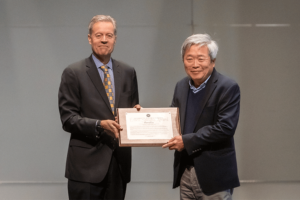
David Yu, professor emerit of electrical engineering and computer science, was awarded an Ernest Spaights Plaza award during the annual UWM Fall Awards presentation Oct. 19. The award is named in honor of the late Professor Ernest Spaights and is dedicated to individuals who have made significant, enduring and campuswide contributions to the growth and development of the University of Wisconsin-Milwaukee.
Chancellor Mone and David Yu
During his 36 years at UWM, whenever David Yu was asked to contribute, he did – and the university and community are better because of it.
In addition to a successful career as a researcher and educator, Yu was a talented administrative leader. Over the years, he served as his department’s chair, associate dean for research in the College of Engineering & Applied Science, and interim dean of the Graduate School.
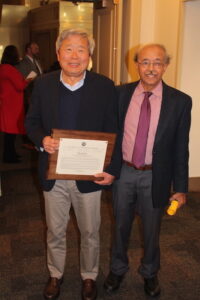
Yu (left) and K Vairavan (right), who received a Spaights Plaza Award in 2012. Vairavan is a professor emerit, electrical engineering and computer science.
Yu was a major contributor to and supporter of the integrated bachelor’s-master’s degree program, which encourages undergraduates to continue their UWM education in the college’s master’s program. As associate dean in the college, he developed initiatives to boost graduate student enrollment across departments.
He stepped in to lead the Graduate School at a critical time – when it was growing its doctoral program offerings for the first time in more than two decades.
Yu led the Graduate School in a reorganization, a step that set the university on the path to achieving R1 status, the top tier of research universities as defined by the Carnegie Classifications of Institutions of Higher Learning, in 2015.
He also forged important collaborations between the Graduate School and the Center for International Education to increase the campus enrollment of international students and form partnerships with numerous institutions in other countries. The relationships he built in China and Taiwan are still active and benefiting UWM faculty and students.
These partnerships resulted in several high-profile international internships. Two of these were with Rockwell Automation in Shanghai, in collaboration with Shanghai Jiao Tong University, and an international co-op program with Foxconn in Taiwan, in collaboration with Chung Yuan Christian University. These allowed UWM students to get experience working in a truly global setting.
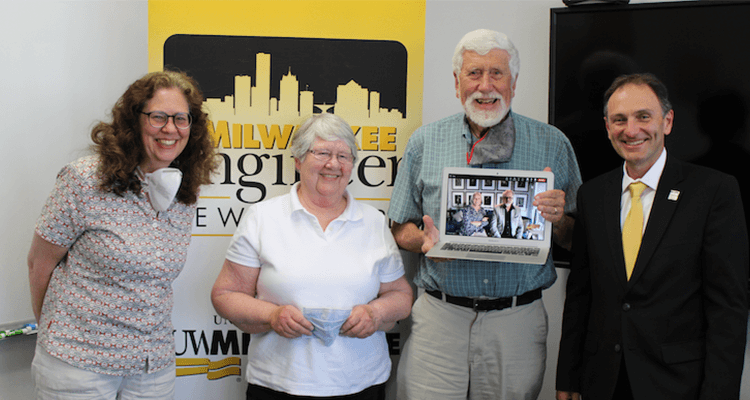
When he was an engineering student at UWM, Dr. Curtis Lueck, P.E. (MS ’77, BS ’75) found a mentor in his thesis advisor, Edward Beimborn, now a professor emerit, civil & environmental engineering.
Beimborn, Curtis said, strongly influenced his education and career and provided the foundation for his professional success. Their professional relationship and personal friendship has lasted decades.
Thanks to provisions that Curtis and his wife Maureen Lueck (BA ’73 Mass Communication) made in their estate plan, Curtis will honor his mentor for years to come.
The couple’s gift is earmarked to establish and support the following three funds.
The Curtis C. and Maureen E. Lueck Fund will provide unrestricted support for the college, to be used as the discretion of the dean.
The Professor Edward A. Beimborn Scholarship Fund will provide scholarships to undergraduate students enrolled in a program leading to an undergraduate degree in civil engineering, with a concentration in urban transportation. The fund gives preference to students in financial need who graduated from Wisconsin high schools.
The Professor Edward A. Beimborn Fellowship Fund will support graduate students in the college who are enrolled in a program leading to a graduate degree in civil engineering, with a concentration in urban transportation. The fund gives preference to students who graduated from Wisconsin high schools or received their undergraduate degrees from UWM.
Now retired, Beimborn strongly believes that public transportation research deeply affects public policies. Milwaukee native, he has studied urban transportation and traffic patterns worldwide, and served on numerous urban transportation and planning boards. His many honors and awards for his work include having his name added to UWM’s Spaights Plaza marker, one of the university’s highest honors and an enduring means by which UWM pays a timeless tribute to colleagues who have made significant and lasting contributions to the university.
“We hope that the endowment and scholarships honoring Professor Beimborn will perpetuate his legacy for generations of new transportation professionals,” Curtis said.
Sobolev, Zhao will collaborate with University of Texas at Arlington on $1.5M NSF grant that supports consortium to decarbonize concrete industry
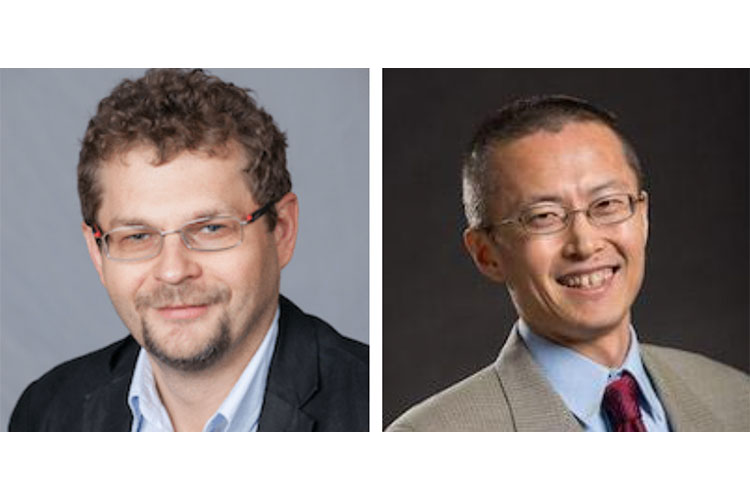
Konstantin Sobolev and Jian Zhao
Konstantin Sobolev, Lawrence E. Sivak ’71 Faculty Fellow and professor, civil & environmental engineering, and Jian Zhao, associate professor, civil & environmental engineering, will collaborate with the University of Texas at Arlington and a consortium of European universities on a project that ultimately aims to mitigate concrete’s role in global warming.
The grant comes from NSF’s Partnerships for International Research and Education (PIRE) Program, which enables international collaborations in research and education to advance scientific solutions to daunting global challenges.
Welcome Shuaiqi Shen; Embedded systems researcher
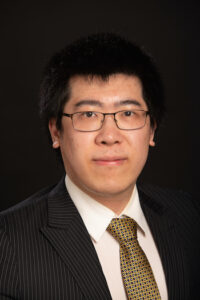
In August, Shuaiqi (Roger) Shen joined UWM’s College of Engineering & Applied Science as an assistant professor in the Electrical Engineering Department.
He is an embedded systems researcher and his expertise will strengthen the college’s already strong collaborations with local industry in the evolution of the Industrial 4.0 era, says Yi Hu, chair of the Electrical Engineering Department.
“Dr. Shen will make a significant contribution in revamping the college’s four-course sequence in embedded systems,” Hu says.
Shen joins a department that is already on the cutting-edge of electronics research (in areas including battery energy storage, cybersecurity, machine learning and AI) and produces graduates who are in high demand by local industry.
Shen’s research will focus on embedded systems—including the power they consume when used within the Internet of Things (IoT)—and energy-efficient artificial intelligence (AI).
Embedded systems are small computers that are embedded inside larger mechanical or electric systems, where they perform a dedicated function, typically in real time. They are changing how all of us interact with technology and are increasingly being used in everyday technology associated with communications (cellphones), home electronics (smart home appliances), cars and trucks (keyless entry), healthcare (medical imaging) and much more.
The IoT enables AI to be distributed to embedded systems, Shen says. However, the additional energy required for the embedded system’s AI algorithms raise sustainability issues.
Milwaukee’s manufacturing community offers opportunity to “turn research outcomes into real-world applications”
Shen’s research interests include green computing, AI-empowered connected vehicles, edge intelligence, cybersecurity, and next-generation wireless networks. He has published more than 10 peer-reviewed journal and conference papers.
UWM and the city of Milwaukee, he said, offered him an “ideal” place to continue his career.
“UWM has first-class scholars in electrical engineering, computer science and industrial engineering,” Shen says. “It is especially strong in embedded systems and IoT, which are the fields I have been interested in.
“Plus, Milwaukee is home to top manufacturing companies, which could offer the necessary partnerships to turn research outcomes into real-world applications. The avenues for collaboration are plentiful and I’m excited to be here.”
Eager to teach undergraduates, graduates
Shen enjoys teaching both graduate and undergraduate students and has taught courses related to AI, machine learning, digital systems, embedded systems, programming language, algorithms, cybersecurity, and computer networks.
“I am looking forward to helping students realize their potential as members of the creative community in engineering,” he says. “I always feel a sense of accomplishment when students obtain new knowledge and, more importantly, the habit of critical thinking and life-long learning.
“For me, teachers are not only responsible for conveying knowledge to students, but for conveying the methodology to apply the knowledge.”
Shen comes to UWM from the University of Nebraska-Lincoln, where he recently completed his PhD in Electrical and Computer Engineering. He received a B.Sc. degree in Electronic and Information Engineering from Hong Kong Polytechnic University (2016) and a M.Phil. degree in System Engineering and Engineering Management from the Chinese University of Hong Kong (2018).
Contact Roger Shen Email: shen8@uwm.edu Temporary office: 584
Welcome William Musinski; Expert in materials research and advanced manufacturing joins UWM
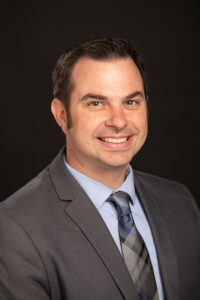
William Musinski comes to UWM from the Air Force Research Laboratory’s (AFRL) Materials and Manufacturing Directorate at Wright-Patterson Air Force Base, Ohio. His addition in August to the faculty at UWM’s College of Engineering & Applied Science bolsters the college’s research and teaching in advanced manufacturing and materials science.
Musinski has a joint appointment as an assistant professor in the Materials Science & Engineering and Mechanical Engineering departments.
At the AFRL, Musinski worked as a materials research engineer with a specialty in fatigue analysis–specifically high-fidelity, experimental characterization and modeling of the meso- to macro-scale mechanical performance of aerospace metal alloys. Such studies on the variability in performance and evolution of stress during fatigue of materials play a crucial role in understanding the limits of current materials systems and developing better-performing, longer lasting alloys for the next generation of aircraft and engines.
His other areas of expertise include high-temperature materials, additive manufacturing, and computational materials science, all of which he plans to pursue at UWM.
Strong industry presence drew him to UWM
Musinski was attracted to UWM because it is centered in a vibrant and culturally diverse city with a strong industry presence in the areas of manufacturing and automation. “These factors were a huge driving force in my decision to come to UWM,” he said.
He is particularly excited about collaborating with Milwaukee-area industry members. “I look forward to augmenting existing university-industry partnerships and developing new ones by coupling my strengths in solid mechanics and materials science with advanced manufacturing.”
Promising technologies such as additive manufacturing, he said, will enable the next generation of advancements in defense, health care, energy, and transportation.
While working at the AFRL, Musinski mentored undergraduate, graduate, and post-doc researchers as an adjunct professor with the University of Dayton. Among the topics he taught were mechanics of materials and fatigue and fractures of metals and alloys.
“I loved seeing the students grow and helping them discover their own passions,” he says. “At UWM, I look forward to fostering growth in a larger number of students so that they can navigate their next steps and solve the problems they encounter in their careers.”
Musinski earned both his PhD (2014) and master’s degree (2010) in Mechanical Engineering from Georgia Tech.
Contact William Musinski Email: musinski@uwm.edu Temporary office: E371F
Welcome Qingsu Cheng; Biomedical Engineering researcher in cancer and biomaterials joins UWM
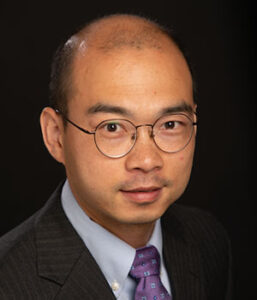
Qingsu Cheng joined the UWM College of Engineering & Applied Science in August as an assistant professor in the Department of Biomedical Engineering.
In this role, Cheng will advance the college’s multidisciplinary research and education in the diverse and evolving field of biomedical engineering.
With the addition of Cheng, the department—which launched in 2015 with just one student—now boasts nine faculty members and two visiting faculty who bring expertise in biomedical engineering, mechanical engineering, materials science, and computer science. ABET (the Accreditation Board for Engineering and Technology) accredited UWM’s Bachelor of Science in Biomedical Engineering Program in 2021.
From battling breast cancer to identifying bacteria
Cheng’s cutting-edge, translational research in the areas of cancer and biomaterials has been supported by the National Institutes of Health, the U.S. Department of Agriculture and NASA, which funded his proposal to study astronaut health on the moon and Mars. He has published 25 peer-reviewed journal papers, which received more than 400 citations.
“UWM is giving me the opportunity to contribute to broadening our knowledge about the interaction between microenvironmental factors and a variety of diseases,” Cheng says. “I hope to translate my research into commercial products, with the university’s support.”
Cheng’s cancer research is in the areas of early detection, risk assessment, and development of new treatments. He is currently investigating the biomechanical properties of breast tissue—knowledge that aids in detecting the disease and planning surgical procedures. He also is researching fibroblasts, a non-cancerous cell type that is found in most solid tumors and associated with disease’s progression. “The goal of non-invasive treatment is to manipulate the tumor microenvironment in a way that combats breast cancer,” he says.
In the expanding field of biomaterials, Cheng’s focus is on biosensors. “Home COVID-19 tests are one example of biosensors that we’re all familiar with,” Cheng says. In general, biosensors alert people to the presence of viruses and bacteria and are being used in disease detection and progression, food safety, environmental monitoring and more.
At UWM, Cheng says, he hopes to develop biosensors that identify diseases in microbiomes—the collection of microbes that live on or inside a person’s body.
Cheng has already developed one biosensor—now patented—that identifies foodborne bacterial pathogens in just 30 minutes. The technique also can be used as a viral pathogen sensor, he says.
The field of biomedical engineering is highly collaborative, and Cheng has developed partnerships with scientists at the University of California-San Francisco, University of California-Los Angeles, Arizona Statue University, the Jet Propulsion Lab and NASA.
In his biosensor research, he typically works with local hospitals and farms to obtain the biological specimens specific to the region and necessary for blind validation tests.
Committed to helping students flourish
Most recently, Cheng was a research scientist in the Department of Electrical and Biomedical Engineering at the University of Nevada Reno. He obtained a PhD in Biomedical Engineering from the University of South Carolina and completed postdoc training at the Lawrence Berkeley National Laboratory.
Prior to joining UWM, Cheng both taught and designed a variety of courses—including Tissue Engineering, Cellular Engineering and Introduction to Biomedical Engineering—and mentored undergraduate and graduate students on both academic and career paths.
“I am committed to fostering a friendly environment that respects, supports, and values all members of our community,” he said.
Welcome Sarah Blackowski; Expert in engineering education
UWM’s College of Engineering & Applied Science has hired its first designated expert in engineering education.
Sarah Blackowski joined the college in August, bringing expertise in increasing student engagement in the classroom, preparing first-generation and minority students for engineering degrees, and more. She is an assistant professor in civil & environmental engineering.
“I hope to support students at UWM to feel included and valued in the engineering classroom,” she said. Among her priorities: to develop an engineering class that’s project-based around problems facing the greater Milwaukee area.
Blackowski arrives at a time when the college seeks to further improve undergraduate student retention with teaching innovation and personalizing student services. Her academic preparation will help the college implement the latest research in engineering education and her presence and efforts will help the college compete for federal grants in engineering education.
Strength lies within diversity of students’ backgrounds
Blackowski’s areas of expertise within engineering education are extensive and include: student motivation, self-regulated learning, and metacognition; research-based instructional strategies; and leveraging knowledge to benefit diverse students and faculty in core engineering courses.
To significantly improve engineering students’ experiences and outcomes, Blackowski said, an institution must support both students and faculty in the classroom.
“Engineering students enter the classroom with varying levels of engineering-related beliefs, motivations, and experiences,” she said. “UWM students bring a wide range of diverse backgrounds and experiences—a strength that can be used to craft student-focused courses.”
In addition, she hopes to better prepare PhD students for their potential roles as professors, noting that those who go on to tenure track jobs typically enter the classroom with little to no teaching experience, as few graduate programs prepare early-career faculty to teach. “Teaching is a core skill and it’s crucial to support faculty members in this role,” she said.
Blackowski comes to UWM from Virginia Tech’s Department of Engineering Education, where she earned a PhD in Engineering Education. She has experience as an instructor of record for the first-year engineering sequence and won the Graduate School Teaching Excellence Award in Spring 2022. Her dissertation explored how early-career, tenure-track engineering faculty at R1 institutions learn about teaching through narrative methods.
She has seven years of experience in engineering education research and has worked on National Science Foundation-funded projects that addressed K-12 engineering engagement, undergraduate engineering student experience, graduate student success, engineering faculty development and more.
In addition, she has co-authored three peer-reviewed journal publications and 15 conference papers.
Blackowski earned a BS in Aerospace Engineering with a concentration in Astronautics from Embry-Riddle Aeronautical University in Daytona Beach, FL. She has worked as a flight simulator technician for Level D flight simulators and a chief engineer on a theoretical project to explore Mars’ largest moon, Phobos.
In May, Dr. Philip F. Judy made a blended gift consisting of a cash gift combined with an estate gift to establish the Philip F. Judy Biomedical Engineering Fund to support biomedical engineering research and fellowships at the UWM College of Engineering & Applied Science.
Dr. Judy earned his undergraduate degree in Applied Science from UWM’s College of Engineering & Applied Science in 1964 and his doctoral degree in Radiological Sciences (Physics) from UW-Madison in 1971.
Now retired, Dr. Judy was the Director of the Physics and Engineering Division at Brigham and Women’s Hospital, Boston and an Associate Professor of Radiology at Harvard University. He has served on the boards of directors for the American Association of Physicists in Medicine and the Academy of Radiology Research. In 1986, he served as vice-president of the Radiological Society of North America.
Dr. Judy lives in Massachusetts with his wife Karen Doppke, a senior medical physicist with the Department of Radiation Oncology at Massachusetts General Hospital and fellow of the American Association of Physicists in Medicine.
When asked why he made this gift to UWM, Dr. Judy said, “I was fortunate to spend my career in research doing something I loved, and I want to give back to the next generation of engineers and researchers at the university that started my lifelong journey of discovery.”
If you would like to learn about making a planned gift to the college, please contact Jean Opitz, development director for the College of Engineering & Applied Science, at opitz@uwm.edu, or click here.