Science
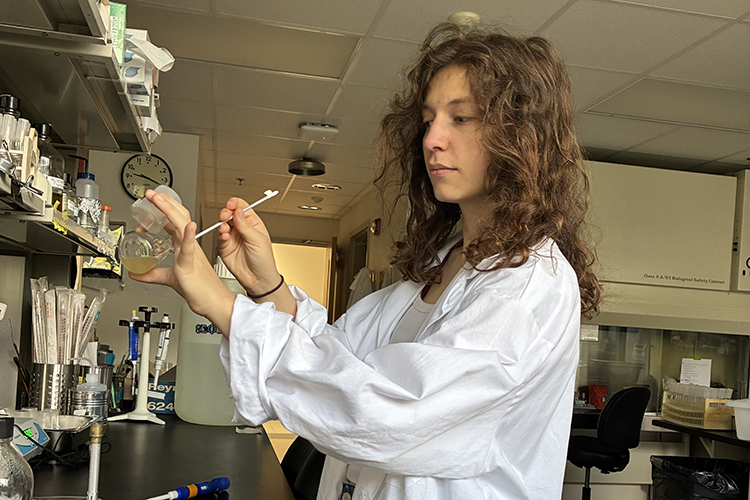
International animal behavior conference at UW-Milwaukee Aug. 3-6

More than 600 scientists from a range of disciplines will gather at the University of Wisconsin-Milwaukee to discuss a host of topics involving all kinds of animals, from communication strategies to mating preferences, at the annual meeting of the Animal Behavior Society Aug. 3-6.
Gas ‘halos’ surrounding young galaxy contain clues to its growth
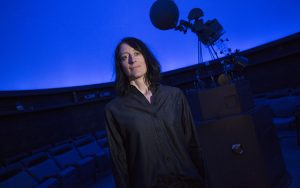
Dawn Erb, an associate professor of physics at UWM, led a team whose study could shed light on how galaxies form stars and grow.
With help from NASA, students launch experiment into space
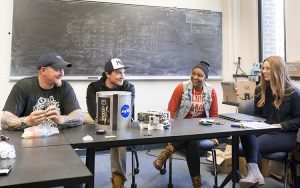
The UWM team sent plasmids up on a rocket to discover how cosmic radiation affects DNA. The results were surprising.
Einstein’s theory of gravity holds – even in extreme conditions
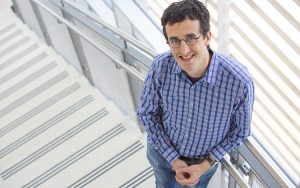
UWM’s David Kaplan is part of a research team that has shown that yet another prediction by Albert Einstein 100 years ago holds up, even in some extreme conditions in deep space.
UWM researcher helps find way to image damage to retina caused by diabetes

What happens to the human retina at the cellular level when it’s exposed to the hyperglycemic conditions of diabetes? No known imaging technique has been able to show such biochemical changes – until now.
Meteorology program tweaks fit employer needs like a glove

A native of Florida, Clark Evans has had to adjust to Wisconsin weather. As he does, he’s helping oversee UWM’s atmospheric sciences program, which is adjusting its offerings to better fit what employers want.
Nobel laureate Joachim Frank visits UWM to speak on imaging molecules

Joachim Frank, who shared the 2017 Nobel Prize in chemistry, came to UWM to deliver a colloquium at the invitation of Abbas Ourmazd, a UWM distinguished professor of physics who has published recent papers with Frank.
Fossil find helps date the origin of complex animals

The earliest complex animals were soft-bodied creatures without bones, which explains why they have left a scant fossil record. The next best thing to validate their existence? Find fossil evidence of their behavior, such as trackways and burrowing. That’s what a group of scientists, including UWM’s Stephen Dornbos, recently uncovered in ancient marine rocks of […]
UWM astronomers to use new tool to hunt gravitational-wave sources
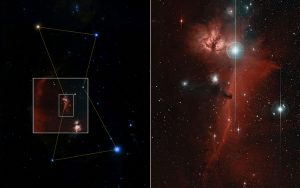
The LIGO observations of gravitational wave over the past two years were groundbreaking. Now, UWM astronomers plan to build off that work by employing a new tool to decode more mysteries of the sky.
Australian radio telescope with UWM connections upgraded
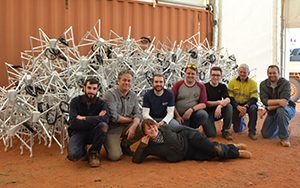
The Murchison Widefield Array recently announced the completion of an expansion that quadruples the radio observatory’s size, giving it a 10-fold increase in observing power. That’ll please a lot of folks at UWM.