Engineering MS MS
The Master’s in Engineering program at UWM is designed to provide a high level academics and hands-on research with flexibility for working professionals and aspiring researchers who want to take their studies to the next level.
Coursework for an Engineering MS at UWM is typically held once per week in the evening and requires students to choose one of the following concentrated areas of study: Artificial Intelligence and Machine Learning, Biomedical, Civil, Electrical and Computer, Energy, Mechanics, Industrial and Systems, Manufacturing, Materials, Mechanical or Occupational Biomechanics / Ergonomics.
Program Type
Master’s
Program Format
On Campus
What to Expect
The Master’s in Engineering coursework at UWM is offered primarily in the evenings to accommodate schedules of working professionals and researchers. Students may choose either a thesis option (30 credits) or a non-thesis option (31 credits).
The thesis option allows students to pursue advanced coursework leading to an original thesis research project, supervised by a faculty advisor. Naturally, we encourage students to pursue the development of a thesis. However, if you have prior engineering or scientific work experience and are seeking an MS for professional advancement, the non-thesis option is a great alternative that requires additional coursework in lieu of a thesis.
The MS in Engineering does not require a rigid set of courses, so you have the flexibility to design your program of study that is compatible with your career objectives. This feature also makes the MS a solid stepping stone for doctoral level study.
More Information
Contact the College of Engineering & Applied Science Graduate Programs Office.
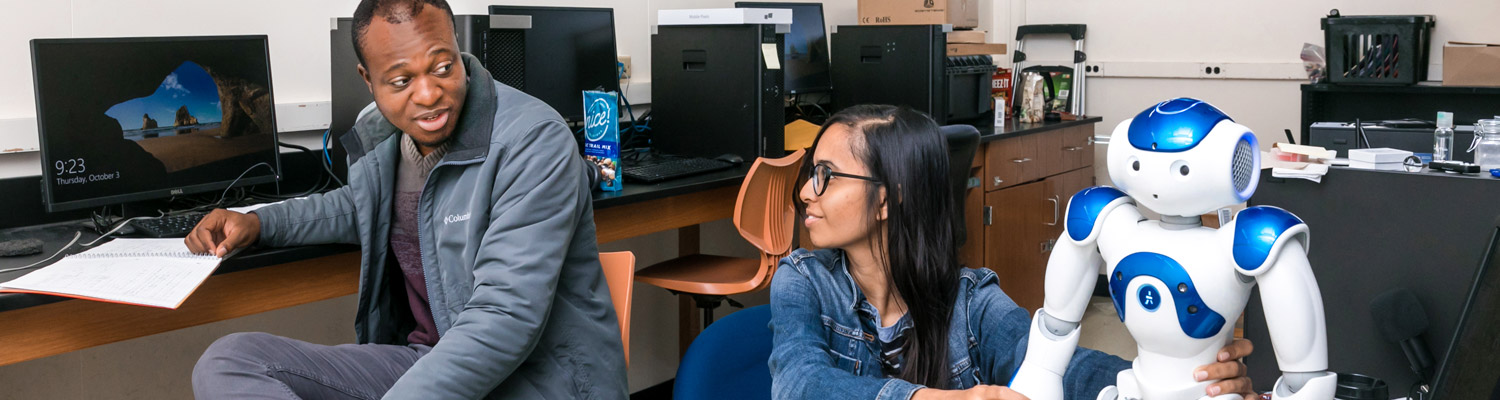
We’re a top tier R1 research university and our students have the opportunity to work with faculty engaged in cutting-edge research in areas such as:
- Advanced manufacturing
- Biomedical engineering
- Grid-connected Advanced Power Electronic Systems
- Renewable energy, conservation and energy storage
- Robotics, controls and mechatronics
- Smart materials and novel materials
- Transportation
- Tribology and nanotribology
- Water flow, sensing and filtration
Research Labs, Centers & Institutes
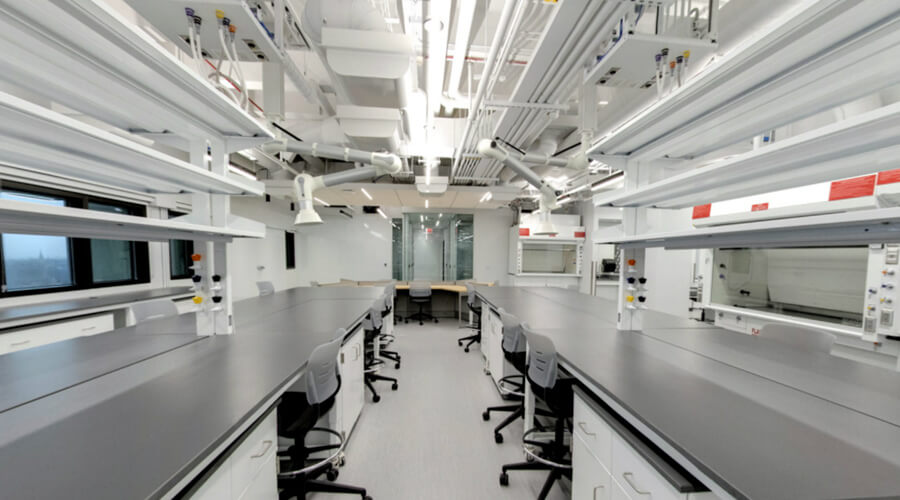
Research is integral to our work at UWM and to the experience of students pursuing graduate degrees. Our college has a wide range of faculty-led labs that perform cutting edge research. Please see the Faculty tab above for the specific research interests and labs of each faculty member. View a full list of our college’s research labs, centers and institutes.
Faculty
View faculty by department here.
Advising
- Advisor, Graduate Programs
- Computer Science, Electrical Engineering, Biomedical Health Informatics
- crary@uwm.edu
- 414-229-7267
- Engineering & Mathematical Sciences E387C

- Advisor, Graduate Programs
- Civil/Environmental Engineering, Mechanical Engineering, Biomedical Engineering, Industrial/Manufacturing Engineering, Materials Science & Engineering
- rpackard@uwm.edu
- 414-251-8543
- Engineering & Mathematical Sciences E387B
UWM is proud to be one of only two R1 research universities in Wisconsin. We’re also a top externally funded institution with robust opportunities for teaching and research assistantships. Partners that support our research include:
- Environmental Protection Agency
- National Institute for Health
- National Academy of Sciences, Engineering & Medicine
- National Science Foundation
- United States Department of Defense
- United States Department of Energy
- Regional businesses including: Johnson Controls, Harley Davidson, Rockwell Automation, We Energies and more.