Find your focus in Civil & Environmental Engineering
A civil engineering degree leads to an in-demand career shaping the infrastructure that impacts everyday life—from the roads and bridges you travel to the water you drink and the systems that keep communities connected.
At UWM, you’ll gain a strong technical foundation in civil engineering, then customize your degree by choosing a concentration that matches your interests and career goals:
Geotechnical Engineering – Study soil and rock mechanics to design safe foundations, earth structures, and pavement systems.
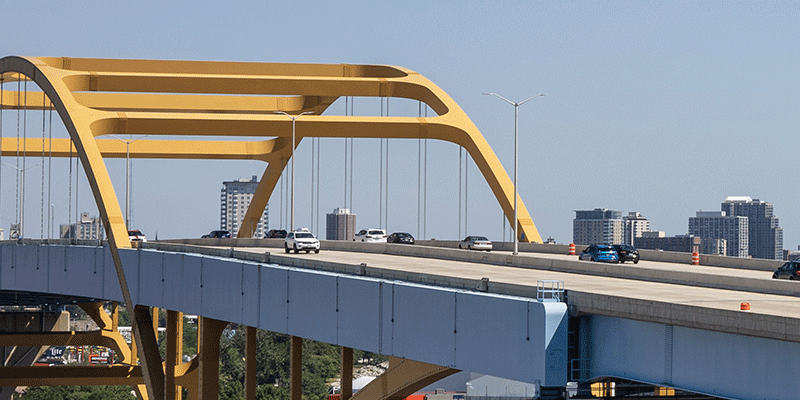
Structural Engineering – Design buildings, bridges, and other structures using materials like steel, concrete, wood, and advanced composites.
Municipal & Transportation Engineering – Plan and manage transportation and infrastructure systems that support safe, efficient, and sustainable mobility.
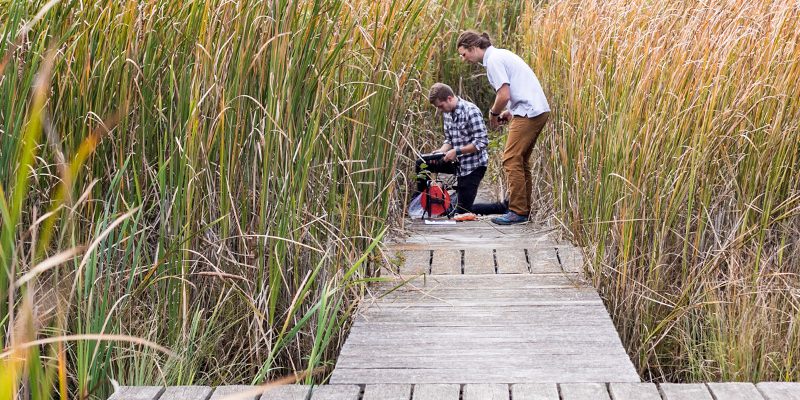
Water Resources & Environmental Engineering – Address water supply, flooding, and environmental challenges using engineering, biology, and chemistry. (Also available as an Environmental Engineering major.)
Through hands-on learning and cutting-edge technology, UWM’s civil engineering program prepares you to design safer, smarter, and more sustainable infrastructure for the future.
In order to earn a bachelor’s degree in civil & environmental engineering, students work in teams to apply the skills they have learned over their years at our college in a year-long senior design project.
American Society of Civil Engineers (ASCE) ASCE at UWM is chapter of Wisconsin ASCE that presents students with the opportunity to participate in engineering related activities and competitions, and network with other engineering students and professionals.
Construction Leadership Council – Student Chapter (CLC) CLC provides young professionals with an opportunity to observe and develop their skills with current industry leaders.
Engineers Without Borders (EWB@UWM) The humanitarian work of EWB@UWM brings running water to impoverished villages in the Ixil Triangle of Guatemala and aims to improve the sustainable use of energy in Wisconsin.
Institute of Transportation Engineers (ITE) ITE is an international society of transportation professionals who are responsible for meeting mobility and safety needs.
Structural Engineering Society at UWM (SES-UWM) SES-UWM expands the experience and knowledge of members in structural engineering-related fields through relevant events and technical workshops featuring notable speakers.
The annual Poster Competition & Three Minute Thesis is a signature event for our college. Both undergraduate and graduate students gain valuable communication experience sharing their research and out-of-classroom experiences with faculty and industry judges, who provide feedback.
Undergraduate Teaching Labs
Concrete and Construction Materials Lab (EMS W190) Students use this lab to test and determine properties of various types of cement.
Engineering Mechanics and Composites Research Lab (EMS W309) This lab is used to study the manufacturing, testing, characterization and nondestructive evaluation of polymer and non-polymer based composite materials.
Hydraulics Lab (Lapham 122) Students use this lab to conduct experiments of groundwater flow theory and Darcy’s law, steady uniform open channel flow, non-uniform open channel flow, sediment transport, HEC-RAS river flow analysis, and stormwater management modeling.
Pavement Materials Lab (EMS W260) This lab uses the Triaxial test for resilient modulus determination of soils and aggregates, California Bearing Ratio, Micro-Deval abrasion test, and specific gravity and absorption of aggregates.
Soil Mechanics Instructional Lab (EMS W265) Students use this lab to perform various tests on soil to determine their physical, engineering, and mechanical properties. Apparatus and tools such as soil crushers and sample splitters are used to prepare soil specimens.
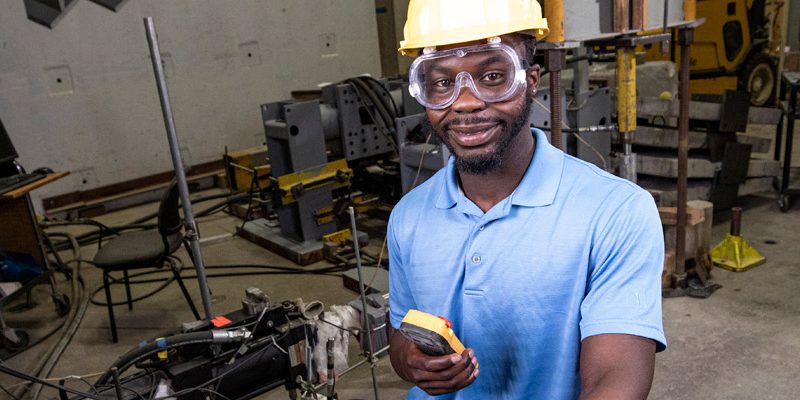
Structures & Mechanics Lab (EMS W185) This lab is used to perform load testing, as well as to test tension and compression, flexure, bend, fatigue and creep testing for reinforced concrete beams, steel and bolted connections.
Surveying Lab Civil engineering students will use equipment and tools from this lab to measure distance and angles to perform a topographic survey,
Virtual Reality Infrastructure Lab (EMS W330) UWM is the first non-military user of this Euclideon hologram table in the U.S. It is unique in allowing multiple people to simultaneously view 3D digital objects from different perspectives without bulky headgear. Students are able to solve design problems here before the product shows up in a shop or in the field.
Water Quality Lab (Freshwater Science Building) Students will use this lab and its state-of-the-art equipment to perform various water quality tests including pH, turbidity, conductivity, and acidity.
UWM students have many additional resources available to them within the College of Engineering & Applied Science. From computer labs and tutoring resources to teaching labs and spaces to create or collaborate. See a full list of our resource rooms and labs at this link.
Undergraduate Research
As an undergraduate student you’ll have the opportunity to work with faculty engaged in research including:
Geotechnical Engineering
Structural Engineering
Municipal & Transportation Engineering
Water Resources
Environmental Engineering
A benefit of attending a top tier R1 research university is the opportunity to work with faculty engaged in cutting-edge research and to participate in the Support for Undergraduate Research Fellows (SURF) program. The SURF program helps you to improve your professional preparation through research by closely working with our faculty to explore, discover, and transform ideas into reality.
Undergraduate students also have the opportunity to participate in the annual Poster Competition, providing them with excellent opportunities to share their work with judges from industry.
Professor Hani Titi, civil & environmental engineering (right), meets new students attending welcome festivities at our college.