Partners Celebrate 60 Years of CLACS
As we commemorate the 60th anniversary of CLACS’s founding in 1965, our center took the opportunity to check in with campus, community, and regional partners about how our collaborations have shaped their work.
All of these partnerships have furthered our core mission of deepening the understanding of Latin America in the Caribbean on campus and beyond. Read on to learn about what this work has meant for some of our collaborators and their own communities!
Professional Development and Supporting College Readiness: Mr. Nick Sprague (South Division High School, Milwaukee Public Schools, Social Studies)
- • Connected with CLACS in 2022
- • Teaches college-credit Dual Enrollment class at SDHS: LACS 101 (Introduction to Latin America and the Caribbean)
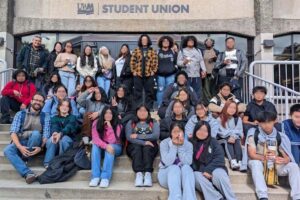
Nick Sprague and his LACS 101 students visit UWM in October 2024
Having the opportunity to teach Latin American and Caribbean Studies at South Division High School through the Dual Enrollment Program has been a game-changer. The students that register for the class are college-bound and are ready for the challenge of learning at a post-secondary level. I am energized by the content I’m teaching and by the excitement that the students bring to the class. I am so grateful for the opportunity to prepare students for the next step in their education through such important coursework. On a personal note, I received an email from a former student that took the Dual Enrollment course and she said that it helped her feel prepared for her college experience.
The Summer Institutes offered by CLACS are one of the highlights of my summer!
Interdisciplinary Collaboration and Program Development Support: Professor Susana Antunes (UW-Milwaukee, World Languages & Cultures)
- • Connected with CLACS in 2016
- • Directs UWM’s Portuguese program on language and Lusophone cultures
My connection to CLACS has benefited me both professionally and personally in meaningful ways. Professionally, it has expanded my academic network, creating opportunities for interdisciplinary collaboration and allowing me to engage with colleagues working on innovative research across Latin America and the Caribbean. This connection has also supported the growth of the Portuguese Program by providing visibility, resources, and a stronger platform to develop new initiatives, events, and partnerships. In particular, CLACS’s support for FLAS fellowships has been essential for our Portuguese students, offering them unique opportunities to deepen their language study, engage in research, and advance academically in ways that would otherwise be inaccessible.
Secondly, [when I joined UWM] the Director of CLACS invited me to meet with her, Julie Kline, and Thomas Danner for introductions and to talk about my research fields, upcoming opportunities, and possible collaborations. We also discussed the different ways CLACS can continue to support my work and strengthen the experiences of our Portuguese students, especially through initiatives such as FLAS fellowships, academic events, and community partnerships. It was a very productive and encouraging conversation, and I am grateful for the openness and support they offered, encouraging me to building the Portuguese program.
On a personal level, being part of CLACS has enriched my sense of community at UWM. It has allowed me to connect with scholars, students, and cultural practitioners whose perspectives continually inspire my work. The exchange of ideas and the collaborative spirit within CLACS have strengthened my commitment to fostering inclusive, intercultural learning spaces and have made my professional journey more fulfilling.
Over almost ten years, our collaboration has grown stronger and increasingly productive, and I am truly grateful for the openness and support that CLACS continues to offer. I honestly cannot imagine being at UWM without the consistent support, kindness, and encouragement I have received from CLACS.
New Study-Away Courses and Belonging in Wisconsin: Professor Marcelo Cruz (UW-Green Bay, Public and Environmental Affairs)
- • Connected with CLACS in 1994
- • Participates in regional CLACS conferences and other exchanges
- • Developed four faculty-led travel courses to South America
Arriving in Green Bay, Wisconsin from Los Angeles, California some 31 years ago was a bit of a culture shock to say the least. It was a tad alienating, not only the urban experience and climate were challenging to adapt, but the lack of diversity that I found in Green Bay coming from a metropole like Los Angeles was surreal to me, and a throwback to another time and place. CLACS was instrumental in helping me make a huge adjustment to the world I entered in 1994. Thinking back, my connection with CLACS began early in my career here. My colleague, Dr. McKenna Brown, here at UW Green Bay, introduced me to colleagues at CLACS at UW Milwaukee and it anchored me to Wisconsin. CLACS did this in two important ways. CLACS funded my research and conference presentations and encouraged me and supported me to develop and grow through faculty led travel courses to South America.
To give a bit of context, during the 1990s there began a significant demographic change in Green Bay. When I arrived here in 1994, there were 1500 Latinos in all of Brown County. Today, Latinos make up 20% of the city of Green Bay and represent more than one third of the Green Bay school district (34.9%). I guess I was a part of this migration to Green Bay and Northeast Wisconsin. This demographic growth among Latinos sparked a new research agenda for me, studying enclave formation and community formation among Latinos in Green Bay. The wonderful staff at CLACS provided funding for the research which has expanded to study the Latino urban experience in the state of Wisconsin. The funding was fundamental for me to publish and present papers on the subject.
Moreover, CLACS provided venues for colleagues throughout the region to come together and share our work and gain new insights from our colleagues. One memorable event was when members of CLACS travelled to Guadalajara, Mexico for the LASA conference in 1997 I believe. It was a wonderful experience. Not only was the intellectual activity enhanced by sharing ideas and methodologies through our work and meeting fellow researchers working on similar projects as my own, but I got to know my CLACS members more at a personal level. This began long friendships with the great people administering CLACS, sharing the many events that CLACS organizes throughout the academic year.
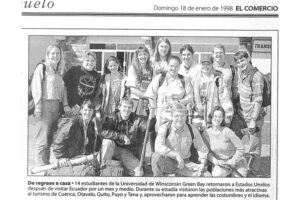
1998 newspaper feature of UWGB students in Ecuadorian publication El Comercio.
CLACS also encouraged me to develop a travel course to Ecuador that has become one of the longest-running faculty-led travel courses at UW Green Bay. It took some convincing to be responsible for students learning abroad, but it has been one of my most gratifying experiences at the university. In my first endeavor, I took only two students to see how it would work, and their experience was published in the Inside University of Wisconsin Green Bay. [See this write-up in the UWGB magazine – Inside UW-Green Bay, 1997, Ecuador article]
On my second trip, in 1998, I took 14 students who were interviewed by the local press in Quito at the airport when they were returning to the States (see below). This led to 27 years of taking Wisconsin students and community members twice a year to Ecuador’s four worlds. I was able to design four distinct travel and learning experiences for my students. CLACS was a tremendous help in reaching out to students and community members in our region.
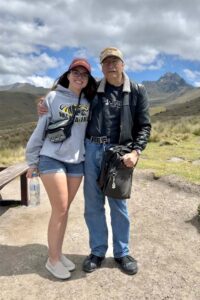
Orndorf and Cruz in Ecuador during January 2024
Lastly, through CLACS I was able to meet and work with Ms. Aimee Orndorf (CLACS Assistant Director) the last years of the travel course experience. Her professional and patient manner made the travel experience a delight. Having Aimee as my co-leader my last three faculty led travel courses to Ecuador only strengthen my ties to CLACS. I have been grateful to be a member of CLACS and to acknowledge that CLACS has been an integral part of my career here at UW Green Bay.
From the beginning of my tenure here to the very end [Cruz retired in 2025], CLACS has been there for me. It’s been real as we say!