Film and Portuguese Student Expands Reach of UWM Faculty Research on Brazil
For most of 2025, UWM student Lucca Marcello (Film Production major, Portuguese minor) worked closely with UWM researchers to steward their 18 years of fieldwork materials on Brazilian folk heritage for the next generation of scholars. The result is a centralized database cataloging tens of thousands of research materials – heading soon to the University of Florida’s Latin American and Caribbean Collection – a documentary feature highlighting the collection, and valuable work experience for Marcello as he prepared for graduation in December 2025.
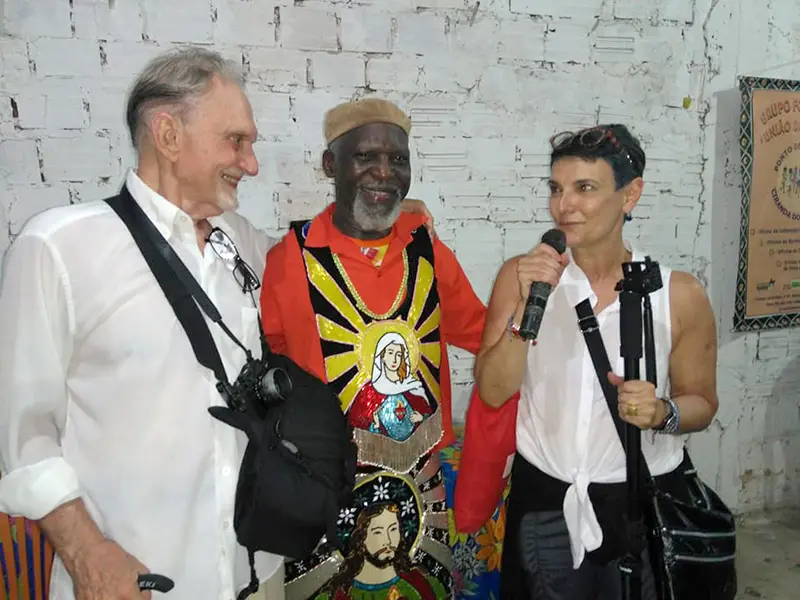
Professor Simone Ferro (Dance; right) and her longtime research partner Meredith Watts (Political Science; left) pictured at a baptism ceremony for one of Bumba-meu-boi’s distinctive ox puppets. The two worked with Marcello to preserve their ethnographic research for a new generation of scholars
The research project in question is Professor Simone Ferro’s (UWM Dance emerita) nearly two decades of ethnographic research on Bumba Meu Boi, a UNESCO-recognized cultural patrimony based in the northeastern Brazilian state of Maranhão and which spans musical performance, choreography, theatrical and ritualistic performance and playful expression. In partnership with Ferro’s longtime research partner Professor Meredith Watts (UWM Political Science emeritus), these collaborations with communities in Maranhão have resulted in a vast trove of video footage, audio interviews, still images, and original artifacts that capture the richness of how this tradition informs community life across northeastern Brazil.
With over 20,000 still images, more than 500 hours of performance videos, and more than 200 interviews, Ferro and Watts knew they needed a research assistant who had both the technical precision and cultural sensitivity to assess and organize these multimedia materials into an easy-to-navigate digital repository for anyone to access for decades to come. Through UWM’s Center for Latin American and Caribbean Studies (CLACS) and Department of Spanish & Portuguese (now World Languages & Cultures), they found a perfect match in Marcello.
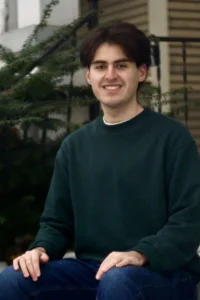
Film & Portuguese student Lucca Marcello produced both an archival database and a feature-length documentary to publicize nearly two decades of research by UWM faculty
Lucca Marcello had just spent the 2024-25 academic year as a FLAS Fellow in Portuguese through CLACS: the prestigious federal grant for language and area studies allowed him to take courses in Portuguese language and cultures as he pursued the minor. UWM Professor Susana Antunes recommended Marcello, whose strong coursework in the area had developed a deep cultural understanding and strong language skills to be able to work with the hours of Portuguese-language interviews in the archive. As a result, he was able to establish a comprehensive metadata framework whose conceptual framing of materials will support public communications about the project for years to come.
As Professor Ferro notes, “The scope of this undertaking required not only rigorous organizational competence but also the intellectual agility to navigate between scholarly transcription, visual anthropology, and audiovisual archiving. Marcello demonstrated a rare capacity to integrate technical precision with cultural sensitivity, approaching each document as both artifact and living testimony within a fragile ecosystem of memory.” Drawing on his skills as a Film Production major through the Peck School of the Arts, Marcello was also able to expand on the original vision Ferro and Watts had outlined for archiving the materials, developing both a feature-length documentary highlighting these dances as well as individual edited videos to educate about and preserve this tradition, posted on YouTube.
For Marcello, whose family is from southern Brazil, the yearlong collaboration was an opportunity to expand his cultural knowledge and produce original research: “There are 2000 miles between Porto Alegre, the city where my family is from, and São Luís, the capital of Maranhão … learning about Maranhão’s traditions made me realize how incredibly diverse Brazil is. I learned about Afro-Brazilian rituals which blend traditional Africanism with Catholicism, and with my undergraduate research I submitted an academic article about the Bumba meu Boi festival to Revista Luso-Hispánica.”

Scene from a Bumba meu Boi celebration in Maranhão (credit: Meredith Watts)
This work, which was supported by an academic internship in Portuguese and a SURF award from the UWM Office of Undergraduate Research, provided invaluable experience in archive management, documentary production, and publicly-oriented research communication. Ferro emphasizes that “[Lucca’s] presence within this ambitious project has been anchored in collaborative rigor, artistic discernment, and a profound respect for the communities represented – qualities that have strengthened both the scholarly integrity and the future public life of this singular archive.”
These cross-disciplinary collaborations are the heart of the work of the Center for Latin American and Caribbean Studies, enabling connections across disciplines that deepen research knowledge and communicate its importance to broader audiences. As Marcello looks to continue working in documentary production, he can point to a strong portfolio of work in public storytelling and cultural documentation that is already reaching new audiences.