2025 Summer Teacher Institute: Reflections and Resources on Childhood and Youth in Latin America
This July 7-9, UWM’s Center for Latin American and Caribbean Studies welcomed 25 K-16 educators to campus for our annual Summer Teacher Institute, supported in part by a National Resource Center grant from the U.S. Department of Education and in partnership with sister centers at UW-Madison and Florida International University.
Representing the full range of grade levels and many disciplines, educators from across Wisconsin and eight other states quickly jumped into collaborations, taking in expert presentations and buzzing in small group discussion on this year’s topic of Childhood and Youth in Latin America.
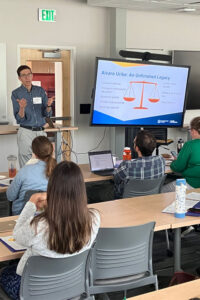
Professor Velez shares his research on Colombia’s educational system and national peace curriculum
On day one, participants learned from Prof. Gabriel Velez (Marquette University, Educational Policy and Leadership) about how Colombian youth are affected by the country’s long history of violence. Dr. Velez shared how internal displacement has affected school systems, and discussed the 2015 implementation of a nationwide peace curriculum. Participants were quick to draw connections on incorporating these Colombian examples in their classrooms, including units on civics, Macbeth, and petroleum’s role in the drug trade.
The group rounded out the day with a visit to UWM Libraries’ Américas Award Research Collection, introduced by cofounder Julie Kline (UW-Milwaukee academic staff emerita): this collection holds over 400 published children’s and young adult books that portray Latin America, the Caribbean, or Latinos in the United States. (And it is free and open to the public!)
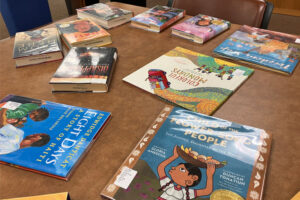
Some highlighted titles from UWM’s Américas Award Research Collection
The second institute day focused on Latin America’s rich history of youth activism, presented by Prof. Jessica Taft (University of California Santa Cruz, Latin American and Latino Studies). Returning participant Michelle Roberts (high school English, VA) was impressed to learn about a Latin American student culture of broad reading in social and political theory: a widespread practice that allows Latin American students to pair their own experiences with deeply-researched knowledge to advocate for change. Roberts plans to incorporate material about the Peruvian Working Children’s Movement, and their concept of trabajo digno (dignified work), to help her own students reflect on how their own extensive work experiences can help them keep learning and growing as whole people.
Later that day, participant Stephany Virrueta Herrera (Loyola University Chicago, School of Environmental Sustainability) appreciated a presentation from photojournalist Misha Vallejo Prut, who shared his reporting on how solar power supports school infrastructure in Ecuador’s Amazon: said Virrueta Herrera, “a lot of my students are majors in environmental sustainability, and sometimes it’s hard to find stories of hope amid these [climate] changes that are happening…I’ll definitely be bringing that story to a few of my classes.”
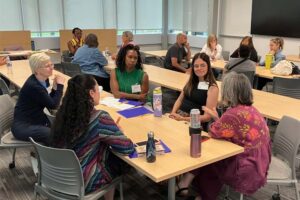
Educators shared ideas for incorporating institute materials into their classrooms
Vallejo’s reporting was supported by the Pulitzer Center for Crisis Reporting. The nonprofit – committed to reporting on systemic, global issues – sees classroom teachers as key partners in this endeavor, and Pulitzer’s website offers abundant free resources developed specifically for K-12 and university educators.
An important throughline in institute conversations was the UN Convention on the Rights of the Child. In this vein, María Morfín shared about her organization La Jugarreta, which promotes children’s right to participate in their communities: the nonprofit facilitates play groups that center democratic decision-making among migrant youth and other vulnerable populations across Mexico.
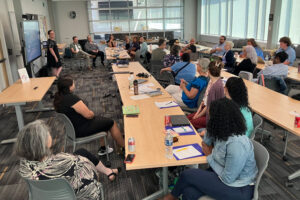
Professor Hogan leads a discussion on how children are represented in Latin American film
The institute concluded with a discussion of how young people are portrayed in Latin American films. Prof. Erin Hogan (U of Maryland Baltimore County, Spanish) shared core principles for using screen studies to build intercultural competence, along with dozens of film titles for teachers to use. Participants watched one such title – Home is Somewhere Else – in preparation for the event, and filmmakers Carlos Hagerman and Jorge Villalobos joined for a discussion of how they created this groundbreaking animated documentary, which depicts the varied migration stories of three Mexican-American youth.
For first-time participant Aaron Kaio (high school social studies, Madison), the institute helped him reconsider existing units and provided new resources for a Latin American studies class he’ll be teaching for the first time this fall. And for UWM’s Center for Latin American and Caribbean Studies, that is a sure sign the event was a success: helping educators bring more Latin American content to their classrooms – in Milwaukee, Wauwatosa, Madison, La Crosse, and beyond – and preparing students to be informed and empowered global citizens.
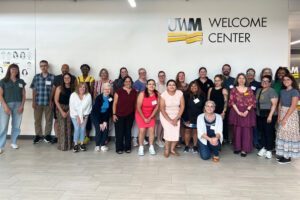
Institute participants celebrate a successful three days of learning and collaboration