If you’re driven by curiosity and motivated by impact, UWM’s PhD in Biomedical Engineering offers a powerful place to explore big ideas—and turn them into real advancements in human health.
A Biomedical Engineering PhD at UWM is built for curious minds who want to explore, experiment, and push the boundaries of how to improve human health.
Discover What’s Possible
Students have the option to pursue either a Doctor of Philosophy (PhD) in Engineering with concentration in Biomedical Engineering (details below) or a PhD in Biomedical & Health Informatics.
As a doctoral student, you won’t just learn—you’ll investigate, design, test and discover alongside faculty who are solving real-world medical challenges.
You’ll work in advanced research labs, collaborate across disciplines, and immerse yourself in hands-on experiences that spark innovation. Whether you’re developing new medical technologies, studying human biomechanics, or exploring data-driven health solutions, you’ll have the freedom and support to follow your questions wherever they lead.
Top Notch Resources
With access to funding opportunities, connections to Milwaukee’s healthcare and biotech community, and the resources of an R1 research university, you’ll gain both the expertise and experience to lead in academia, industry, or clinical research.
The Advanced Mobility Biomechanics Lab at UW-Milwaukee, led by Jacob Rammer, develops and applies connected health technology to study mobility of people with disabilities and outcomes of clinical rehabilitation, with particular attention to underserved communities globally.
The Big Data Analytics and Visualization Lab, led by Zeyun Yu, is focused on developments of new computational approaches and software tools for various types of massive data processing, data mining and visualization using both knowledge-based and data-driven techniques.
The Biorobotics Lab, led by Mohammad Habibur Rahman, focuses on the design, development, and control of wearable robots that can rehabilitate and assist physically disabled individuals whose upper and lower extremities are impaired. These wearable robots are designed for the individual to use to rehabilitate and, ultimately, be able to leave the wearable robot behind.
The focus of the Data Science and Artificial Intelligence Laboratory (DSAIL), led by Susan McRoy, is to develop computational approaches that combine human expertise with data-analytic models to solve complex problems, such as improving health outcomes.
In the Mechanobiology and Vascular Biomechanics Lab, led by Mahsa Dabagh, graduate and undergraduate students use biology, mathematics, mechanics, biomaterials, and fluid dynamics to answer key questions about human diseases. We develop innovative prevention and treatment plans for cancer and cardiovascular diseases, which are tightly interconnected.
The Bone Lab, led by Priya Premnath, is comprised of engineers, chemists, and biologists aiming to create innovative solutions in tissue engineering and regenerative medicine.
Assistantship decisions are made by the academic departments only after an applicant has been accepted to the program.
Poster Competition & Three Minute Thesis
The annual Poster Competition & Three Minute Thesis is a signature event for our college. Students gain valuable communication experience sharing their research and out-of-classroom experiences with faculty and industry judges, who provide feedback.
Three Minute Thesis is a research communication competition that challenges PhD students to explain their research thesis and its significance to a general audience in three minutes, using a single PowerPoint slide as a reference.
Student Organizations
Our college has an active chapter of Biomedical Engineering Society that makes connections between students and faculty and facilitates volunteer opportunities, like 3D printing prosthetic hands for kids in need through eNable, a non-profit. They host monthly speakers from different realms of Biomedical Engineering, including research, industry, and continuing education.
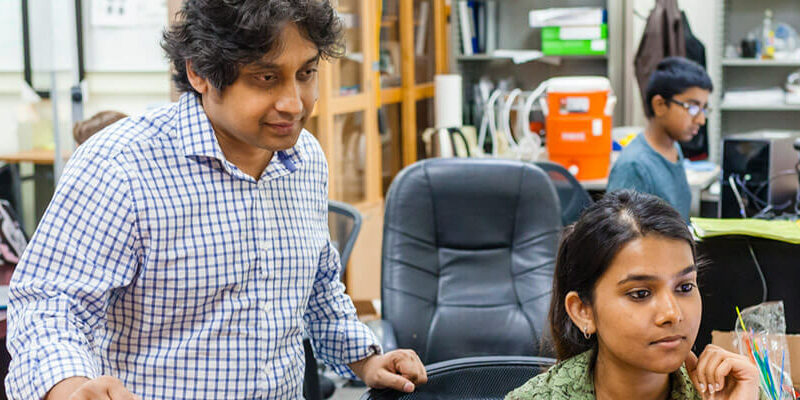
Priya Premnath, assistant professor, partners with Ashwin Narasimhan, visiting assistant professor, to demonstrate the magnetic properties of tiny, engineered particles that are able to find rare tumor cells circulating in a patient’s blood. The particles are part of a platform the two biomedical engineering researchers are developing that will improve these “liquid biopsies.”