Lead the Future of Engineering with a PhD from UWM
A PhD from the UWM College of Engineering & Applied Science prepares you to solve complex challenges, drive innovation and become a leader in research, academia or advanced engineering practice. Whether your goal is to develop new technologies, influence infrastructure design or teach the next generation of engineers, UWM gives you the foundation to make a lasting impact.
Conduct meaningful research at an R1 university As Southeast Wisconsin’s only R1 research university, UWM offers the highest level of research activity. You’ll work alongside faculty who are tackling critical challenges in construction materials, geotechnical engineering, water resources, structural design and transportation—research that improves infrastructure, strengthens communities and protects the environment.
Work closely with expert faculty mentors At UWM, you won’t be just another graduate student. You’ll collaborate directly with faculty mentors who are committed to your success, guiding your research and helping you publish, present and build a strong professional reputation.
Advance your career and expand your opportunities A PhD opens doors to careers in academia, national laboratories, industry research and specialized technical leadership roles. You’ll graduate with deep expertise, advanced problem-solving skills and the ability to lead complex projects and innovation initiatives.
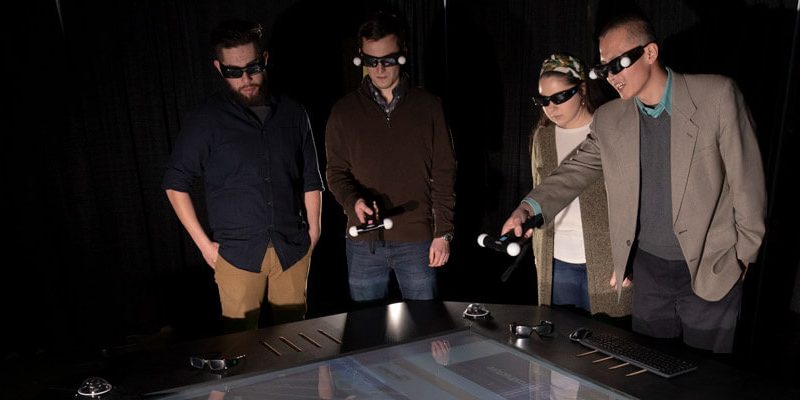
Access state-of-the-art facilities and industry connections UWM’s research labs and partnerships with engineering firms, government agencies and industry leaders provide opportunities to work on real-world problems and build valuable professional connections.
Make discoveries that matter From developing more resilient infrastructure to advancing sustainable engineering solutions, your research at UWM can contribute to safer, smarter and more sustainable communities.
At UWM, your PhD isn’t just a degree—it’s your opportunity to push the boundaries of engineering knowledge and shape the future.
Assistantship decisions are made by the academic departments only after an applicant has been accepted to the program.
Civil & Environmental Engineering Research Labs
The Advanced & Nano Cement Laboratory (ANCL) uses nanotechnology and nano-engineering to create higher performing and more durable cements and composites to build safer, more dependable roads, bridges and buildings, lower repair and replacement costs, and minimize waste and carbon dioxide emissions.
The Advanced Structures Laboratory (ASL) advances intelligent structures by addressing barriers to real-world use. Their research area includes sensors, data interpretation, structural health monitoring, ultrasonic signals to evaluate materials, automatic damage detection, self-healing materials, and shape memory alloys.
The Automated, Connected & Electric Mobility Systems (ACEMS) Lab focuses on evaluating emerging mobility technologies, including automated and connected vehicles, and developing novel solutions through field experiments and hardware-in-the-loop testing.
The Concrete Advancement Network (CAN) is an Industry-University Cooperative Research Center (IUCRC) that aims to develop new technologies to produce more efficient, rapidly deployable concrete with reduced dependency on natural resources.
The team at the Institute for Physical Infrastructure and Transportation (IPIT) brings together researchers across UWM to use research, collaboration, education, and innovation to solve real-world infrastructure and transportation challenges around safety, mobility, and public health.
The Safe and Smart Traffic Lab (S2) offers research consulting services to facilitate scientific and informed decision making in areas including Highway Safety, Human Factors and Driver Behavior Modeling, Traffic Operations and Control, Transportation Data Analytics, Mathematical Modeling of Urban Transportation Systems, Intelligent Transportation Systems, Geographic Information System (GIS) Application in Transportation, and Impact Analysis.
The Structural Engineering Research Lab (SEL) supports cutting-edge research, education and real-world testing of structures. It encourages collaboration across institutions and provides tools and expertise for faculty, students and industry partners through hands-on learning in mechanics and materials and specialized testing for industry partners.
The annual Poster Competition & Three Minute Thesis is a signature event for our college. Students gain valuable communication experience sharing their research and out-of-classroom experiences with faculty and industry judges, who provide feedback.
Three Minute Thesis is an international research communication competition that challenges PhD students to explain their research thesis and its significance to a general audience in three minutes, using a single PowerPoint slide as a reference.
Student Organizations
American Society of Civil Engineers (ASCE) ASCE at UWM is chapter of Wisconsin ASCE that presents students with the opportunity to participate in engineering related activities and competitions, and network with other engineering students and professionals.
Construction Leadership Council – Student Chapter (CLC) CLC provides young professionals with an opportunity to observe and develop their skills with current industry leaders.
Engineers Without Borders (EWB@UWM) The humanitarian work of EWB@UWM brings running water to impoverished villages in the Ixil Triangle of Guatemala and aims to improve the sustainable use of energy in Wisconsin.
Institute of Transportation Engineers (ITE) ITE is an international society of transportation professionals who are responsible for meeting mobility and safety needs.
Structural Engineering Society at UWM (SES-UWM) SES-UWM expands the experience and knowledge of members in structural engineering-related fields through relevant events and technical workshops featuring notable speakers.