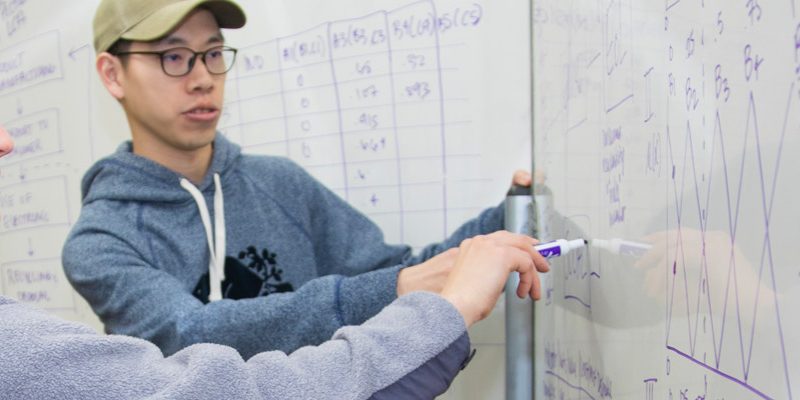
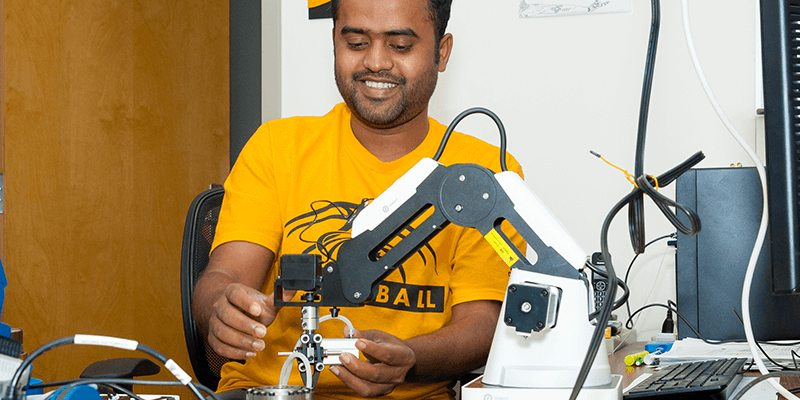
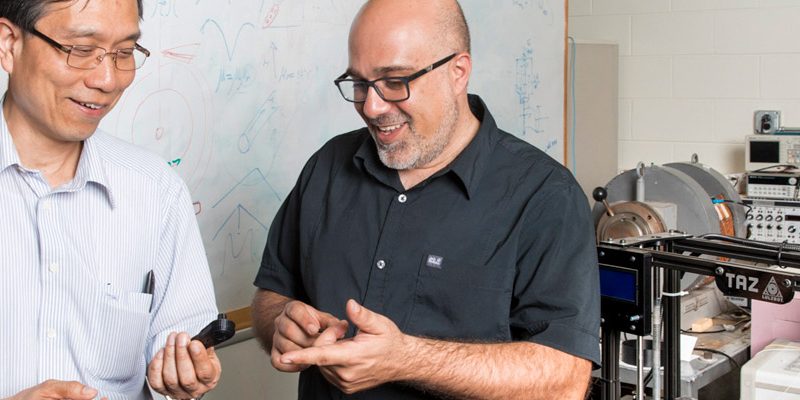
Take your impact in healthcare further with a master’s degree in biomedical engineering at UWM. Here, graduate students work side-by-side with faculty researchers on real-world projects—collaborating with medical professionals, government agencies and academic partners—to turn innovative ideas into technologies that improve patient care and change lives.
The Master of Science degree in Engineering with a concentration in Biomedical Engineering is a far-reaching discipline and our flexible program welcomes those whose undergraduate degrees were in biomedical engineering, other fields within engineering, or health and natural sciences.
Thesis or Non-Thesis Options
The thesis option allows our biomedical engineering master’s degree students to pursue advanced coursework leading to an original research project, supervised by a faculty advisor. Naturally, we encourage students to pursue the development of a thesis.
However, if you have prior engineering or scientific work experience and are seeking an MS for professional advancement, the non-thesis option is a great alternative that requires additional coursework in lieu of a thesis.
Industry Connections
With strong ties to Milwaukee’s healthcare and biomedical industries, UWM provides access to internships, collaborative projects and career opportunities. Supported by dedicated faculty mentors and a growing career field, UWM’s biomedical engineering degree equips you to make a lasting impact on human health and technology.
Accelerated Graduate Program
Qualified UWM undergraduate students can take up to six graduate credits during their senior year by participating in the Accelerated Graduate Program. This saves you time and money, as the credits are effectively counted towards your bachelor’s and master’s degrees, and charged at the undergraduate tuition rate.
The Advanced Mobility Biomechanics Lab develops and applies connected health technology to study mobility of people with disabilities and outcomes of clinical rehabilitation, with particular attention to underserved communities globally.
The Big Data Analytics and Visualization Lab is focused on developments of new computational approaches and software tools for various types of massive data processing, data mining and visualization using both knowledge-based and data-driven techniques.
The Biorobotics Lab focuses on the design, development, and control of wearable robots that can rehabilitate and assist physically disabled individuals whose upper and lower extremities are impaired. These wearable robots are designed for the individual to use to rehabilitate and, ultimately, be able to leave the wearable robot behind.
The focus of the Data Science and Artificial Intelligence Laboratory (DSAIL) is to develop computational approaches that combine human expertise with data-analytic models to solve complex problems, such as improving health outcomes.
In the Mechanobiology and Vascular Biomechanics Lab graduate and undergraduate students use biology, mathematics, mechanics, biomaterials, and fluid dynamics to answer key questions about human diseases. We develop innovative prevention and treatment plans for cancer and cardiovascular diseases, which are tightly interconnected.
The Bone Lab is comprised of engineers, chemists, and biologists aiming to create innovative solutions in tissue engineering and regenerative medicine.
Assistantship decisions are made by the academic departments only after an applicant has been accepted to the program.
Poster Competition & Three Minute Thesis
The annual Poster Competition & Three Minute Thesis is a signature event for our college. Students gain valuable communication experience sharing their research and out-of-classroom experiences with faculty and industry judges, who provide feedback.
Student Organizations
Our college has an active chapter of Biomedical Engineering Society that makes connections between students and faculty and facilitates volunteer opportunities, like 3D printing prosthetic hands for kids in need through e-NABLE, a non-profit. They host monthly speakers from different realms of Biomedical Engineering, including research, industry, and continuing education.
Qingsu Cheng (left), assistant professor, biomedical engineering, examines magnified images of fibroblast cells with post-doctoral researcher Michael Weizheng Wang. Cheng has received funding to investigate the interactions of fibroblasts with breast cancer cells during radiation treatment.