At UWM’s College of Engineering & Applied Science, a bachelor’s degree in biomedical engineering puts you at the intersection of innovation and impact—where engineering meets human health.
You’ll learn how to design medical devices, equipment and intelligent systems that improve lives, using the same tools and approaches engineers apply in real healthcare settings.
What Sets Us Apart
We offer a truly interdisciplinary experience. You’ll draw from mechanical, electrical, materials science and computer engineering while applying biological and medical knowledge to solve complex, real-world challenges. This collaborative approach mirrors how biomedical engineers work in industry and research.
Strong Industry Connections
Our faculty collaborate with the College of Health Sciences, College of Nursing, School of Freshwater Sciences and Zilber School of Public Health, as well as partners like the Medical College of Wisconsin and local industry leaders—giving you exposure to diverse perspectives, hands-on opportunities and a strong foundation for a career improving human health.
In order to earn a bachelor’s degree in biomedical engineering, students work in teams to apply the skills they have learned over their years at our college in a year-long senior design project.
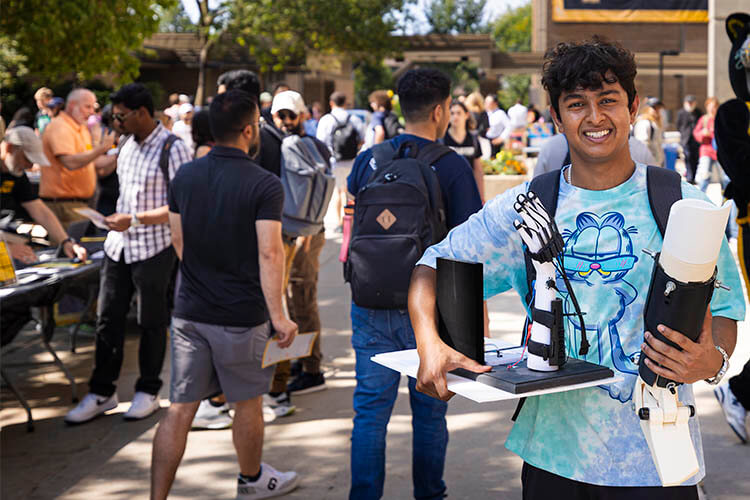
Our college has an active chapter of Biomedical Engineering Society that makes connections between students and faculty and facilitates volunteer opportunities, like 3D printing prosthetic hands for kids in need through e-NABLE, a non-profit. They host monthly speakers from different realms of Biomedical Engineering, including research, industry, and continuing education.
The annual Poster Competition & Three Minute Thesis is a signature event for our college. Both undergraduate and graduate students gain valuable communication experience sharing their research and out-of-classroom experiences with faculty and industry judges, who provide feedback.
Undergraduate Teaching Labs
Biomedical Instrumentation Laboratory (EMS E129)
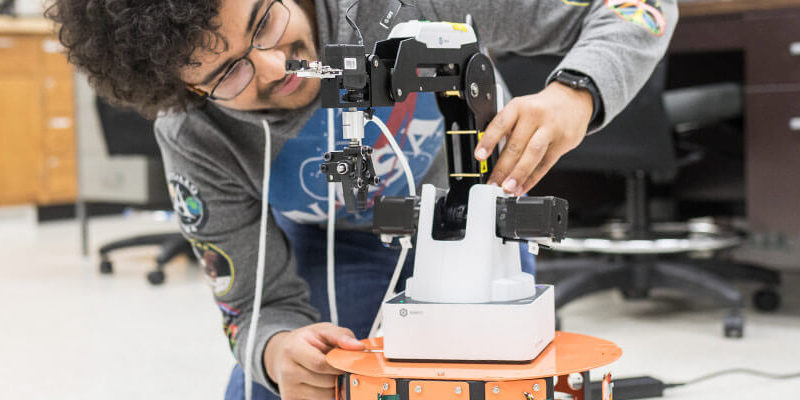
The Biomedical Instrumentation Lab provides hands-on signals and processing experience using sensors to record and analyze brain waves, which control today’s state-of-the art prosthetic limbs, robotic arms, and humanoid robots. The lab also contains Virtual Reality (VR) headsets that are coupled with state-of-the-art EEG equipment to study cognitive processes and translate brain waves into movements in a VR environment.
Biomechanics and Human Motion Analysis Lab (EMS W180)
The Biomechanics and Human Motion Analysis Lab is where our students get hands-on experience learning about the musculoskeletal system, including tissue engineering and biomechanics of tissues, structures, and joints. Motion capture technology tracks detailed human motion and can model gait, wheelchair use, sports, and upper body movements. In addition to the motion capture system, the laboratory includes a force platform, wireless electromyography system and a full-featured mechanical testing machine.
UWM students have a wealth of additional hands-on teaching labs available to them within the College of Engineering & Applied Science. From computer labs and tutoring resources to teaching labs and spaces to create or collaborate.
Undergraduate Research
As an undergraduate student you’ll have the opportunity to work with faculty engaged in research including:
Biomechanics
Biorobotics
Bone Healing
Intelligent Assistive Devices
Medical Imaging
Medical Instrumentation
Rehabilitation Engineering
A benefit of attending a top tier R1 research university is the opportunity to work with faculty engaged in cutting-edge research. This could include participating in the Support for Undergraduate Research Fellows (SURF)program. The SURF program helps you to improve your professional preparation through research by working closely with our faculty to explore, discover, and transform ideas into reality.
SURF students also receive funding for their efforts: from 2012-2023 almost $1.5M was awarded to over 700 students from our college.
This biomedical engineering student brings out the prototypes.