Water & Environment
UWM grad helps bring fresh water to impoverished villages
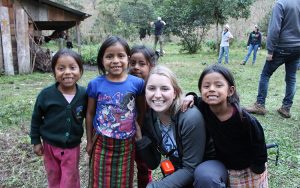
Clean drinking water is something we might take for granted, but for people in impoverished areas of the world, it’s a necessity that takes time and energy every day to acquire. Recent UWM grad Cassandra Bence is helping do something about it.
Fellowships allow Freshwater students to wade into policy
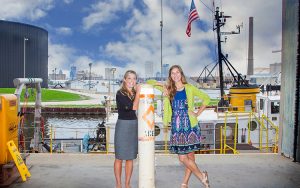
Danielle Cloutier and Shelby LaBuhn, both doctoral students in the School of Freshwater Sciences, will soon head to Washington, D.C., to see how the research they do translates into law.
How does Thanksgiving affect rivers? Sampling project aims to find out
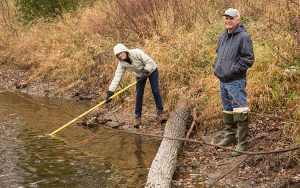
UWM researchers will analyze samples taken from Milwaukee rivers before and after Thanksgiving. They suspect they’ll find evidence of human behavior over the holiday – such as acetaminophen, caffeine, cinnamon and nutmeg.
UWM geoscientist drills deep to find Lake Michigan’s origins
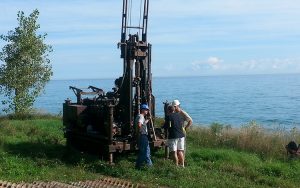
Great glacial forces shaped Lake Michigan and the Milwaukee area thousands of years ago. UWM researcher Mark Borucki is drilling into the bluffs along the lake to figure out just what happened and how.
UWM scientist’s model key to climate change study
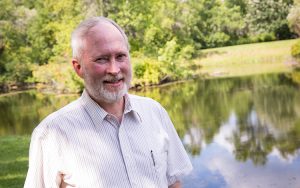
Spring is beginning earlier than its historical average in three-quarters of United States’ national parks studied, according to new research that employed a model created by UWM climatologist Mark Schwartz.
UWM biologist leads county’s first-ever wildlife survey

UWM field biologist Gary Casper’s work will be used to determine how pollution and development have affected wildlife in urbanized Milwaukee County, and will help guide efforts to restore habitats.
UWM anthropologist looks inside global seed vault
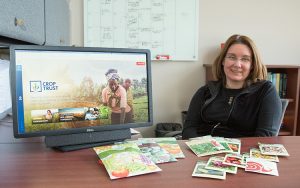
Anthropologist Tracy Heatherington is studying the Svalbard Global Seed Vault, an international repository that safeguards seeds against war and natural disasters that could lead to famine.
New fountain doubles as experiment for UWM water research
A fountain and green space at the Greenfield Avenue and First Street intersection will beautify the neighborhood while cleaning the environment.
UWM Freshwater Sciences lab receives $1.5 million grant
Sandra McLellan’s lab at the University of Wisconsin-Milwaukee’s School of Freshwater Sciences has received a $1.5 million grant to help fund a better assessment tool for water pollution that affects rivers and beaches in urban areas. Currently, pollution in urban waterways is assessed by measuring the levels of E. coli and fecal coliform bacteria in […]
Freshwater grad turns love of Wisconsin outdoors into career
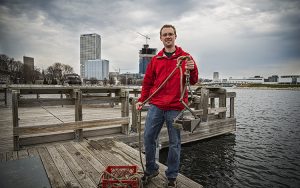
Steven DeVilbiss landed a job in water quality monitoring for the state of Virginia before he even left UWM.