Science & Technology
UWM astronomer helps find cosmic searchlight
New Fast Radio Burst discovery finds ‘missing matter’ in the universe MILWAUKEE _ An international team of scientists using a combination of radio and optical telescopes has for the first time managed to identify the location of a fast radio burst, allowing them to confirm the current cosmological model of the distribution of matter in […]
Interested in local food? Check out fish farming
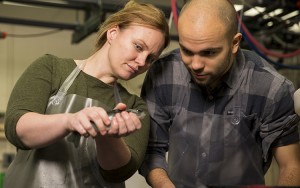
The 1-year-old aquaculture certificate program at UWM’s School of Freshwater Sciences trains graduate and undergraduate students in urban fish farming.
Do your research: Summer’s the perfect time
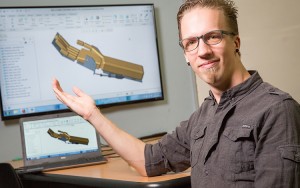
More than 150 UW-Milwaukee undergrads participate in a campus summer research experience and whether paid or not, the consensus is, it’s worth it.
Doctoral student in right place at right time for gravity waves
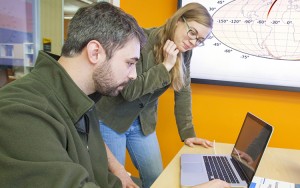
UWM doctoral student Alex Urban was at the Laser Interferometer Gravitational-Wave Observatory in Louisiana at the historic moment when a gravitational wave was detected, confirming Einstein’s theory.
UWM’s big data helps find gravitational waves
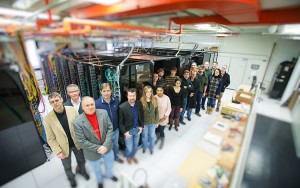
UWM physicists provided computing power and analytical tools critical to the detection of gravitational waves, first predicted by Albert Einstein 100 years ago.
UWM brings science (and zebrafish!) to Wisconsin high schools
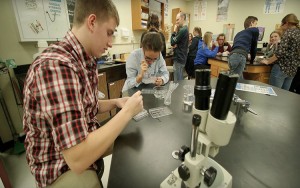
For 20 years, David Petering’s goal has been to help high school students understand science and technology – and have them ready for college research labs.
Prototyping lab preps future architects for real world
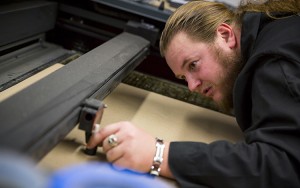
The rapid prototyping lab in the School of Architecture and Urban Planning exposes architecture students to state-of-the-art fabrication equipment and manufacturing concepts used in professional design and construction today.
Renee Spiewak, international traveler, physics star

A home-schooled, first-generation college student, Renee Spiewak excelled at UWM, working side by side with professors on undergraduate research and winning National Science Foundation funding to study with scientists in Italy and Australia.
UWM scientist develops new way to find age of drinking water
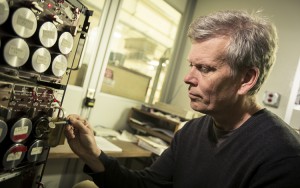
A UWM scientist can determine the age of drinking water in distribution pipes by measuring “leftovers” from 1950s atomic weapons testing. The method could help improve water quality at the tap.
Companies team up with UWM to conserve energy, cut costs
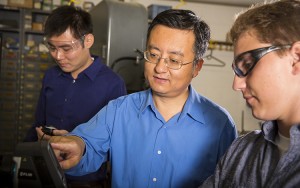
The Department of Energy-funded Industrial Assessment Center embeds UWM engineering professors and students in manufacturing plants, where they make recommendations that have helped manufacturing companies save $6.5 million to date.