UWM-developed app helps protect patients’ brains during surgery
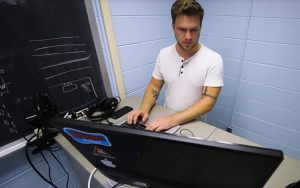
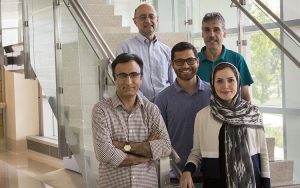
Students in UWM’s App Brewery worked with doctors at the Medical College of Wisconsin to develop an app that helps guide doctors during the delicate process of brain surgery.
News from the University of Wisconsin-Milwaukee
Students in UWM’s App Brewery worked with doctors at the Medical College of Wisconsin to develop an app that helps guide doctors during the delicate process of brain surgery.
Gravity-wave astronomy is giving us a dramatically new way to look at our universe – which is why LIGO – the Laser Interferometer Gravitational-Wave Observatory – was awarded this year’s Nobel Prize in Physics. Learn more about LIGO’s discovery and its scientific impact at Patrick Brady’s talk “When Black Holes Collide: Gravitational Waves and the […]
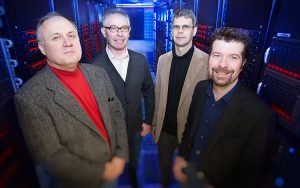
The 2017 Nobel Prize in physics was awarded Tuesday morning to Rainer Weiss, Kip Thorne and Barry Barish, but scientists at UWM played important roles in the worldwide effort to detect gravitational waves.
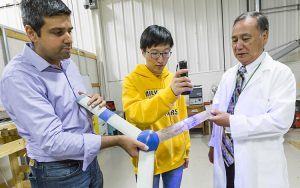
Technology being developed by Ryoichi Amano could automatically repair cracks in wind turbine blades, making this important source of green energy safer and more efficient.
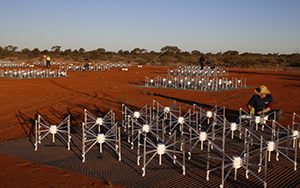
University of Wisconsin-Milwaukee astronomer David Kaplan and colleagues have begun a radio search for the magnetic fields of planets orbiting distant stars. The team reported its initial findings in “A search for circularly polarized emission from young exoplanets,” published in the Monthly Notices of the Royal Astronomical Society. The astronomers conducted a search of star […]
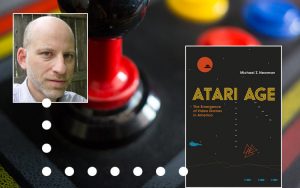
Video games emerged in the early 1970s and soon made a huge impact on American life. A new book by Michael Z. Newman, associate professor of JAMS at UWM, chronicles that time.
The research has the potential to fundamentally advance our understanding of biological processes inside cells. UWM physicists developed algorithms to reconstruct sequential images of viruses too small to photograph.
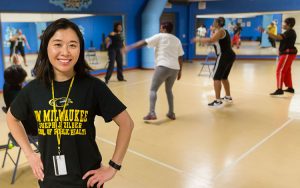
African-American women have a lower breast cancer survival rate than their white counterparts. Alice Yan, a UWM associate professor, is leading an effort to counteract that.
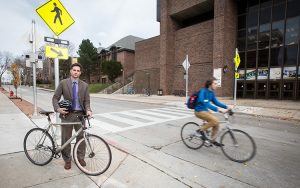
UWM researchers analyzed the 46 largest regions of the country to identify which are the safest and most dangerous for walkers and bicyclists.
When the National Parks Service wanted know if spring was coming earlier at many national parks around the U.S., it turned to the USA National Phenology Network (USA-NPN), an online environmental change-tracking resource cofounded by Mark D. Schwartz, UWM distinguished professor of geography. The National Phenology Network provides Start of Spring maps and tools that […]