Howdy, BugFans,
It’s that time of year again—time to put our feet up, sip adult beverages by the light of the tree, hum “The Twelve Bugs Days of Christmas,” and dream of spring. (The days are getting longer, you know.) Here are a Baker’s Dozen from 2025.
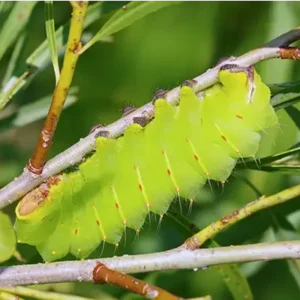
Polyphemus Moth Caterpillar
This glorious polyphemus moth caterpillar, in the giant silk moth family Saturniidae (not the same family as the moths that produce silk for textiles), is huge! How big is it? And it’s going to grow up to be a very large moth.
American Rubyspot

One of the lovely River damsels. Males are beautiful, but this female is pretty spectacular in her own right. (The BugLady wishes she knew how she got that halo effect—probably a random sparkle off the Milwaukee River beyond—she’d employ it in more pictures.)

Ambush Bug
Seasoned BugFans can attest to the BugLady’s fascination with Ambush bugs, which lay in wait on flowers until lunch arrives. When she took this shot, the Ambush bug reminded her of another fascinating insect, the Orchid Mantis. Read here for a deeper Orchid Mantis dive.

Dogbane Leaf Beetles
They are spectacular green beetles – except when they aren’t. The beetle’s color and incandescence are the result of the play of light on exceedingly small, tilted plates that overlay its pigment layer. As you walk around it, the light bouncing off both the pigment and the plates causes the colors to change with your angle (and sometimes bring up Christmas colors). Life is physics. Check the bugguide.net image gallery for more.

Oblong-Winged Katydid
A splendid katydid, splendidly in tune with its surroundings!
Bee Fly

This Bee fly deposits her eggs in the egg tunnels of solitary wasps that live in sandy/bare areas, though “deposit” doesn’t quite describe the process. She hovers above the tunnel of a wasp like this one and lobs an egg down into the opening. But, there’s a secret sauce. She dips her rear end into the sand in order to take up some sand grains which she will store in a special receptacle. As an egg emerges, it gets a gritty coating that may help camouflage it and may also make it heavier so that her” throw” will be more accurate.

Bumble Bee
The BugLady has pictures of a number of insects nectaring on the spiny center of Purple coneflower (Echinacea sp.), and it always looks like an iffy proposition. The name “Echinacea” comes from the Greek word for hedgehog.

Crab Spider
Crab spiders like orchids. This one is on a Small Yellow Lady’s Slipper! They don’t spin trap webs, and orchids give them a nice platform on which to wait for pollinators, though some might have a long wait because not all orchids are pollinated by insects. The BugLady has a color slide of a Bog candle orchid with a white crab spider fitting neatly onto a horizontal flower. Just as there is an orchid-mimic mantis, there’s an Orchid mimic crab spider.

Tufted Bird Lime/Bird-Dropping Moths
Tufted Bird Lime/Bird-Dropping Moths look marbled to the BugLady. Jim Sogarrd, author of Moths and Caterpillars of the North Woods, tells a story about attempting to collect a bird-dropping moth from the side of a building, only to discover that it actually was a bird dropping.

Robber Fly
Robber flies are carnivorous flies that come in quite a variety of sizes and shapes. Larger species, like this green-eyed beauty, can gather bees, butterflies, grasshoppers, dragonflies, and even cicadas for lunch. Others are great bumble bee mimics, and still others, like this small fly sitting on a daisy fleabane, capture mosquitoes and gnats.

Hackberry Emperor Butterflies
Some kinds of caterpillars feed on a variety of plants, but Hackberry Emperor caterpillars eat only one thing and so can live only where Hackberry trees grow—no hackberry, no Emperor. This one was posing under the roof overhang of the Barn, at Riveredge. Adults rarely feed on flowers, preferring tree sap, rotting fruit, carrion, and dung, and they collect minerals from damp/muddy soil with their proboscis. Their top side is handsome, too. They’re not pollinators. When they do visit flowers, they don’t touch down with their feet, and they avoid putting their antennae on the flower. They only extend their proboscis into the flower, and so do not pick up nor spread pollen.

Jumping Spider
Even people who don’t like spiders like Jumping spiders, and some keep them as pets. This one looks like the Bold jumper, Phidippus audax.

Blue Dasher
When the BugLady was a kid, Angie the Christmas Tree Angel (BugFans who are old enough can hum a few bars here) used to smile benignly from the top of the tree. That was before the BugLady knew about dragonflies. This guy makes an excellent substitute for Angie or for the Partridge in the Pear Tree.
May your days be merry and bright,
The BugLady