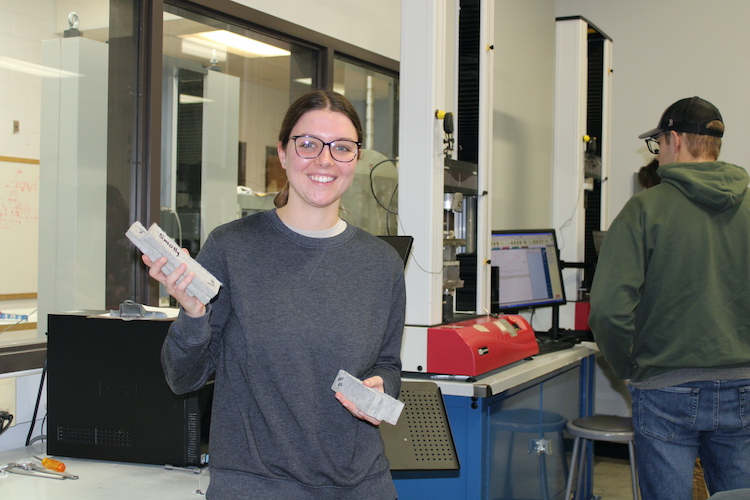
For the 15th straight year, teams of UWM civil & environmental engineering undergraduate students competed to create the most bendable concrete from scratch.
Twenty students formed five teams that designed, mixed and poured original concrete formulas. Their finished products – miniature beams measuring 40mm X 12.5mm X 160mm — were curated from portland limestone cement, water, superplasticizer, polyvinyl alcohol (PVA) fiber, slag, fine sand and other components selected by the students. Teams then tested the responses of their creations under flexural load to determine its ultimate strength and maximum deflection.
When pushed to the breaking point, the winning concrete would not snap in a single location but instead develop multiple hairline cracks.
“Tiny cracks give you a warning that the concrete is weakening,” said senior Cindy Thorlton, whose team won the competition with a concrete composed of fine sand, slag, water and fiber.
(Most bendable concrete competitions have ended in ties—one team wins for ultimate strength, one for maximum deflection. However, this year Thorlton’s team won both.)
This response—called strain hardening—is key to creating stronger, longer-lasting concrete, says Konstantin Sobolev, Lawrence E. Sivak ’71 Faculty Fellow and professor, civil & environmental engineering.
“Concrete that can withstand a higher load and higher deflection would reduce repair costs and be more environmentally friendly in the long run,” he said.
UWM is a powerhouse in engineering new and improved concrete
At UWM, civil & environmental engineering faculty, graduate students and undergraduate students are constantly researching ways to improve concrete, including engineering carbon-neutral concrete, lunar concrete and water-repelling concrete. Faculty are currently collaborating with the University of Texas at Arlington and a consortium of European universities on a $1.5 million project, funded by the National Science Foundation, that aims to mitigate concrete’s role in global warming.
The bendable concrete contest was the culmination of a semester of lab work in which the students in a class called Materials of Construction learned about the different types of construction materials and concrete.
The class was led by Sobolev with key support provided by teaching assistant and doctoral student Filip Zemajtis (below, left).
Master’s student Gregory Vieira (below, right) also assisted with the competition as it was related to his master’s thesis.
Vieira said the competition and interaction with Zemajtis and undergrads extended his experience with high-performance fiber-reinforced concrete and enhanced his research on bridge overlays. He is currently assisting Habib Tabatabai, professor, civil & environmental engineering and director of the UWM’s Structural Engineering Lab, on a $150,000 research project funded by the Wisconsin Highway Research Program that aims to improve bridge performance and the durability of concrete used for bridge deck overlays.
Concrete that is less brittle and more bendable will develop fewer cracks and last longer, Vieria said. “This could be a revolution in the transportation industry as we can consider using thinner bridge overlays and less rebars. It could lead to projects that cost less and overlays that last longer.”

