Alumni Spotlight: Heather Abbott-Davis

Tell us about yourself.

I am a Racine, WI native, married to my wife for three years and we have three dogs and two cats plus the occasional foster dog(s). I completed my BS in IME in 2016 and my MS in Engineering in 2020.

Since graduating with my BS, I have held several roles: process coordinator, industrial engineer, and manufacturing engineer. My current role is engineer analyst at SC Johnson, where I work in the Lean Department. Outside of work I really enjoy being in nature and working with Furever Friends Sanctuary to help rescue dogs from all over the U.S., including Puerto Rico.

What drew you to choose UWM?

UWM’s location and reputation were big factors in my choice. I was a non-traditional student who already had some tech college experience and a life established in Racine. I had always heard good things about the university’s engineering programs and knew that companies valued the skills that students took away from UWM. It ended up being a no-brainer and my only choice after moving on from a tech college.

How beneficial was your decision to pursue the accelerated Industrial and Manufacturing Engineering BS/MS program?

Honestly, I had no intention of getting a master’s degree of any kind. But as I started to get further into my BS, and I learned about the accelerated program, it was an opportunity I could not pass up. Not only are there monetary incentives for postgrad work, having a MS has opened up several opportunities that I would not have had otherwise. It will continue to be beneficial as I work through higher positions in my career.

Which courses/aspects of your IME education have been most beneficial in your career?

It was extremely beneficial to graduate having AutoCad experience (from IME 112) and standard wok knowledge (from IME 470). My first role was a typical IE position where I was doing standard work and plant layouts utilizing AutoCAD frequently. As I started to grow in my career and take on more responsibilities, utilizing the undergraduate- and graduate-level ergonomic courses helped me grow in a new area at work, an area in which the company had been lacking.

Highlight some of your involvement at UWM.

During the last year and a half of my undergrad work, I was working in the battery lab under Dr. Qu. I was able to make so many connections and meet others outside of IME, which helped me shape how I think about things. Obviously, I learned a lot about batteries but I was also able to grow the professional skills required to work in a research lab. Those skills transferred to the real world and navigating the “real job” world.

Highlight an accomplishment in your career so far.

My highest accomplishment so far is successfully transitioning into very different roles. There is so much you can do with an engineering degree, and I struggled to find my work passion. One of my goals after graduating was to be open and willing to try new things, which is something I usually try to avoid. I still consider myself a young engineer but trying out new roles tin order to learn different skill sets has helped me refine what I want to do in engineering and what I absolutely do not want to do. It was very scary trying new jobs that were different from previous roles, but it has set me up in a good position to work in an area I love.

What motivates you to continue to collaborate with the UWM IME department?

I enjoyed working with everyone in the IME department during my time as a student and I did not want to lose those relationships after graduation. I also enjoy helping students and mentoring them. Collaborating with the UWM IME Department is a way for me to help students and give back to a place I hold close to my heart. My time at UWM not only grew me as an individual ready to work in the engineering world, it helped me grow as a person—to find myself and the things that are important to me on a personal level.
The research of GRAPES is helping Southeast Wisconsin emerge as a leader in the energy revolution

In May, members of a National Science Foundation-backed research center that focuses on energy solutions held their annual review meeting at UWM. One result was the addition of four Midwest members to this Industry/University Cooperative Research Center that aims to make electricity more dependable, greener and less expensive.

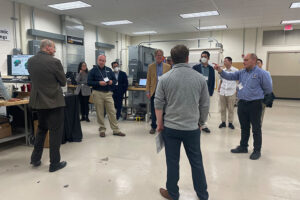
The meeting brought industry and university members of GRAPES (GRid-connected Advanced Power Electronic Systems) to campus, during which time the more than 60 attendees reviewed their ongoing research projects, toured UWM’s semi-anechoic chamber (used for electromagnetic interference, or EMI, testing) at Century City Tower, saw a demonstration of UWM’s microgrid, and got a glimpse of why southeast Wisconsin is emerging as a leader in the energy revolution.

The meeting also included hardware demonstrations by UWM engineering graduate students and presentations by GRAPES’s international affiliate members–RWTH Aachen University (Germany), Korea University (South Korea) and Yonsei University (South Korea).

“GRAPES’s research is affecting how Americans access and use renewable energy sources,” said Rob Cuzner, GRAPES site leader at UWM. “It’s also changing the future electrification of transportation systems, including ships, automobiles and aircraft.”

Cuzner—an expert in power conversion and distribution, with more than 30 years of experience in the field—is an associate professor of electrical engineering and computer science, and director of UWM’s Center for Sustainable Electrical Energy Systems.

The two-day meeting, he said, was a perfect opportunity to highlight the region’s capabilities in this area. Southeast Wisconsin has everything needed to be the Silicon Valley of emerging technologies for storing, controlling and distributing energy,” Cuzner said. “UWM already is a leading research institution in both energy storage and electric grid technology.”


Founded in 2009, GRAPES is an NSF Industry/University Cooperative Research Center (I/UCRC) whose members include UWM, University of Arkansas, University of South Carolina, and 18 industrial and government members. Members vote on annual research projects during a separate meeting held at the University of Arkansas each November. 

4 new members joined GRAPES

In preparation for this meeting, Cuzner, along with Bill Weber, outreach program manager for UWM’s Center for Sustainable Electrical Energy Systems, and Mike Andrew, director of corporate relations for the college, visited industries throughout the greater Midwest to introduce them to UWM’s research into power, power conversion, generation, energy and distribution-based controls and protection, and energy-system solutions. 

This meeting saw the addition of four new Midwest GRAPES members:

  • Dynamic Ratings (Sussex, WI), which develops monitoring, controls and communications solutions for distribution, transmission and industrial assets
  • Kohler Power Systems (Sheboygan, WI), which develops generators, UPS systems and microgrid solutions
  • Electronic Concepts (Waukegan, IL) which manufactures film capacitors
  • Midwest Engineered Components (Burnsville, MN), a distributor and representative of electronic component vendors.

The new members join long-standing Wisconsin members that include Eaton, Leonardo DRS and We Energies.

Visiting companies in attendance included Badger Technology Group (Port Washington, WI), Generac (Waukesha, WI) Vitesco Technologies (Deer Park, Illinois) and Hitachi Energy (Raleigh, NC).

“There are benefits to being a member of GRAPES,” Cuzner said.

GRAPES provides an opportunity for industries to partner with UWM researchers and students to develop new technologies to store, control and distribute energy,” he said. “All GRAPES’s innovations are compatible with the existing grid and power and energy systems and are efficient, power dense, reliable and resilient.”

To learn more about membership in GRAPES, contact Cuzner at cuzner@uwm.edu.

UWM’s Materials Science Department helps train high school teachers in materials engineering and metallurgy

HS teachers at Foundry

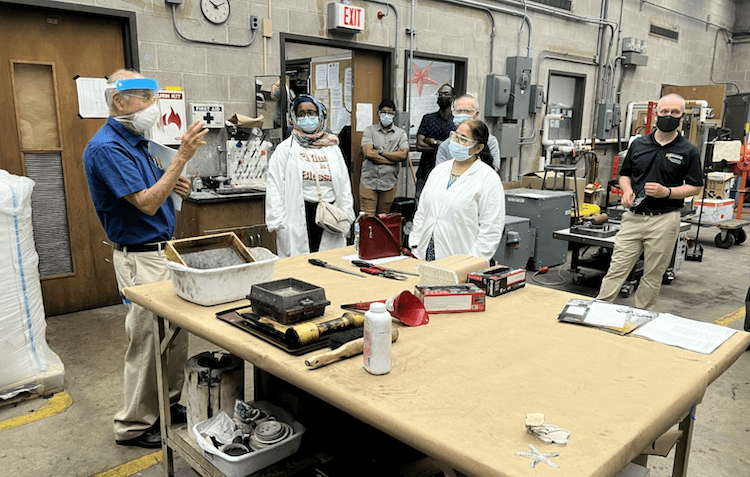
In June, five high school science teachers from Milwaukee and McHenry, IL visited UWM’s College of Engineering & Applied Science to learn about materials engineering and metallurgy. 

The group was part of an ASM International teachers camp that provides training in materials engineering to high school teachers.

Associate Professor Ben Church and doctoral students Calvin Nyarangi and Phani Ravi Teja Nunna helped the group test the impact strength of aluminum and steel samples, then led a discussion on crystallography, phase changes, and various material properties.        

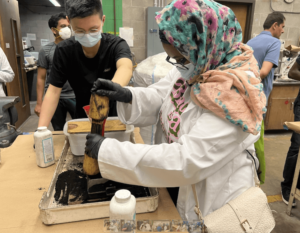
Next, the teachers toured UWM’s foundry, where they got a tour and a hands-on experience in metal casting.

In the foundry, Pradeep Rohatgi, UWM distinguished professor and Foundry Education Foundation key professor, doctoral students Omid Ghaderi and Masum Bellah, and several undergraduates all contributed to the tour and activity, in which the teachers used FEF’s Foundry in a Box to create a casting of a starfish.

Rohatgi highlighted the following to the group:

  • Teachers could host a casting event or apply for Foundry in a Box equipment. 
  • UWM offers a range of opportunities to students interested in materials science or metallurgy.  
  • FEF offers many scholarships to undergraduate students at UWM.
  • FEF helps UWM students find jobs.

The group also learned about the castings developed by UWM researchers, including; ultralight composite castings; syntactic foam castings; and self-healing, self-lubricating and self-cleaning castings. 

Alumni business instrumental in building of Lake Country Hounds baseball stadium

Alum Jim Jendusa (’87 BS civil engineering, ’92 MS structural engineering), was involved in the design and construction of the new Wisconsin Brewing Company Park in Oconomowoc, Wisconsin that recently opened in May, 2022, home to the Lake Country Dock Hounds. Jendusa Design & Engineering acted as both architect and structural engineer for the baseball stadium and used their patented Forteco Framing system for the wall and floor framing of the building. Jendusa is owner of Jendusa Design & Engineering, Inc., owner of Forteco Framing Company, and Manager of Lightweight Structures, LLC. See Jendusa’s LinkedIn page here.

College exposes high-school students to STEM careers

In June, the college teamed up with the UWM School of Architecture and Urban Planning, NAF, MPS, the MPS Foundation, Milwaukee Area Technical College, Journey House and All Hands Boatworks to introduce the NAF Future-Ready Scholars at UW-Milwaukee

STEM HS summer

The five-week program (one week of engineering and four weeks of architecture) engages high-school students in hands-on investigating, design, construction, and experiential learning as they spend time living and learning on campus.

“The program helps students to imagine STEM careers and the college paths that would lead to those careers,” says Chris Beimborn, UWM EnQuest coordinator and STEM outreach manager.

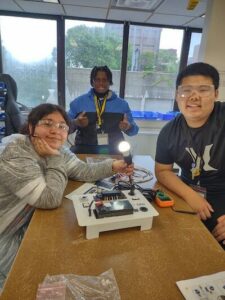
In the college’s Makerspace, the 16 students of the engineering cohort created a solar power station that will be installed in a community garden shade pavilion that the architecture cohort will build in the coming weeks. They used kits contributed to the college’s pre-college outreach programs by Creation Technologies.

In addition to working on their real-world project, the group visited the Virtual Reality Infrastructure Lab and the Foundry, met faculty members, took part in a game design workshop with a Girls Who Code instructor, interacted with our college’s students and participated in college and career readiness sessions. 

The engineering students presented their work to families and guests on June 10.

This year’s group of students attend the following MPS high schools: Audubon, Bay View, Golda Meir, Hamilton, Marshall, Reagan, Riverside University and Rufus King. Many belong to year-round NAF Academies that provide STEM career exposure and work-based learning in their schools. They learned about the opportunity from teachers, counselors, and parents.

In new study abroad program, UWM students dive into hands-on research in Bacalar, Mexico

Through a new UWM study abroad program, environmental engineering undergraduate Rachel Clark conducted hydrology mapping for six weeks this spring in Mexico’s Yucatan peninsula.

Clark was one of six students from UWM and UW–Whitewater to participate in field research at Laguna Bacalar International Research Station on the campus of CREN Normal College in Bacalar Mexico. Laguna Bacalar is Mexico’s second largest freshwater lake and a one-of-a-kind ecosystem.

“I felt so incredibly lucky to have this experience and collaborate with such knowledgeable and experienced faculty and local agency leaders,” Clark says. “I was able to practice my Spanish and be in a wonderful culture in an incredibly unique ecosystem.” Read more.

Applications open for Fall 2022 semester   

The program to the Yucatan Peninsula is offered through UWM’s Freshwater Sciences and is open to undergraduates and graduates in diverse degree programs. It was established with support from the National Science Foundation’s International Research Experience for Students (IRES) Program.

Applications for the Fall 2022 semester are now open; closes Aug. 26.   

First full-ride Nadella scholarships awarded at UWM

Satya and Anu Nadella

Nine recent graduates from Milwaukee high schools are the first to be awarded full-ride scholarships to UW-Milwaukee to study computer science, data science and information technology funded through a gift from UWM alumnus and Microsoft Chairman and CEO Satya Nadella and his wife, Anu Nadella (pictured).

The Anu and Satya Nadella Scholarships are specifically for students who graduate from Milwaukee high schools. They provide financial and academic support, and cover tuition, fees, room and board for up to five years.

Satya Nadella (’90 MS Computer Science) is a UWM alumnus.

More.

OTC hearing aid created at UWM wins 2nd place in Wisconsin Governor’s Business Plan contest

Yi Hu prototype 750 x 500

A new type of hearing aid developed at UWM’s College of Engineering & Applied Science won second place in a statewide contest designed to encourage entrepreneurs in the startup stage of tech-enabled businesses.

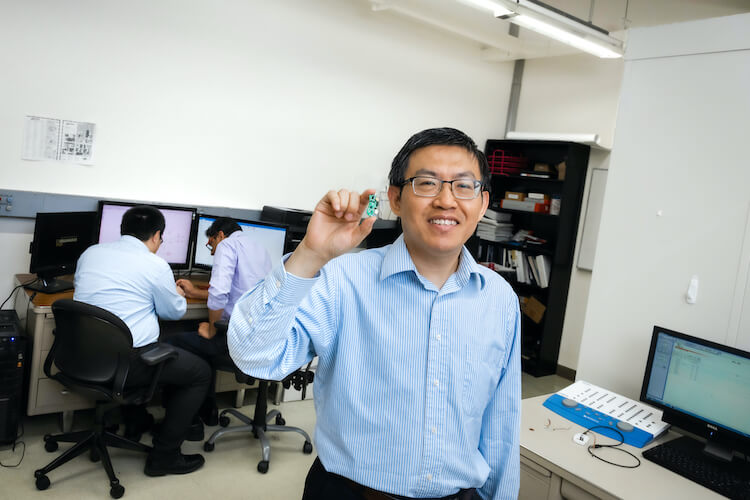
In June, Yi Hu, won second place in the Life Sciences Division of the 19th annual Wisconsin Governor’s Business Plan Contest with his submission of My Hearing Care, a hearing aid startup established in 2017 that makes better hearing more accessible and more affordable for the millions of people suffering from mild to moderate hearing loss. Hu is chair of UWM’s Electrical Engineering Department and associate professor of electrical engineering and computer science.

Fang Du, PhD, and Santhosh Yegnaraman, PhD candidate, Biomedical and Health Informatics, collaborated with Hu. Only 13 contestants from an initial pool of more than 200 had advanced to this stage.  

OTC hearing aids could improve life for those with hearing loss

The Federal Drug Administration is expected to roll out regulations for over-the-counter (OTC) hearing aids later this year. Hu envisions consumers easily purchasing low-cost devices the way one buys reading glasses at the drugstore without a prescription.

My Hearing Care pairs with a smartphone app called TruFIT to approximate the audiologist experience. “People use the TruFIT app to customize their hearing aids,” Hu said, adding that the self-test is done according to audiologists’ standards.

Currently, only one in five people in the U.S. who could benefit from hearing aids use them, with the primary reason being cost. Basic Medicare does not cover traditional hearing aids.

Hu hopes My Hearing Care and other OTC hearing aids will put treatment within reach for many people.

My Hearing Care builds off Hu’s 20 years of researching technology to help improve life for those with hearing loss.

Read more about Yi Hu’s hearing aid.

Read more about the Wisconsin Governor’s Business Plan contest.  

Listen to Hu on UWM’s podcast Curious Campus in an episode titled “Novel technologies to help people with hearing loss.”

UWM builds diversity in STEM: 13 engineering and computer science students graduate with support from NSF program

PECS students at commencement

Lue Lor was in high school, working a minimum wage job at the Dollar Tree, when he applied to UWM in 2018. “Honestly, if I didn’t get into college, I would most likely have pursued a factory job,” he says.

Lue Lor receives a PECS certificate from Wilkistar Otieno.

Lor—a first-generation, low-income student whose family emigrated from Thailand when he was 6 years old—was accepted into a UWM program that would help him toward his dream of an engineering career.

The program—Preparing Engineering and Computer Scientists, or PECS—is funded through the National Science Foundation and has provided scholarships, mentoring, research experience and internship opportunities for 35 UWM students from underrepresented groups who, like Lor, are academically talented and face financial challenges. Many become the first in their families to attend college.

13 students built “community of scholars” while at UWM 

Lor was one of 13 engineering and computer science students who this spring completed the PECS program and graduated from UWM, ready for their first jobs or graduate school. (After an intimate PECS Program celebration, the students received their diplomas along with about 3,500 other UWM graduates at the 2022 Spring commencement.)

Diego Avila receives a PECS certificate from Wilkistar Otieno.

At UWM, the students completed their studies in the College of Engineering & Applied Science, where they earned undergraduate and graduate degrees in six different disciplines. Congratulations to:

Computer Science, BS: Jacob Dymond

Civil Engineering, BSE: Evan Callow, Cassie Wilke

Civil Engineering, BS, MS: Brynn Glennon

Electrical Engineering, BSE: Lauren Chingway, Rediet Tesfu

Industrial Engineering, BSE: Diego Avila, Alison Danison, Yareth Meza, Jake Smith

Materials Engineering, BSE: Selena Cao

Mechanical Engineering, BSE: Lue Lor, Carly Rowe

“The experience has given all students an opportunity to build a community of scholars as they work together to complete their degrees in a challenging field,” says Wilkistar Otieno, director of the UWM PECS program and chair of industrial and manufacturing engineering.

“In high school, I didn’t have the opportunity to talk to college engineering students”

Carly Rowe receives a PECS certificate from Wilkistar Otieno.

Lor agrees, noting that the PECS program did more than help him meet financial challenges. “It allowed me to build connections with other engineering and computer science students,” he says.

He now hopes to inspire teens from unrepresented groups to pursue STEM careers. Through the PECS program, he recently participated in a panel discussion for Milwaukee Public School students who were applying to college.

“I was very grateful for this experience,” Lor says. “My family moved from Thailand to the U.S. to pursue a better future. My parents are Hmong and grew up in a refugee camp. While they had no schooling, they encouraged me and my siblings to attend college, and I wanted to pursue a career that could financially support me and my family.” (Lor is now the third UWM alumni among his siblings.)

“But when I was a high school student, I didn’t have the opportunity to talk to any college engineering students,” he adds.

Without the financial and extra-curricular support from the PECS program, he says, this may never have become a reality.

Rediet Tesfu receives a PECS certificate from Wilkistar Otieno.

Extra-curricular activities—which can include stepping into the community as Lor did—is a significant component of the program and seen as essential to helping students prepare to be successful in the job market.

UWM’s commitment to increasing diversity in STEM fields goes beyond classroom 

The program requires students to attend at least two professional development workshops and participate in at least two community engagement activities each semester.

This year, for example, the PECS students participated in Discovery World’s Girls & STEM Day, the Wisconsin MATE ROV Competition, the Milwaukee Public Schools STEM Fair, the Milwaukee Maker Faire and the Contrapt! Wisconsin Competition.

Chris Beimborn, PECS program coordinator, connects students with volunteer and collaborative activities. “Roles in STEM outreach offer communication and leadership experience,” she says. “Interactions with community members give the students well-deserved recognition, reminding them that they are on challenging paths and their hard work inspires others.”

PECS leadership also collaborated with UWM’s STEM-Inspire Program to bring a speaker to campus – Vanessa Hill, a mathematics professor at Springfield Technical Community College in Springfield, MA who has studied ways to revamp remedial math education to enable inclusivity and to ensure more students progress into college -level courses and graduate.

Her talk reinforced the message that regardless of students’ backgrounds or initial aptitudes in their STEM major, they can succeed with the right support.

“Peer networking, which is woven into both programs, enhances students’ sense of belonging on campus and their sense of belonging in their chosen profession,” Otieno says. “It can play an integral role in their success once they leave campus.”

Eighteen PECS students have graduated since the program began 2017.

In memoriam: Leonard Levine

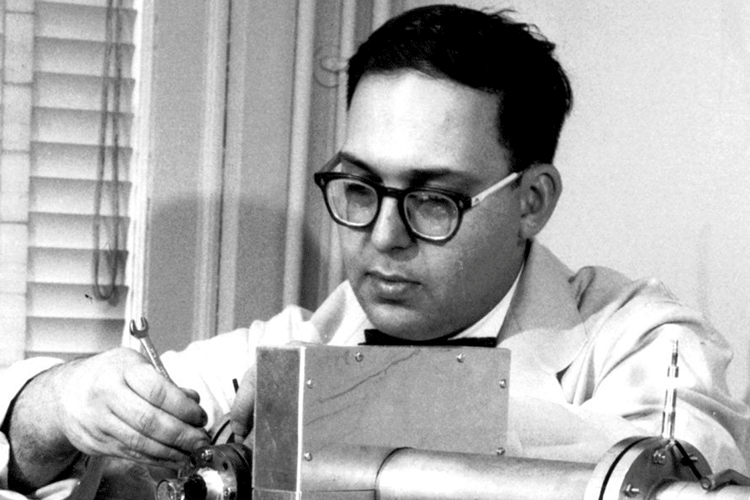
Len Levine early photo

Leonard (“Len”) Levine, professor emeritus, electrical engineering and computer science, passed away peacefully on May 25 at the age of 89.

Levine’s contributions to UWM and its College of Engineering & Applied Science were enormous during his more than 30 years of service to the institution. He is remembered by colleagues and former students not only for his key roles in helping UWM reconfigure to meet the rapidly changing needs of the Milwaukee community—he was instrumental in developing its now thriving Computer Science program—but for his extraordinary humor and dedication to students.

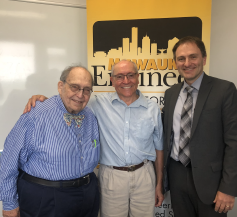
Len Levine, former student Ken Alix and Brett Peters, dean, UWM College of Engineering & Applied Science

“I will always remain grateful for his guidance and the inspiring example he set as an educator,” said Ken Alix, ’78 MS Electrical Engineering. (Alix retired from Intel Corporation, where for 23 years he worked as a senior process integration engineer in semiconductor manufacturing and technology transfer.)  In 2019, Alix created the Dr. Leonard Levine Scholarship in honor of his college advisor.

One of first people to know computer language and its potential impact on work

Levine grew up in New York City and received his bachelor’s degree in physics from Queens College and PhD in physics from Syracuse University. In a ballroom dancing class, he met Marilyn (1933 – 2010), the love of his life, knowing after just one dance that he would marry her.

After graduation, he was employed by Sperry Gyroscope and Honeywell Aerospace, outside of Minneapolis, where he worked on vacuum science and on one of the world’s first computers, a machine that nearly filled an entire room. He was one of the early people to use programming languages in research and to realize their potential impact on science, engineering, and society.

These experiences made Levine a powerful asset to UWM when he came to campus in the late ’60s, a time during which the young university was developing its engineering and computer science programs.

Service to students and UWM was “of the highest order”

At UWM, Levine helped develop and grow the Computer Science program and became an admired teacher and mentor to the many TA’s he supervised.

For many years, he served as the director of the university’s Computer Center and oversaw the development of the emerging computing resources for the entire campus.

He was also active in numerous campuswide committees and was a member of the Faculty Senate.

“Across campus, Len was a highly visible member of the College of Engineering & Applied Science, and his contributions were much valued,” said K Vairavan, professor emeritus, electrical engineering and computer science. “His service to the students and institution was of the highest order. He was a great colleague and will be deeply missed by those of us who had the pleasure to work with him and call him a friend.” 

Service continued after retirement 

Even after he retired in December of 1999, Levine continued to support those who wanted to learn.

In the community, he ran a weekly workshop for older adults at the Shorewood Senior Resource Center called If it Goes Beep, a free discussion on computers, digital cameras, telephones other technological devices.

At UWM, his support took the form of student scholarships designed to elevate the community by providing students with opportunities and affording them more study time. 

He and his wife, Marilyn Levine (’82 PhD Urban Education), created two scholarships for undergraduates. 

After Marilyn passed away, Levine established the Levine Science Fellowship Fund for graduate students.  

When asked why he created scholarship funds, Len said he was motivated by rising tuition costs and the fact that college students were graduating with debt. During his own undergraduate years, he recalled, he was able to devote himself to his education, studying at the counter of his family’s candy store in New York City.

“My goal is to create the time a student needs to devote to their studies and get the best education they can,” he said at the time.

If you would like to contribute to the Dr. Leonard Levine Scholarship for students in computer science, computer engineering and electrical engineering at UWM, please give at www.give.uwm.edu/levinescholarship or contact Jean Opitz at opitz@uwm.edu or 414-229-5603.