Renewable energy expert Deyang Qu named UWM Distinguished Professor

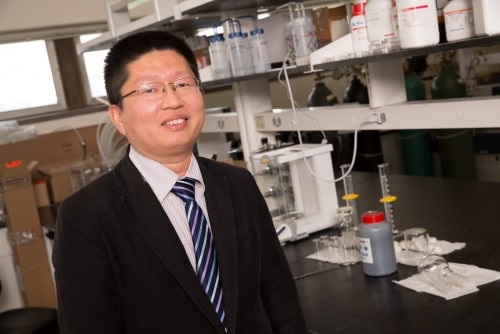
Deyang Qu

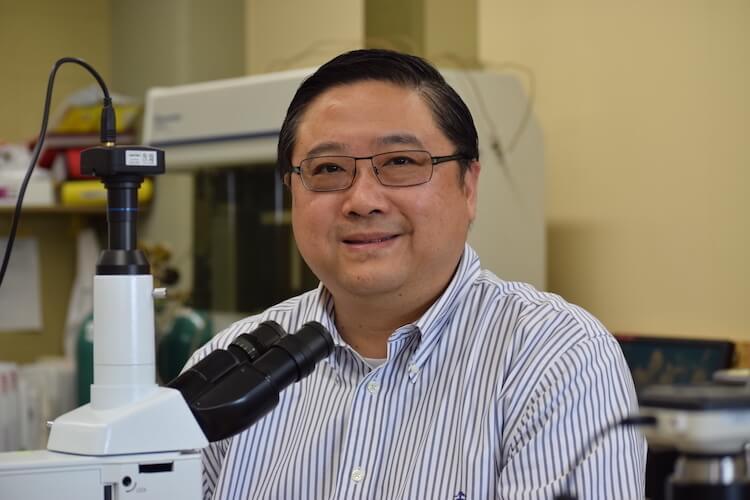
Deyang Qu, an internationally recognized energy-storage and renewable energy expert, was named a UWM Distinguished Professor in May. Qu is a Johnson Controls Endowed Professorship in Energy Storage Research and is chair of the Department of Mechanical Engineering in UWM’s College of Engineering & Applied Science.

At the pinnacle of their careers, UWM Distinguished Professors have had significant impact on their fields of study. With remarkable productivity, international reputations, and glowing testimonials from peers, they continue to make significant scholarly contributions to their disciplines.  

Qu has made extraordinary contributions to the electrochemistry and electrochemical engineering of next-generation batteries, including long-lasting lithium-ion, Li-Air and Li-sulfur batteries and capacitators such as those used in electric vehicles.

In layman’s terms, he explains that he applies his knowledge of chemistry and technology to advance electrification, which in turn burns less fossil fuel.

“If I can contribute to new battery technology by helping to create a battery that lasts significantly longer, that would be like hitting a home run,” he said. “Doing research that plays a part in turning around global warming became my passion.”

$10.4 million in funded research aimed at developing next-generation batteries

Since Qu joined UWM in 2015, his cutting-edge research has attracted nearly $10.4 million of grants from the National Science Foundation, the U.S. Department of Energy and Johnson Controls (now Clarios) and other industries including MilliporeSigma.

His research helped develop batteries that supported the then-emerging start-stop technology, which reduces vehicle fuel consumption and carbon dioxide emissions by about 5 percent. 

Supported by the U.S. Department of Energy, Qu has been engaging in the fundamental research of next-generation batteries for decades. Most recently, the department—through a subcontract from Pacific Northwest National Laboratory—awarded him a five-year, $650,000 grant to continue his successful three-year, $1.25 million contract to research solid-state Li batteries.

In 2020, Qu was listed in a ranking of the top 2% of scientists in the world in a study by Stanford University, which identified top scholars by considering how often their work has been cited over the course of their careers.

Qu is one of two active faculty members from the College of Engineering & Applied Science who have been named UWM Distinguished Professors; he is joined by Materials Science Professor Pradeep Rohatgi, whose research has had a profounds impact on cast metal matric composites.

3 NASA awards support Salowitz’s research and a student organization

Nathan Salowitz 750W

Nathan Salowitz, associate professor, mechanical engineering, recently received the following three awards from NASA through the Wisconsin Space Grant Consortium. The awards support Salowitz’s research and a UWM student organization.

  • A $25,000 award to support research into embedded inspection and structural health monitoring of pressurized water containers. This research will enable automated detection of damage and buildup to prevent catastrophic failures in such devices.
  • A $10,000 award to support research into the micromechanical properties of self-healing metal-metal composite materials that have an innate ability to repair damage. This research will specifically enable design and microstructural optimization of the materials.  Self-healing materials have the potential to fundamentally change how structures are designed by altering the definition of “failure” and leading to lighter-weight and longer-lasting structures and vehicles. 
  • A $2,400 award enabling students in the UWM chapter of Students for the Exploration and Development of Space to participate in the RockSat program, in collaboration with the Colorado Space Grant Consortium. In this program, students build a rocket payload that will be launched from NASA’s Wallops Flight Facility in Virginia.

UWM and Badger Technology receive Air Force renewable energy contract

Badger Technology Group and the UW-Milwaukee College of Engineering & Applied Science have received a contract from the United States Air Force Research Lab to produce, integrate and test a hybrid energy storage system at the Ellsworth Air Force Base in South Dakota.

This project supports the Department of Defense’s focus on energy resiliency through the increased use of renewable energy.

Badger Technology is supported in this program by the UWM College of Engineering & Applied Science Energy Advancement Center and the Center for Sustainable Electrical Energy Systems.

More in UWM Report.

More in Milwaukee Journal Sentinel.

Foundry Education Foundation awards record number of scholarships to UWM students

Foundry FEF

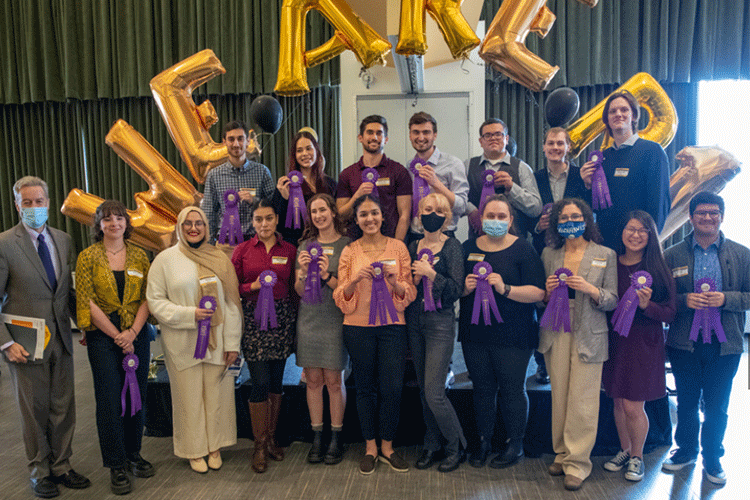
A record 17 UWM students received scholarships from the Foundry Education Foundation (FEF) this semester. “The foundry industry needs innovative minds to create materials that advance sustainability, health and medicine, aircraft, and space exploration,” says Pradeep Rohatgi, UWM distinguished professor, materials science & engineering.

Congratulations to the following students, who are studying diverse fields at UWM including architecture, biomedical engineering, computer science, materials engineering and mechanical engineering.

  • Ross Abrams
  • Telemachos Agoudemos
  • Cameron Ahles
  • Swaroop Behera
  • Masum Bellah
  • Owen Bellevage
  • Omid Ghaderi
  • Rosalba Huerta
  • Pradnya Narvekar
  • Luke Osvatic
  • Kaustubh Rane
  • Kaveri Salunke
  • Mason Steffe
  • James Veltri
  • Shreya Wadekar
  • Tien Wong
  • Pablo Zertuche Flores

FEF’s support helps UWM students secure internships and jobs

“One of the great pleasures has been to get over $200,000 in FEF scholarships to UWM students over the years, and to help them find jobs in Wisconsin and across the nation,” says Rohatgi, who has served as the university’s FEF key professor since 1996. 

These jobs have been with foundries – including Waupaca, Kohler Industrial Castings, Signicast, Grede, Badger Alloys, Spuncast, Stainless Foundry—and companies — including General Motors, Tesla, GE Aviation, Intel, Boeing, Oshkosh,and Lockheed Martin.

FEF certifies UWM’s Foundry Education Program. Scholarships are one way that the foundation supports students who want to master metallurgy and pursue careers in the foundry industry.

FEF also helps students find jobs in the foundry industry and supports the Foundry Lab at UWM.

Most students receive scholarships starting their freshmen year and continue to receive them until they graduate. Working as paid assistants, students also take part in research projects at the UWM Foundry.

Donor spotlight: Robert T. Balmer, family, friends, students and colleagues

Thank you to Robert T. Balmer, professor emeritus, mechanical engineering, and his family, friends, students and colleagues who together established the Dr. Robert T. Balmer Mechanical Engineering Scholarship for students enrolled in a program leading to a degree in mechanical engineering.

Balmer –a lover of culture, technology, history and philosophy– received the College of Engineering & Applied Science Outstanding Instructor Award three times— 1971, 1972 and 1988.

He joined the college in 1969, after a year as a NATO visiting professor at the University of Naples in Italy. At UWM, he established himself as an immensely popular instructor.

With a small grant from UWM he had made period-correct costumes; he then gave lectures dressed as historical figures famous for their contributions to astronomy, mathematics and engineering, including Galileo Galilei, Sir Isaac Newton, Daniel Bernoulli and Lord Kelvin. 

Over the years he co-taught courses on culture and technology in UWM’s departments of Philosophy and History, and he participated in the UWM Mortar Board Last Lecture Series providing insight into various socially taboo technologies.

After 30 years of service to UWM, Balmer accepted a position at Union College, in Schenectady NY, as dean of engineering and computer science. He returned to UWM after his retirement and has taught mechanical engineering courses since 2005.

Industrial experience, research

Balmer is the author of more than 100 articles on a variety of engineering topics, has published three engineering textbooks, and holds a US patent on a chemical-to-mechanical energy converter. He holds four academic degrees: a PhD in mechanical engineering from the University of Virginia, an MSE in mechanical engineering from the University of Michigan, a BSE mathematics and a BSE in mechanical engineering.

Outside of academia, he has worked for the Westinghouse Bettis Atomic Power Laboratory’s Nuclear Reactors Division, helping to develop the replacement nuclear core for the USS Enterprise, and the DuPont de Nemours, Inc.

Now at UWM, he is currently carrying out both theoretical and experimental research in a nonequilibrium thermodynamic phenomenon called “viscoelectric effect” that results from electrostatic generation in moving dielectric fluids.

If you would like to contribute to the Dr. Robert T. Balmer Mechanical Engineering Scholarship fund, please contact Jean Opitz, development director for the College of Engineering & Applied Science, at opitz@uwm.edu, or click here.

UW System awards Niu $50K to create green technology to support growing use of lithium-ion batteries

Junjie Niu

In May, Junjie Niu was awarded a $50,000, 12-month Ignite Grant from UW System to create a green technology to recycle and manufacture spent lithium-ion batteries. Niu is a Richard and Joanne Grigg associate professor, materials science & engineering, in UWM’s College of Engineering & Applied Science.

As the U.S. addresses the surging demand for lithium-ion batteries in the electric vehicle and cordless tool markets, huge amounts of used batteries will need to be recycled, Niu says.

In the next nine years, he says, the global recycling market for this type of battery is projected to grow from $4.6 billion to $22.8 billion. In this project, Niu will turn his attention to finding an eco-friendly way to do that.

His goal is to create lithium-ion battery manufacturing and recycling technologies that reduce energy consumption by 20 percent compared with traditional methods and significantly reduce the environmental impact caused by inappropriate management of associated waste.

Such technologies would provide Wisconsin industries with a low-cost, efficient way to recycle used batteries and use recovered cobalt, lithium, and manganese to be used in the manufacturing of new batteries.

UW System’s support of Niu’s green technology research

With funds made available by the state legislature and the governor, UW System Ignite Grants support applied research projects and prototype development that support economic development in Wisconsin. They are awarded each spring to a handful of faculty members from universities throughout the UW System. 

UW System’s financial support has advanced Niu’s eco-friendly discoveries in clean water technology and energy efficiency. Last year, for example, the system awarded him another 2021-22 Ignite grant to further his research to develop a hybrid material that chemically degrades per- and polyfluoroalkyl substances, or PFAS, which are pervasive, toxic man-made chemicals that don’t break down naturally in the environment or in bodies.

Thanks in part to UW System grants, Niu has filed invention disclosures, received funding from the National Science Foundation to further this research, and created a Milwaukee-based start-up company, Niu Energy, devoted to providing high-quality electrode materials for high energy-density lithium-ion batteries.

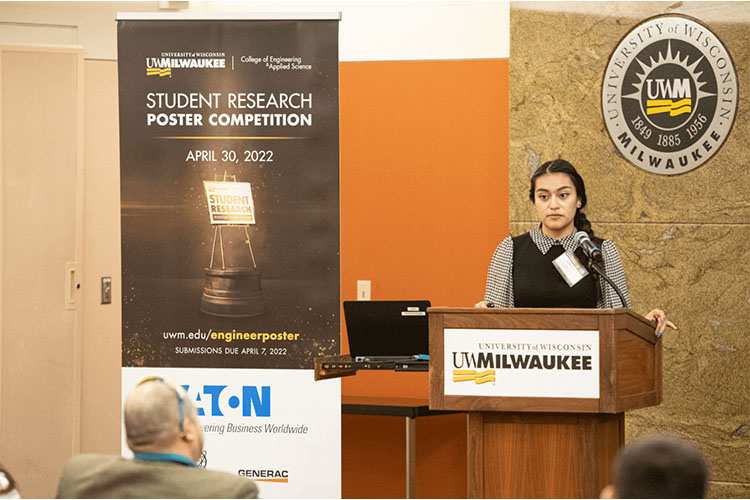
Winners announced for 2022 Student Research Poster Competition

Congratulations to the winners–and their faculty advisors– of the 2022 Student Research Poster Competition. This year’s competition drew 37 graduate poster submissions and 24 undergraduate submissions. Fifty-seven judges – industry employees and faculty members—volunteered as judges.

Graduate Awards

First Place
Dantong Qiu (Mechanical Engineering)
Faculty advisor: Deyang Qu, Johnson Controls Endowed Professor in Energy Storage Research

Second Place
Farah Nazifa Nourin (Mechanical Engineering)
Faculty advisor: Ryoichi Amano, Richard and Joanne Grigg Faculty Fellow and Professor, Mechanical Engineering

Third Place
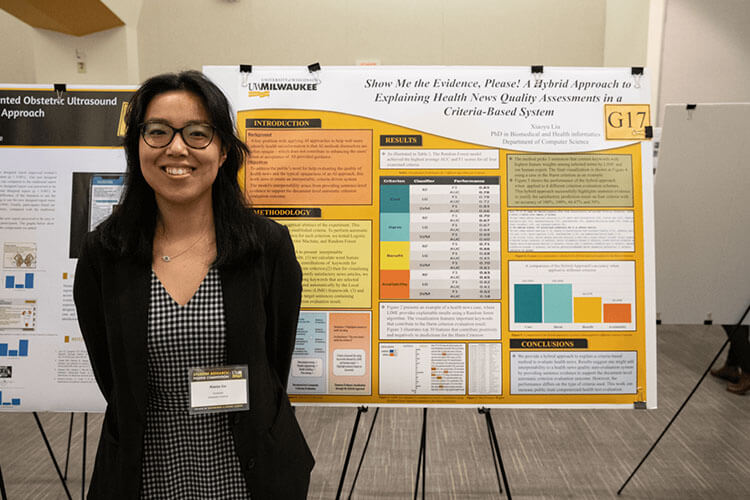
Xiaoyu Liu (Computer Science)
Faculty advisor: Susan McRoy, Professor, Computer Science

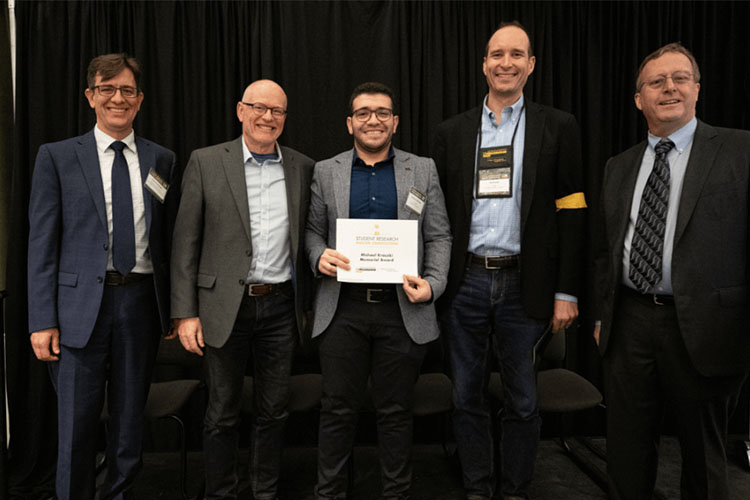
Student Choice Award & Michael Krauski Memorial Award
Mohamed Abousabae (Mechanical Engineering)
Faculty advisor: Ryoichi Amano, Richard and Joanne Grigg Faculty Fellow and Professor, Mechanical Engineering

Undergraduate Awards

First Place
Morgan Connaughton (Biomedical Engineering)
Faculty advisor: Mahsa Dabagh, Assistant Professor, Biomedical Engineering

Second Place
Diego Avila (Industrial & Manufacturing Engineering)
Faculty advisor: Matthew Petering, Associate Professor, Industrial & Manufacturing Engineering

Third Place
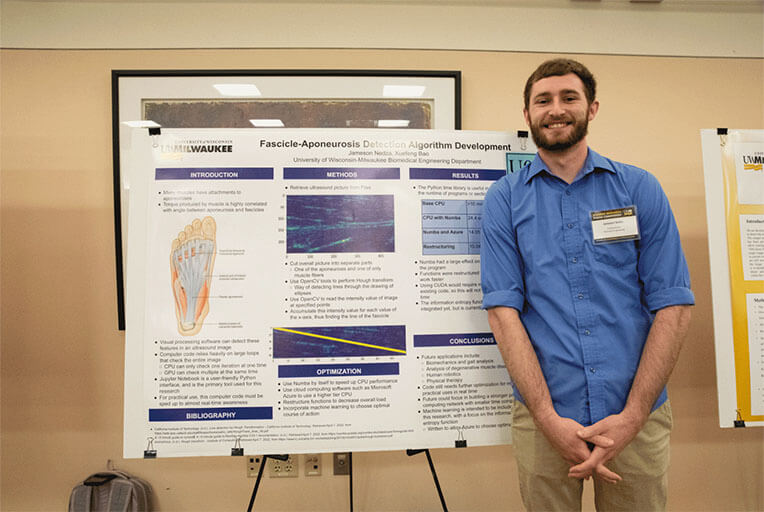
Jameson Nedza (Biomedical Engineering)
Faculty advisor: Xuefeng Bao, Visiting Assistant Professor, Biomedical Engineering

Student Choice Award
Rosalba Huerta (Civil & Environmental Engineering)
Faculty advisor: Konstantin Sobolev, Lawrence E. Sivak ’71 Faculty Fellow and Professor, Civil and Environmental Engineering

Mike Krauski Memorial Award

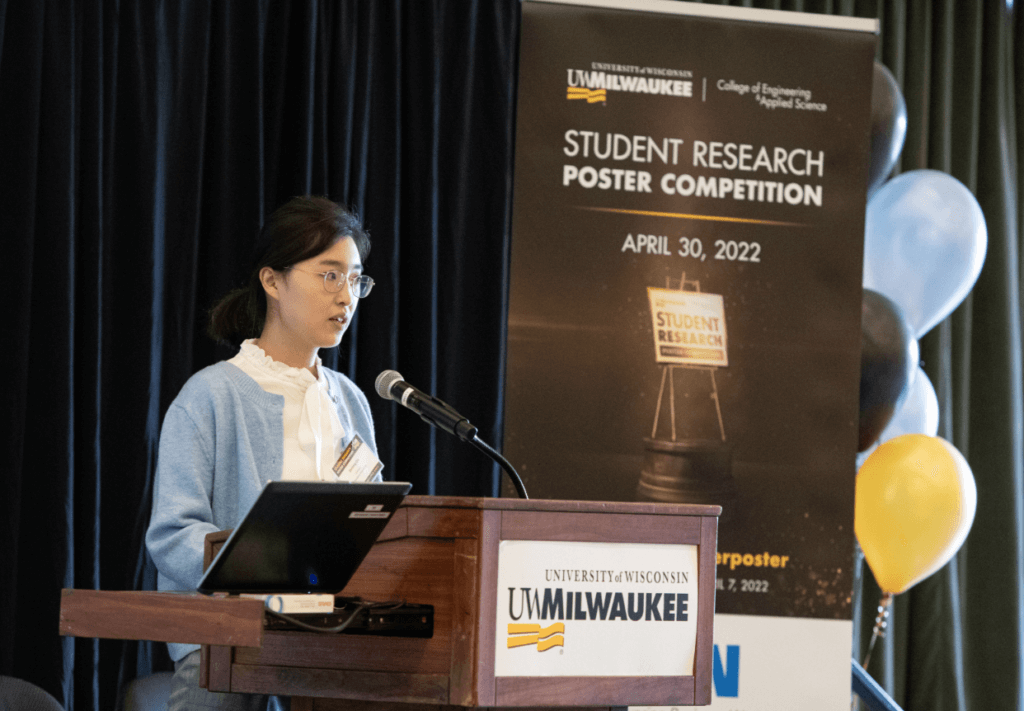
Mohamed Abousabae (Mechanical Engineering) is pictured above for the Graduate Student Choice Award.
Faculty advisor: Ryoichi Amano, Richard and Joanne Grigg Faculty Fellow and Professor, Mechanical Engineering  

Click here to view a full list of student poster entries. On this page, you can view all posters entered in the competition.

About the Student Research Poster Competition

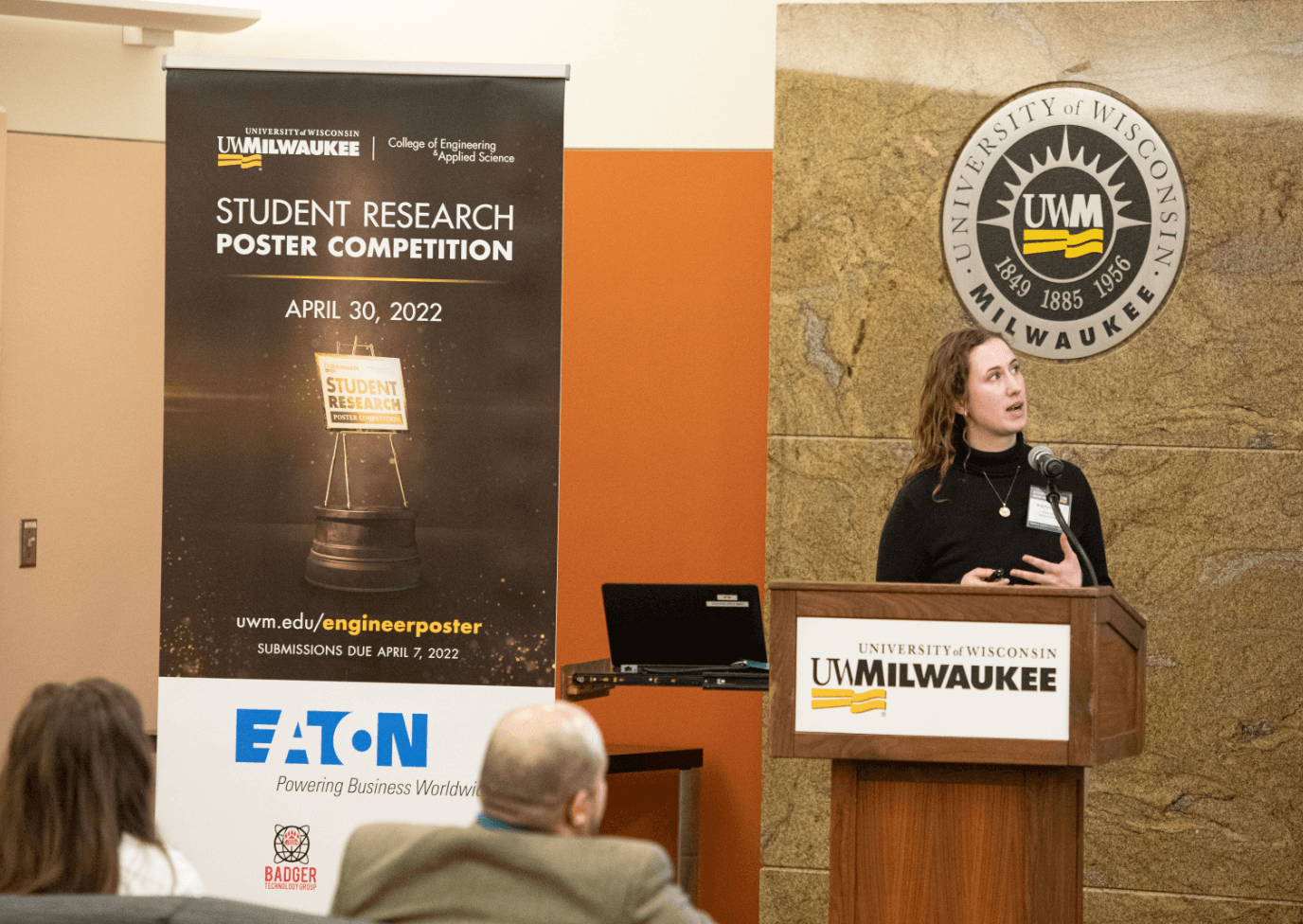
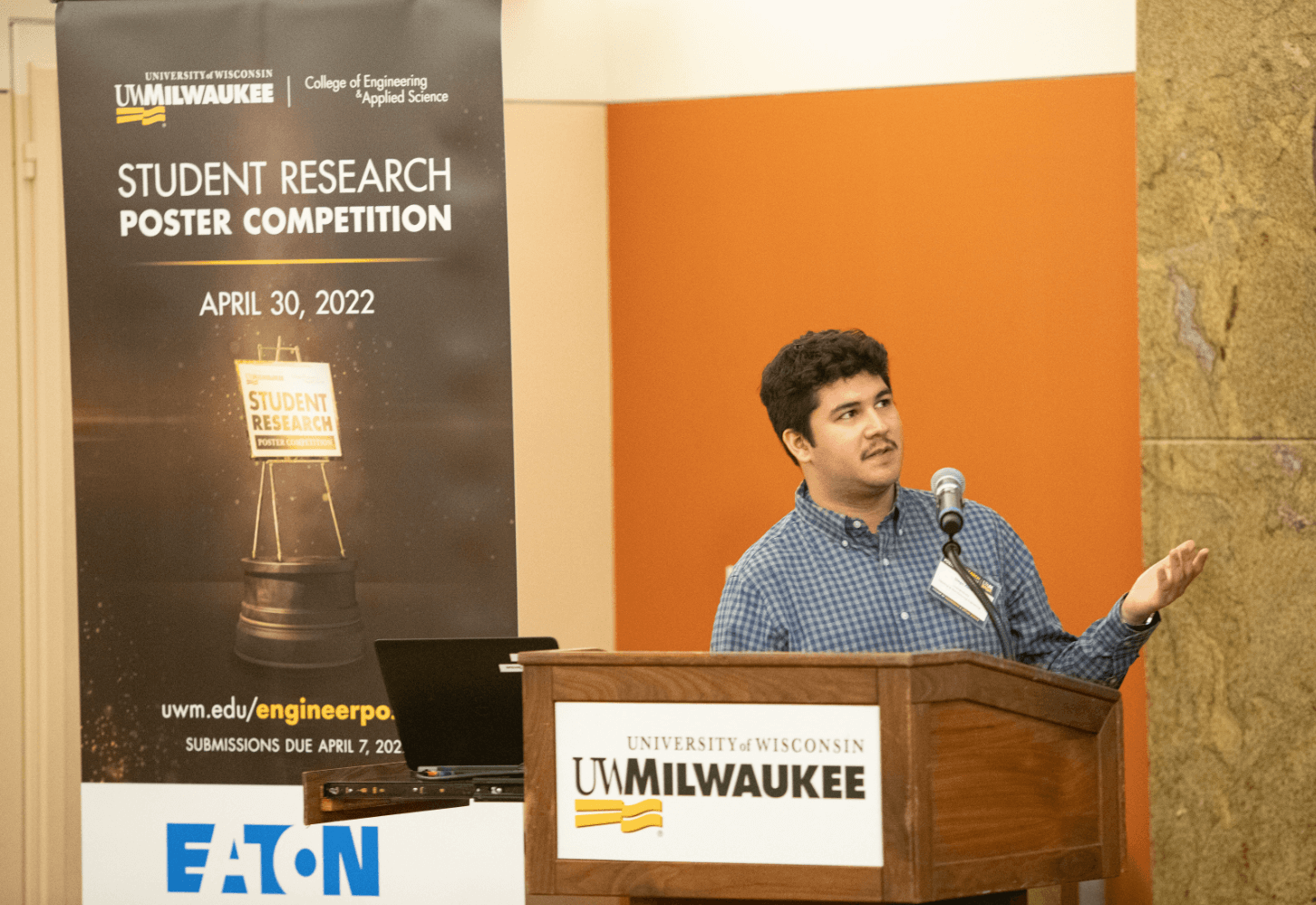
The college’s annual Student Research Poster Competition showcases the many ways UWM engineering and computer science students are addressing society’s challenges.

Now in its 14th year, this event illustrates the curiosity, passion and abilities of students who attend one of the nation’s top research universities—and the dedication of their faculty advisors who supported and inspired them in their research efforts.

Happy Judges

Each year, volunteer judges (including many alumni) from many companies graciously offer their time and expertise. Without them, this event would not be possible. If you think you might like to take part in the 2023 Student Research Poster Competition, please visit this page and click on the “Register to Judge in 2023.” We will get in touch with you as the 2023 competition takes shape.

Finally, the competition is made possible each year thanks to our industry partners. Thank you to Eaton, this year’s platinum sponsor, and Badger Technology Group, Generac, Graef Foundation, Siemens, Strattec, We Energies Foundation and the Family of Michael Krauski.

Five students earn the top award at UWM’s Undergraduate Research Symposium; supported by 4 faculty advisors in the college; Stern wins mentorship award

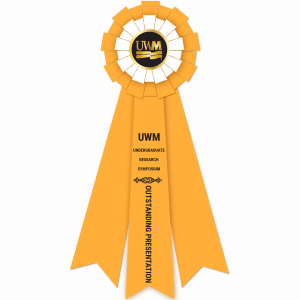
Five UWM students who worked with four faculty mentors from the College of Engineering & Applied Science earned Outstanding Presentation Awards at UWM’s 14th annual Undergraduate Research Symposium held April 29.

Nathaniel Stern, professor of mechanical engineering and art & design, won an award for Undergraduate Research Mentor of the Year.

The annual symposium celebrates the collaborations of undergraduate students with research-active faculty and staff across all UWM schools and colleges. This year, 280 UWM students (including 28 from the College of Engineering & Applied Science) entered the competition; 24 received Outstanding Presentation Awards.   

Congratulations to the following students and their faculty mentors. (For detailed information on all presentations from students who collaborated with faculty in the College of Engineering & Applied Science, click here.)

Student: Diego Avila
Major: Industrial & Manufacturing Engineering
Mentor: Matthew Petering, Associate Professor, Industrial & Manufacturing Engineering
Presentation: Overtime and Paid Leave Effects on Burnout: Conceptualizing an Anthroengineering Methodology to Predict Turnover

Student: Morgan Connaughton
Majors: Biomedical Engineering, Psychology
Mentor: Mahsa Dabagh, Assistant Professor, Biomedical Engineering
Presentation: Quantifying Impact of Organ-Specific Microenvironment on Cancer Cells

Students: Rosalba Huerta, Katelyn Sprandel
Majors (respectively): Materials Engineering, Materials Engineering
Mentor: Konstantin Sobolev, Lawrence E. Sivak ’71 Fellow and Professor, Civil & Environmental Engineering
Presentation: Study of Lunar Regolith Material in Concrete Systems for Construction

Student: Seth Krebs
Major: Chemistry
Mentor: Priyatha Premnath, Assistant Professor, Biomedical Engineering
Presentation: p21 Inhibition Improves Bone Regeneration

American Foundry Society presents Best Paper awards to 3 current UWM students, 2 alumni, 1 professor

Cast Expo 2022

Research coming out of the UWM Foundry Lab was recognized nationally with top honors at CastExpo 2022, held in Columbus, Ohio in April. 

Congratulations to members of the two research teams who won the following two Best Paper awards.

Best Paper, Molding Methods & Materials Division

Hannah Ullberg (’21 BS Materials Science), Kaustubh Rane (PhD student, Materials Science), Amir Kordijazi (’21 PhD Industrial Engineering) and Pradeep Rohatgi (UWM distinguished professor and Foundry Education Foundation key professor) authored a paper on a novel process to cast biomedical tissue scaffolds – a low-cost foam that could open new markets in biomedical applications and transportation systems.

Paper title: Cast Magnesium Foam for Energy Absorption and Bone Regrowth.
Read the published paper in Modern Casting.

Best Paper, Steel Division

Kaustubh Rane, Michael Beining (PhD student, Materials Science), Swaroop Behera (PhD student, Materials Science) Amir Kordijazi and Pradeep Rohatgi authored a paper that describes a new process of surface alloying to conserve critical alloying elements; the UWM Research Foundation has since licensed this process to Watts Water Technologies.

Paper title: Sand Casting of Surface-Alloyed Butterfly Valve with Improved Hardness and Corrosion Resistance by Incorporating Metal Powders in Mold Coatings.

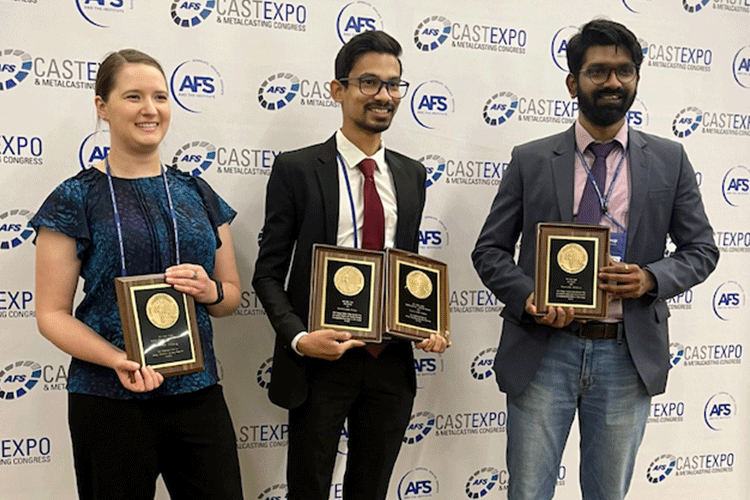
Three of the authors received their awards at a volunteer awards luncheon. (Pictured L-R: Ullberg, Rane, Behera.)

“It has been wonderful to see UWM students—who are doing foundry research—excel and win national awards,” Rohatgi says. Rohatgi has received numerous awards for research excellence from the AFS.

Linsmeier, Otieno, Rosenthal named to list of 2022 Notable Women in Engineering

Notable Women in Engineering 2022

The BizTimes Milwaukee named two of the college’s alumnae and one current professor to their list of 2022 Notable Women in Engineering. Congratulations to (pictured L-R):

  • Kristi Linsmeier, environmental engineering group leader for Milwaukee-based The Sigma Group
  • Wilkistar Otieno, chair and associate professor, industrial & manufacturing engineering
  • Lori Rosenthal, vice president, principal, and group leader at GRAEF’s Milwaukee headquarters.