UWM welcomes first Nadella scholarship winners; application open for 2023-24

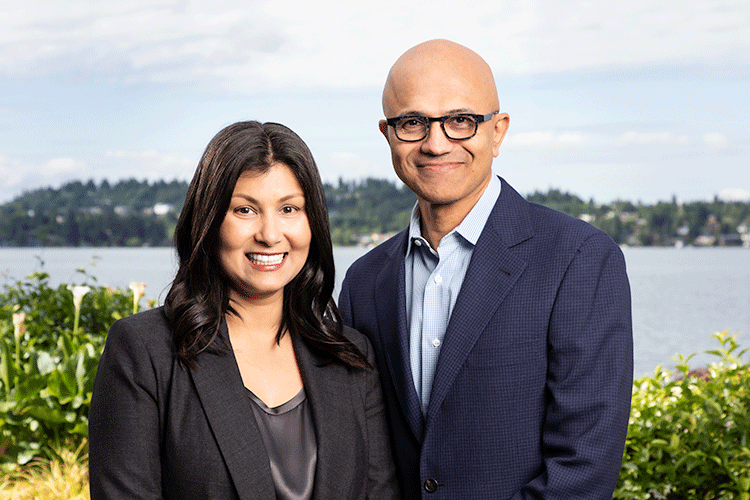
UWM celebrated the inaugural class of Anu and Satya Nadella Scholars at a welcome event recently at the Lubar Entrepreneurship Center.

Nine recent graduates from Milwaukee high schools were awarded full-ride scholarships to pursue tech degrees, which are being funded through a gift from UWM alumnus and Microsoft Chairman and CEO Satya Nadella and his wife, Anu Nadella.

The Nadellas’ $2 million gift supports the Fund for Diversity in Tech Education at UWM, which helps the university attract, retain and graduate undergraduate students from marginalized communities, preparing them with the skills to enter high-tech careers.

Of the nine recipients, eight are majoring in computer science while one is majoring in information technology management. More.

Applications are now being accepted for the 2023-24 class. The deadline is Dec. 1.

At UWM, female STEM students find support, opportunities at Grace Hopper Celebration

For the ninth consecutive year, UWM’s Computer Science Department supported female undergraduate and graduate students who wanted to take part in the annual Grace Hopper Celebration of Women in Computing. The event is the world’s largest conference for women in technology and supporting student attendance is one of the ways in which UWM champions female students in tech.

In September, 14 UWM students studying Computer Science, Computer Engineering, Electrical Engineering, Applied Math and Computer Science, and Information Science and Technology flew to Orlando to attend this event. The group was under the direction of Wilkistar Otieno, associate professor and department chair, industrial & manufacturing engineering.

“While women make up about 50 percent of the population, they account for a much smaller percentage of workers in STEM fields,” Otieno said. “Our attendance at Grace Hopper plays a role in helping our female students pursue computing careers and I was grateful for the opportunity to accompany the group.”

“This was an amazing trip”

This year, Grace Hopper attracted approximately 240 companies, 10 non-profit organizations and representatives of 85 graduate programs, many of whom held on-site interviews. Many UWM students interviewed and were offered internships or consideration for graduate programs.

The students experienced encouragement, support and empowerment, especially from notable keynote speakers and activists, including Brenda Wilkerson, the president and CEO of AnitaB.org, Daphne Koller, CEO and founder of Insitro, Anita Hill, professor of social policy, law, and women’s, gender and sexuality studies at Brandeis University, and Megan Rapinoe, U.S. Women’s National Soccer team star and recipient of the Presidential Medal of Freedom. 

“This was an amazing trip and I really appreciate the opportunity,” one student commented.

Financial support for attendance at Grace Hopper comes through the BRAID (Building, Recruiting and Inclusion for Diversity) program of AnitaB.Org, a non-profit institute that aims to recruit, retain and advance women in technology. The BRAID funds support diversity initiatives in the Computer Science Department.

Donor spotlight: Curtis C. and Maureen E. Lueck

When he was an engineering student at UWM, Dr. Curtis Lueck, P.E. (MS ’77, BS ’75) found a mentor in his thesis advisor, Edward Beimborn, now a professor emerit, civil & environmental engineering.

Beimborn, Curtis said, strongly influenced his education and career and provided the foundation for his professional success. Their professional relationship and personal friendship has lasted decades.

Thanks to provisions that Curtis and his wife Maureen Lueck (BA ’73 Mass Communication) made in their estate plan, Curtis will honor his mentor for years to come.

The couple’s gift is earmarked to establish and support the following three funds.

The Curtis C. and Maureen E. Lueck Fund will provide unrestricted support for the college, to be used as the discretion of the dean.

The Professor Edward A. Beimborn Scholarship Fund will provide scholarships to undergraduate students enrolled in a program leading to an undergraduate degree in civil engineering, with a concentration in urban transportation. The fund gives preference to students in financial need who graduated from Wisconsin high schools.

The Professor Edward A. Beimborn Fellowship Fund will support graduate students in the college who are enrolled in a program leading to a graduate degree in civil engineering, with a concentration in urban transportation. The fund gives preference to students who graduated from Wisconsin high schools or received their undergraduate degrees from UWM.

Now retired, Beimborn strongly believes that public transportation research deeply affects public policies.  Milwaukee native, he has studied urban transportation and traffic patterns worldwide, and served on numerous urban transportation and planning boards. His many honors and awards for his work include having his name added to UWM’s Spaights Plaza marker, one of the university’s highest honors and an enduring means by which UWM pays a timeless tribute to colleagues who have made significant and lasting contributions to the university.

“We hope that the endowment and scholarships honoring Professor Beimborn will perpetuate his legacy for generations of new transportation professionals,” Curtis said.

UW System to present Otieno with Outstanding Women of Color in Education Award

UW System has awarded Wilkistar Otieno, associate professor and department chair, industrial & manufacturing engineering, with a 2022 Outstanding Women of Color in Education Award. She was selected as the UW-Milwaukee honoree for this award and will be formally recognized in a ceremony at the UW-Madison campus on Nov. 10.

This high honor is given annually to faculty, staff, students, or community members to recognize their achievements in advancing equity and inclusion for people of color within the UW System as well as communities across Wisconsin.

“I am grateful to have been nominated for this award and very humbled to receive it,” Otieno said. “The award would not have been possible were it not for the opportunity to work at UWM with very supportive colleagues and amazing students.”

When she was hired in 2010, Otieno became the first Black female faculty member at UWM’s College of Engineering & Applied Science. In 2018, she was named chair of the college’s Department of Industrial & Manufacturing Engineering, the first Black woman to hold the position. Her successful collaborations during these years with Rockwell Automation contributed to the establishment of the Connected Systems Institute at UWM.

Otieno’s respect for all students has placed her among the favorite faculty members in the college. She has distinguished herself as a passionate educator, researcher, leader, collaborator, and champion for diversity, equity and inclusion (DEI).

Supporting a diverse STEM workforce through efforts at UWM 

In the college and campuswide, Otieno drives positive organizational change.

Currently, she is overseeing and coordinating DEI issues at UWM; in 2021, Chancellor Mark Mone appointed her as a special assistant for DEI issues for UWM’s 2030 Action Team, which provides a framework for the university to advance student success and fulfill its mission as a research and access institution. DEI issues are one of the plan’s eight priorities.

In 2016, she secured $1 million from the National Science Foundation (NSF) to fund a program at UWM that builds diversity in the STEM fields. The program– Preparing Engineers and Computer Scientists (PECS) – has provided scholarships, mentoring, research experience and internship opportunities to 45 highly talented students from underrepresented groups, all of whom faced financial challenges. Thanks to the program, the students were able to build a community of scholars as they complete their degrees in the challenging fields of engineering and computer science.

Twenty-four PECS students have graduated since the program opened its doors in 2017 and the rest are on the path to graduation.  

In addition, Otieno is a longstanding faculty mentor for UWM’s STEM-Inspired Program, which enhances learning opportunities for students majoring in science, technology, engineering and mathematics disciplines.

“It has been an honor work with my student mentees and have the chance to impact their research and scholarship,” she said. “I am very proud of their accomplishments.”

New event welcomes engineering, computer science students to college

Fall Welcome Fest Electric Vehicle Club

More than 500 students, faculty and staff took part in the college’s Fall Welcome Fest on Sept. 22. The lively new event aimed to help students meet faculty in their home departments, discover student organizations related to their interests, learn the various ways in which they can get academic support from the college, and meet friends.

As the outdoor plaza was unavailable due to the new chemistry building construction, the event was hosted for the first time inside the Engineering & Mathematical Sciences building. Students were encouraged to get stamps at stations throughout the first three floors of the building in exchange for prizes. Thanks to the 16 student organizations for staffing information tables and to all the faculty and staff who helped welcome students and distribute lunch from Jimmy John’s to make this first Fall Welcome Fest a huge success.

Qin joins WisDOT advisory committee to help Wisconsin plan for vehicles of the future

In September, Xiao Qin, professor of civil & environmental engineering and a Lawrence E. Sivak ’71 professor, accepted an invitation from Craig Thompson, secretary of the Wisconsin Department of Transportation, to serve on WisDOT’s Wisconsin Automated Vehicle External (WAVE) Advisory Committee.

The committee supports the development of a safe and efficient transportation system in Wisconsin at a time when Connected and Automated Vehicle (CAV) research and technological advances are moving forward at an incredible pace.

Specifically, they will review critical issues related to CAV research and make recommendations to WisDOT on planning priorities, implementation policies, and transportation system impacts.

Qin is renowned expert on highway safety and transportation data analytics

Qin is the director of UWM’s Institute for Physical Infrastructure and Transportation. He is a nationally renowned expert in transportation data analytics and highway safety whose research is supported by the National Cooperative Highway Research Program, the Federal Highway Administration, and WisDOT.

For several years, he has led UWM’s work with WisDOT on preparing for vehicles of the future, city planning, resource allocation, workforce development and technology transfer.

Engineering senior honored to meet U.S. vice president and represent Latino community

For Javier Retana Jr., the chance to meet and talk to the vice president of the United States was an honor and a chance to represent the Latino community.

Retana, a senior in civil engineering from Kenosha, is a first-generation university student and leads UWM’s chapter of the Society of Hispanic Professional Engineers. “My parents came here from small villages in Mexico, so they were excited that I had this opportunity,” he said.

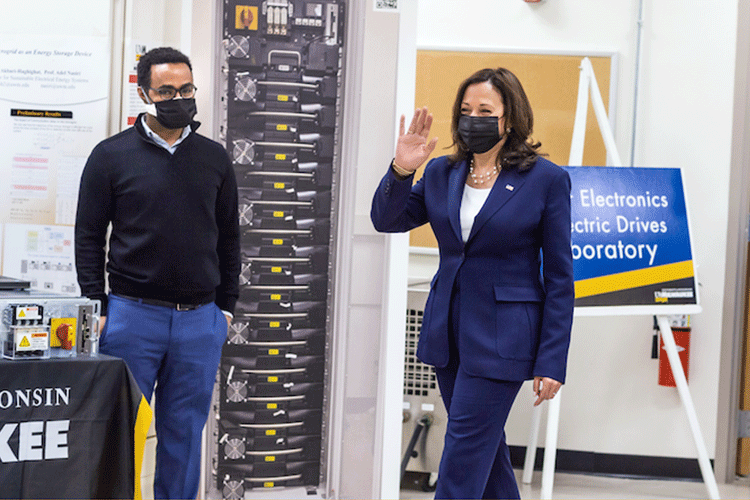
Retana was one of the participants in a roundtable on Hispanic community concerns who visited with Vice President Kamala Harris during her trip to the UWM campus Thursday, Sept. 22. More.

Milwaukee Tool joins college to offer heavy-duty recruitment day at UWM

Twelve Milwaukee Tool employees—all CEAS alumni—and a human resource rep—an alumna from Lubar School of Business—were on the EMS plaza Sept. 21 to help engineering and computer science students learn the wide variety of employment opportunities available at Milwaukee Tool.

Traditionally, the power tool industry has hired mechanical engineers to design mechanisms and deliver the end product, said Andy Davis (BS 2004, Electrical Engineering) group manager, platform IOT at Milwaukee Tool. “Today’s event is meant to show how our mechanical engineers work on teams with electrical engineers, computer engineers, and computer science majors to design and deliver modern cordless power tools.”

The event was arranged by Davis and Juli Pickering, career development manager for the college.

Through Office of Naval Research, Park awarded $148K to study partial discharge in power electronics

Chanyeop Park, assistant professor, electrical engineering, will receive $148,000 over two years in sub-contracted funding from Mississippi State University. The funding is part of a contract that MSU received from the Office of Naval Research.

In this project—Development of Electrets as a Solution to Partial Discharge in Power-Electronics-Driven Shipboard Power Systems—Park will research a solution to mitigate partial discharge in power electronics in shipboard power systems.

Park’s expertise is securing dielectric integrity of future of power technologies

Park joined the college in August. His research has focused on securing the dielectric integrity and preventing the aging of next-generation power and energy technologies. Specifically, he has aimed to identify, characterize, and address existing knowledge gaps and challenges that are emerging with the advances in power electronics, renewable energy, electric ships, electric aircraft, and soft electronics, which can be reformed or reshaped.

Sobolev, Zhao will collaborate with University of Texas at Arlington on $1.5M NSF grant that supports consortium to decarbonize concrete industry

Konstantin Sobolev and Jian Zhao

Konstantin Sobolev, Lawrence E. Sivak ’71 Faculty Fellow and professor, civil & environmental engineering, and Jian Zhao, associate professor, civil & environmental engineering, will collaborate with the University of Texas at Arlington and a consortium of European universities on a project that ultimately aims to mitigate concrete’s role in global warming.

In September, a $1.5 million National Science Foundation grant launched a project—Advancing International Partnerships in Research for Decoupling Concrete Manufacturing and Global Greenhouse Gas Emissions—that will support the creation of a multidisciplinary consortium in the U.S. and Europe dedicated to technological advancements to decarbonize the concrete industry. It is being led by investigators at the University of Texas at Arlington.

The grant comes from NSF’s Partnerships for International Research and Education (PIRE) Program, which enables international collaborations in research and education to advance scientific solutions to daunting global challenges.