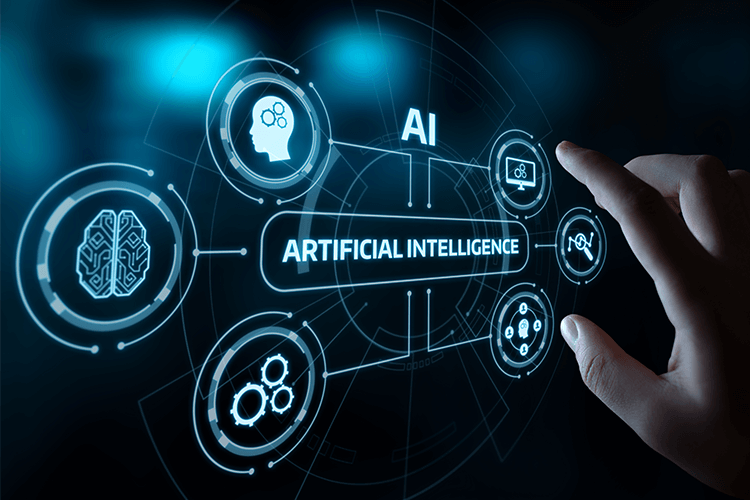
Computer science and artificial intelligence research at the UWM College of Engineering & Applied Science reflects our tenacity, confidence and ambition to solve real-world problems.
UWM is a proud R1 research-oriented university, and our faculty and students push boundaries in AI, data science, cybersecurity and software systems to create technologies that improve lives, strengthen communities and drive innovation.
This research combines strong fundamentals with hands-on discovery, giving students opportunities to work alongside faculty on cutting-edge projects with real impact. Through collaboration with industry, healthcare and government partners, ideas move beyond the lab and into practical solutions.
At UWM, computer science and AI research isn’t just about what’s next in technology—it’s about the confidence to lead, the ambition to innovate and the tenacity to make meaningful change in a rapidly evolving digital world.
Computer Science Research Areas
Artificial Intelligence & Machine Learning
Learn how computers understand language, recognize patterns, and make smart decisions.
AI and machine learning
Natural language processing (chatbots, text analysis)
Intelligent agents and automation
AI applications in healthcare
Data Science & Big Data
Use data to solve real-world problems, especially in health and science.
Data science and analytics
Health and biomedical data
Predictive modeling
Text and data mining
Cybersecurity & Secure Computing
Protect data, systems, and AI technologies from cyber threats.
Cybersecurity fundamentals
Secure and distributed systems
AI system security
Edge and cloud security
Software Systems & Programming
Build reliable, efficient software and understand how programming languages work.
Programming languages and compilers
Software correctness and testing
Concurrent and parallel programming
Specialized programming languages
Algorithms & Computer Science Foundations
Learn the core problem-solving skills behind all computing technologies.
Algorithms and data structures
Graphs and networks
Optimization and problem-solving theory
Computer Graphics, Vision & Virtual Reality
Create and interact with digital worlds and visual data.
Image processing and computer vision
3D graphics and visualization
Virtual and augmented reality
Interactive and immersive environments
Robotics, Games & Intelligent Systems
Design systems that sense, move, and interact with the real world.
Robotics and motion planning
Internet of Things (IoT)
Game design and intelligent simulations
Advanced Computing & Smart Devices
Explore how computing works at the smallest scales.
Smart sensors and devices
Nano-enabled technologies
Energy-aware and connected systems
Computer Science Research Centers and Labs
The Big Data Analytics and Visualization Lab is focused on developments of new computational approaches and software tools for various types of massive data processing, data mining and visualization using both knowledge-based and data-driven techniques.
The Connected Systems Institute (CSI) accelerates innovation by bringing together industry and academic researcher to facilitate digital transformation for small and medium-sized manufacturers, ultimately developing an educational curriculum to better prepare the workforce of the future.
The Data Science and Artificial Intelligence Laboratory (DSAIL) develops computational approaches that combine human expertise with data-analytic models to solve complex problems, such as improving health outcomes.
A benefit of attending a top tier R1 research university is the opportunity to work with faculty engaged in cutting-edge research. This could include participating in the Support for Undergraduate Research Fellows (SURF)program. The SURF program helps you to improve your professional preparation through research by working closely with our faculty to explore, discover, and transform ideas into reality.
SURF students also receive funding for their efforts: from 2012-2023 almost $1.5M was awarded to over 700 students from our college.