Evinrude supports UWM’s School of Freshwater Sciences
Two new graduate fellowships at the UWM School of Freshwater Sciences will be supported by BRP USA, which makes powersports vehicles and propulsion systems.
News from the University of Wisconsin-Milwaukee
Two new graduate fellowships at the UWM School of Freshwater Sciences will be supported by BRP USA, which makes powersports vehicles and propulsion systems.
A fountain and green space at the Greenfield Avenue and First Street intersection will beautify the neighborhood while cleaning the environment.
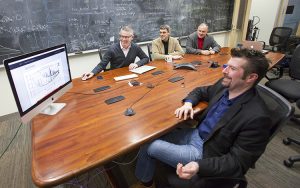
UWM physicists are part of an international team that has detected gravitational waves for a second time.
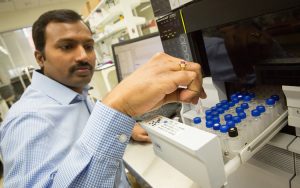
New drugs under development by UWM scientists, who are working through the Milwaukee Institute for Drug Discovery, could eventually change millions of lives.
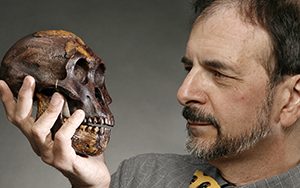
Andrew Petto, senior lecturer in the UWM Department of Biological Sciences, received a Friend of Darwin Award from the National Center for Science Education. The award recognizes outstanding contributions to advancing the teaching of evolution and climate science. A pioneer in evolution literacy, Petto helped advance education standards in Pennsylvania and Wisconsin, and helped local […]
UWM researchers are among those being honored for the detection of gravitational waves in space, a discovery announced earlier this year. The international group of more than 1,000 contributing scientists and engineers won the Special Breakthrough Prize in Fundamental Physics. Founded by Sergey Brin and Anne Wojcicki, Mark Zuckerberg and Priscilla Chan, Yuri and Julia […]
More than 250 UWM students from across disciplines presented results of their research on April 29 at the annual symposium sponsored by the UWM Office of Undergraduate Research. The projects included oral and poster presentations – and even a dance performance – on topics as diverse as the AIDS virus in green monkeys, tiny houses […]
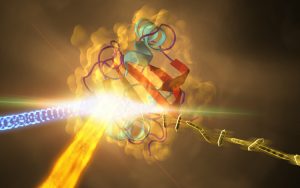
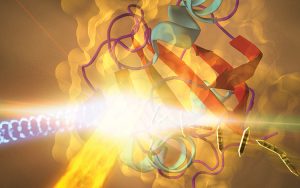
UWM researchers used a groundbreaking experiment to observe molecular changes with unprecedented detail and speed.
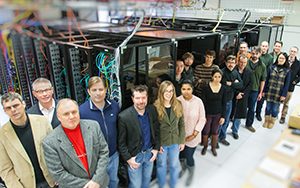
UWM physicists have created a machine-learning algorithm that improves the accuracy of timing estimates by a factor of up to 300.
UWM researchers Marius Schmidt and Jason Tenboer harnessed X-Ray Free Electron Laser technology and became the first people to witness proteins changing in real time.