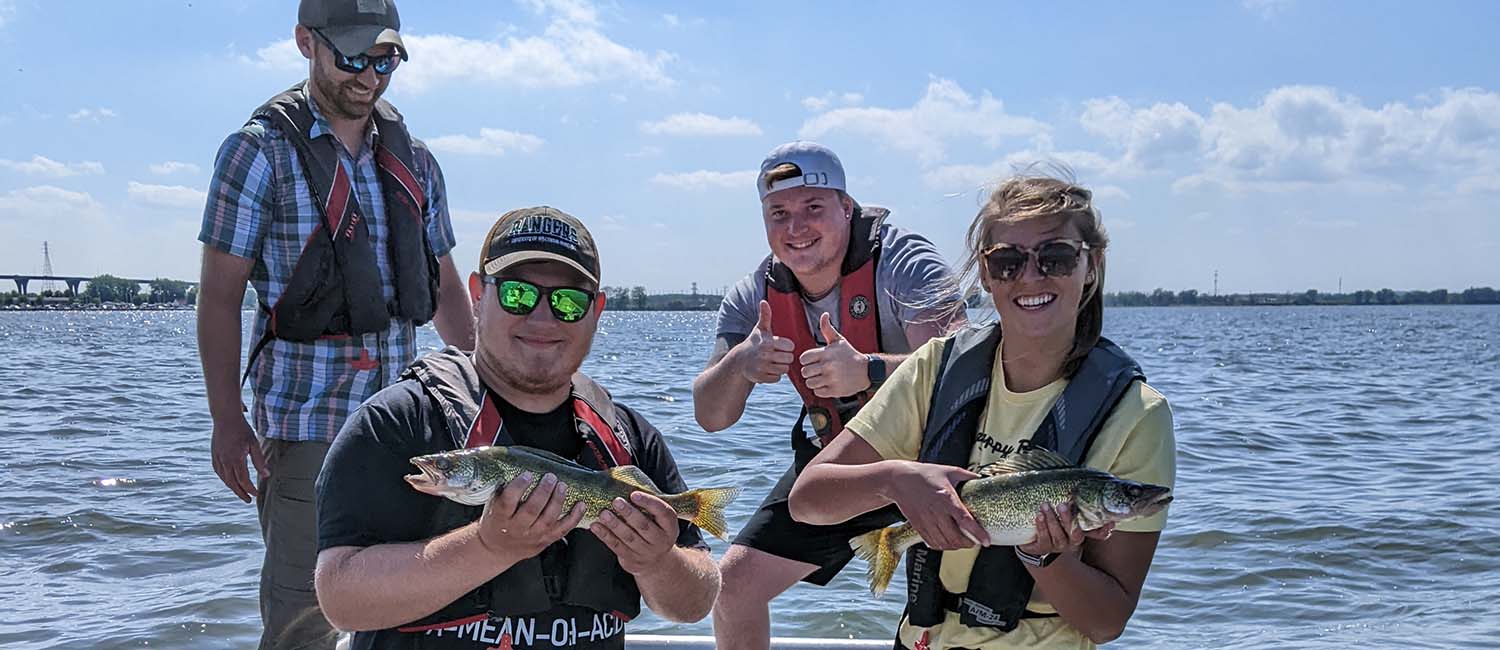
Are you ready to dive into an unforgettable summer experience? The School of Freshwater Sciences at UWM offers a unique lineup of courses designed for undergraduate students eager to explore the world of weather and freshwater science. These courses will help you build valuable skills and make meaningful connections in a rapidly growing field. Whether you’re passionate about weather phenomena, exploring Lake Michigan, or learning about the important of fresh water, there’s something for you.
Click below to learn more about each course and start planning your summer adventure today!
Enrollment opens on March 30, 2026
FRSHWTR 101, 3 credits
Course runs June 15 – July 27, MTWR 9:00am-10:40am
Instructor: Samir Qureshi
Course description:
The most important natural resource on Earth is freshwater. This course will address the importance of water in biological, ecological, physical, climate and economic systems, and the consequences of distributing the natural water cycle.
This course meets the NS General Education Requirement and is open to high school students enrolled in the Early College Credit Program.
Course format:
This is an in-person course.
Enrolling: Students interested in this course can enroll via PAWS. Students not enrolled at UW-Milwaukee must enroll as a guest student first.
Human Interactions with Lake Michigan Coastal Ecosystems (FRSHWTR 300, section 101), 3 credits
Course runs June 8 – July 3, 2026
Instructors: Dr. John Janssen (UWM), Liz Sutton (UWM), Dr. Chris Houghton (UWGB)
- Week 1 (June 8-13) – Online
- Week 2 (June 15-19) – In person in Green Bay
- Week 3 (June 22-26) – In person in Milwaukee
- Week 4 (June 29-July 3) – Online
Course description:
Great Lakes ecosystems are unique among freshwater systems due to their large size and depth, with consequent strong influences of hydrodynamic phenomena such as currents and waves that are, at times, dangerous. Their large size means that they support diverse industries and often large populations, much rarer at inland lakes. There are also adverse impacts due to wastewater, including sewage and runoff from urban and agricultural areas. In addition, the Great Lakes support a variety of recreational activities including world-class angling (that is sometimes in conflict with commercial fisheries), boating, beach activities, bird watching, and passive uses such as scenic viewing. The ecosystem services provided by Lake Michigan often result in conflicting uses (e.g., need for stormwater management and environmental preservation), ramifications of which can be exacerbated by climate change and its own unique physio-chemical dynamics.
The purpose of this course is to facilitate a greater understanding of human impacts on Lake Michigan coastal ecosystems. Students will explore the land/sea interface with a focus on urban vs rural changes and habitat/habitat potential as we move from north (Green Bay, Peshtigo, Manitowoc, Sheboygan) to the south (Milwaukee, Racine, Kenosha) along the coast. The land/water interface is often a site of physical (anthropogenic) alterations which can exert environmental stress as well as act as a conduit for pollutants that may result in habitat degradation, health risk, and loss of utility. Important anthropogenic stressors and the associated habitat and community dynamics will be discussed including Polychlorinated Biphenyls (PCBs), Perfluorinated Alkyl substances (PFAs), fecal pollution, sedimentation, hypoxia/non-point nutrients, and impacts of stormwater/wastewater discharge and coastal erosion. Hands-on experiences will demonstrate why technical expertise is important. Interactions with diverse faculty and local practitioners will provide insight into potential academic and career opportunities.
What’s Included:
Meals during class time and lodging are provided at no cost, thanks to support from the Freshwater Collaborative of Wisconsin.
Prerequisites:
You’ll need to have completed courses equivalent to UWM’s BIO SCI 150 (Foundations of Biological Science I) and CHEM 100 (Chemical Science). Science educators, please contact Mallory Kaul (malkaul@uwm.edu) for enrollment instructions.
Enrolling:
This course is open to undergraduate students from any accredited college or university, or science educators. There is a limited number of 12 seats available.
Questions? Contact Mallory Kaul at malkaul@uwm.edu.
Expedition to Great Lake Michigan (FRSHWTR 300, section 102), 1 credits
Course runs June 1-5, 2026 – 8am-5pm
Instructors: Cpt. Maxwell Morgan, Dr. Ben Peterson
Course description:
Learn the fundamentals of working on a Great Lakes vessel and operating Great Lakes research equipment. This course provides a broad range of training ranging from line handling and winch operation to the deployment of water quality instruments. Gain hands-on experience while aboard the R/V Neeskay and earn a Marine Technician micro-credential certificate while also exploring the ecology of Lake Michigan. This course meets the requirements for the Deck Operations Certificate through the Marine Technology Society. Upon demonstrating your competency, you will be awarded a digital badge that demonstrates your skill set to employers. Badges are a transferable symbol used to verify the attainment of specific competencies and can be added to resumes, LinkedIn profiles, and other social media platforms as instant recognition of your personal skill set. Students interested in this certificate should notify the School’s Head of Academic Services, Mallory Kaul (malkaul@uwm.edu).
What’s Included:
Lunch will be provided; lodging can be coordinated on an as-needed basis for students enrolling outside the Greater Milwaukee area. Students requiring lodging should contact Mallory Kaul (malkaul@uwm.edu) prior to enrolling.
Prerequisites:
You’ll need to have completed courses equivalent to UWM’s BIO SCI 150 (Foundations of Biological Science I) and CHEM 100 (Chemical Science).
Enrolling:
This course is open to undergraduate students from any accredited college or university. There is a limited number of 10 seats available.
Questions? Contact Mallory Kaul at malkaul@uwm.edu.
ATM SCI 109, 3 credits
Course runes June 15 – July 25
Instructor: George Duffy
Course description:
The phenomenology and dynamics of exciting severe weather phenomena, including tornados and hurricanes, is addressed in this introductory level course. It is a one-term course for interested students including business, engineering, life and social sciences, and liberal arts majors, as well as prospective elementary school teachers. The course provides a brief introduction to the composition, structure, energetics, and circulation of the atmosphere, as well as to the analysis of weather systems. This is followed by an in-depth examination into the physical principles and phenomenology of severe weather events. The course introduces the scientific method and emphasizes the importance of meteorology in the modern world.
This course meets the NS General Education Requirement and is open to high school students enrolled in the Early College Credit Program.
Course format:
This course is delivered fully online, and will not have a designated virtual meeting time; computer & internet access required.
Enrolling:
Students interested in this course can enroll via PAWS. Students not enrolled at UW-Milwaukee must enroll as a guest student first.