Howdy, BugFans,
Another day, another crab spider. This time, it’s the Metallic Crab spider, and while it may resemble last week’s Whitebanded crab spider (family Thomisidae), it’s in a whole, different crab spider family, Philodromidae, the Running crab spiders. Philodromidae comes from a Greek word meaning “lover of the race/course,” a name that fits these speedy spiders. Philodromids’ legs are long, with the second pair a tad longer than the first. There are two large genera in the family, and they have very different looks – Philodromus spiders are “chunky,” and Tibellus (the Slender crab spiders) are not.
Philodromus genus members have distinctively-flattened abdomens, and their eight eyes are small and set in two rows. While they are fast runners, they are also good hiders, escaping from predators by ducking onto the underside of a leaf or by relying on their natural camouflage as they freeze against bark, leaf litter, rocks, or vegetation.
For “Philodromidae 101,” see Running Crab Spiders – Field Station.
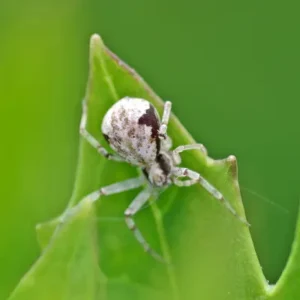
METALLIC CRAB SPIDER (Philodromus marxi). There are 55 members of the genus Philodromus, and they can be hard to tell apart. As one source said about the Metallic crab spider, “There are so many Philodromus, we haven’t been able to figure out if this pattern is distinct to one species yet.” So, Metallic crab spider – probably. The name is not one you would come up with from looking at the gray, “felty” female (sometimes described as “bristly” and sometimes as “soft”), but it turns out that this species is named after the (sexually dimorphic) male, who, if he’s not exactly metallic, is certainly shiny, often with a purplish or orangish cast. Males have long legs (the better to hunt females with, my dear), and females have large abdomens (the better to produce eggs with).
Look for them from East Texas to Wisconsin to the Atlantic, in woodlands, edges, sunny openings, and suburbia; on tree trunks, walls, and low vegetation; and in orchards and gardens. Juveniles prefer the cover of leaf litter on the ground, while adults cling to low vegetation.
Like last week’s Whitebanded crab spider, the Metallic crab spider does not spin a trap web for food (though both do use silk for draglines and egg sacs), but catches its prey “on the hoof,” detecting it by sight or by vibration. It feeds on small flies, aphids, beetles, and soft-bodied invertebrates it finds on leaves or in leaf litter. Like other spiders, it is pest control on the hoof.
Metallic crab spiders occupy the first half of summer. Males wander the landscape looking for females, and when they find one, they court by waving their legs and sending out vibrations. Females make one or more egg cases that they guard, often until the eggs hatch. The spiderlings emerge a little later in summer and molt a few times before overwintering as juveniles (which explains their maturity in spring). Adults may live as long as two years.
The Metallic crab spider was named for George, not Karl, Marx, an arachnologist who was born in Germany, earned degrees in both medicine and pharmaceutical studies, and served in the American Civil War. George Marx (1838 – 1895) moved to Philadelphia after the war, and there he became enthralled with spiders. He worked as a scientific illustrator for the US Department of Agriculture in 1878 (some considered him the best scientific illustrator of his time) and later headed the USDA’’s newly-formed Division of Illustrations, all the while continuing to collect, study, and publish manuscripts about spiders. Like many of the pioneering natural historians, he was a polymath – Wikipedia lists him as an entomologist, arachnologist, pharmacist, physician, scientific illustrator, and collector.
.jpg)
The BugLady