Howdy, BugFans,
Here’s a rerun from 2010, with a few new words and pictures.
The BugLady would like to state up front that this episode is about “pennants” (as in “small flags”), not about “penance,” which is between BugFans and their deities.
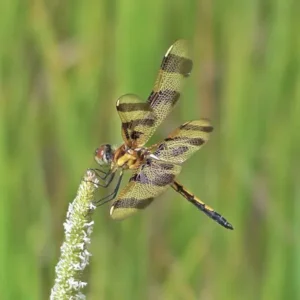
After the awesome Slaty Skimmer, some of the BugLady’s (many) favorite dragonflies are the Calico and the Halloween Pennants. The Pennants are the stuff that tattoos are made of (someday). The internet agrees; it’s light on Pennant information and heavy on Pennant pictures, but they are eye candy!
The BugLady enjoys the challenge of photographing these jumpy beauties – standing out in the field on a hot, breezy day, sweat trickling down her back, hoping for that moment of calm as the Pennants wave back and forth on the grass tops (the reason for the “pennant” part of their name is that they resemble tiny flags streaming off the weeds). Good times. In Dragonflies and Damselflies of the East, Dennis Paulson writes that, “their disproportionately long hind legs are “probably an adaptation for keeping the abdomen horizontal while tip-perching.”
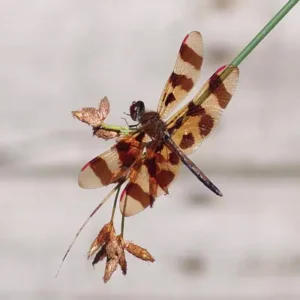
Pennants are smallish dragonflies in the genus Celithemis, in the Skimmer family (Libellulidae) and there are just eight species in the genus. Most members of the genus are southeastern, but the ranges of the Calico and the Halloween Pennants take them into the Great Plains. The Halloween and the Calico have spots in their wings and reddish eyes. The Halloween’s wings are tinted an orange-ish-yellow; the un-tinted wings of the Calico have fewer spots, but males have a spot at the base of each hind wing. Both are found near water for egg-laying but may stray far from water to forage.
When naturalists explain the differences between dragonflies and damselflies, we tell people that damselflies can fold their wings over their bodies or hold them in a backwards-pointing “V” along their sides (the Spreadwings, genus Lestes), but dragonflies must hold their wings straight out to the side. The Pennants didn’t get the memo – perched, they often hold their front wings at a different angle than their hind wings, with their wings in several planes.
They are found near/lay their eggs in slow-moving to still waters Halloween Pennants coupled – Celithemis eponina – BugGuide.Net. Several sources said that the young/naiads Dragonfly larva, Calico Pennant – Celithemis elisa – BugGuide.Net of these Pennants are not very competitive, and as such they are more successful in newer waters (borrow pits, ditches, etc.) than in waters with lots of established predators. The naiads are great vegetation climbers and not-so-great swimmers.
Insects are cold-blooded, their internal temperature similar to the temperature of the air or water that surrounds them, and they appreciate a jump-start from the sun to get the juices flowing. But, cold-blooded or not, too much sun is too much sun. It is thought that the Pennants’ wing spots cast some much-needed shade on the thorax of this open-country percher. An alternate suggestion for the spots at the base of the Calico’s hind wings is that the dark color absorbs heat and warms the insect’s thorax (and, by extension, its wing muscles). Several sources mentioned that the thorax of the pennants is “reduced” without elaborating on what that means for the dragonfly. Is there a connection between a smaller thorax and the need to heat it? Don’t know. Do they have reduced wing muscles? Unlikely, when you consider their activities.
To minimize the amount of sun that hits their body, some kinds of dragonflies (about 10% of species, including the Calico and especially the Halloween Pennants) perch in a “tail-up” posture called the “obelisk position” (Calico Pennant Male – Celithemis elisa – BugGuide.Net). They will rotate their body to maintain the correct angle as the sun moves. But, a dragonfly with its abdomen raised may also be assuming a threat position, or if the sun is waning, may be trying for more sun exposure.
Dragonflies are unapologetic carnivores as aquatic naiads (catching with their extendable mandibles anything in the water that is smaller than they are), and as adults (catching with their spiny legs anything airborne that is smaller than they are).
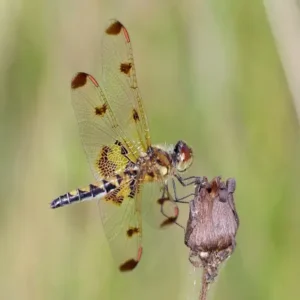
CALICO PENNANTS (Celithemis elisa) are called “Elisa Skimmers” in some books. They are small dragonflies (less than 1 ¼” long), locally common in shallow water and slow streams with emergent plants east of the Great Plains. Females and juveniles are decorated with a yellow face, yellow stigmas (the solid, pigmented spot toward the tip of the wing), and yellow, heart-shaped spots along the top of the abdomen. Where the female is yellow, the male is red. Male Calicos also have the afore-mentioned dark patch on the hind wing, near the body, like a saddlebags dragonfly.
Male Calicos are not particularly territorial, though they will chase intruding males. They may patrol a pond, flying a few feet above its surface, or they may search for a mate by perching on vegetation near the water, facing away from the pond in order to spot females as they fly in. After she mates, the female lays eggs for a few minutes in the shallow water of a pond’s edge, flying in tandem with the male. He departs and she continues to lay eggs solo, tapping her abdomen on the water’s surface, breaking through the surface film so the eggs can be washed off of the tip of her abdomen. She may deposit as many as 800 eggs.
HALLOWEEN PENNANTS (Celithemis eponina) are also called the “Brown-spotted yellow-wings” (though the BugLady has no idea why anyone would hang that prosaic name on this creature!). They were named “Halloween” for their orange-tinted, black-patterned wings, and they are considered the most colorful pennant. Like the Calicos, female Halloween Pennants sport a yellowish face, elongated yellow “hearts” along the top of the abdomen, and yellow stigmas, and males are more intensely colored. Many sources refer to them as “butterfly-like” because of their bouncy flight and colorful wings. They are slightly larger than the Calico.
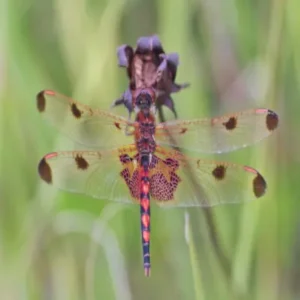
Much of their business is conducted in the morning. Mating generally occurs well before lunch, and the mating pair may ascend to 50’ in the air before getting down to tandem egg-laying in open water. Males are not territorial. The BugLady has seen Halloween Pennants over the water but not Calico Pennants (yet).
Halloween Pennants seem more unconcerned about weather than other dragonflies are. They are more likely to “obeslik;” they fly and lay eggs on windier and cooler days than other dragonflies; and they are out and about even in a light rain, shaking the water from their wings as they hunt.
Check out a field near you next summer!
The BugLady