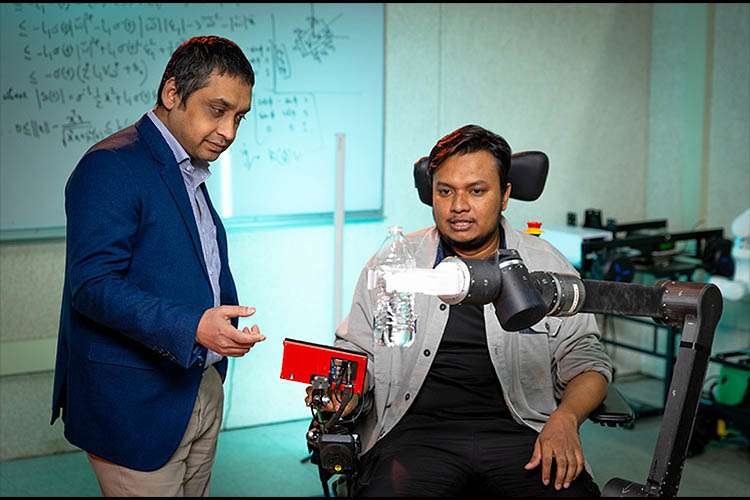
For people who use powered wheelchairs and have limited use of their arms, everyday tasks can require help from a caregiver.
Habib Rahman wants to change that.
Rahman, professor, mechanical and biomedical engineering, has received a $1.5 million, three-year grant from the National Institute on Disability, Independent Living, and Rehabilitation Research (NIDILRR) to develop an artificial intelligence-powered control system that could help wheelchair users complete more daily activities by themselves.
The project builds on Rahman’s earlier work developing a robotic assistive arm that attaches to a powered wheelchair. The arm helps users interact with objects around them, but controlling it can be challenging. Users may need to switch between control modes, repeat commands, or make small adjustments to position the arm precisely.
With this grant, Rahman aims to develop an AI-enabled system that combines multiple ways of giving commands, making the arms easier to control – whether or not a caregiver is present.
More ways to control the arm
Users could direct the robotic arm through speech, a touchscreen, wheelchair controls, switches or their eye gaze. Rather than manually guiding every movement, users could request an approved activity with just two or three selections. They would remain in control, with the ability to confirm an action, pause it, cancel it or override the system.
The approach, known as “shared control,” combines the user’s decisions with the robot’s ability to carry out a task. AI helps manage the details, while the user directs what happens.
Researchers will work with wheelchair users, caregivers and other specialists to refine the system and ensure it meets users’ needs. They will then test its safety and performance under different conditions, including cluttered spaces, changing lighting and interrupted tasks.
From the lab to the home
In a simulated home environment, wheelchair users will compare the new system with conventional joystick controls. A subsequent four-week study will evaluate how the technology performs in participants’ homes.
Researchers will measure whether users can complete more tasks independently, how long activities take, how easy the system is to operate, and whether it reduces caregiver assistance.
The ultimate goal is to develop technology that works reliably in people’s daily lives, not just in the lab.
By studying how wheelchair users interact with the system at home, Rahman’s team hopes to identify which features make the biggest difference in helping people accomplish activities that matter to them.
The project will produce a refined robotic-arm control system, along with safety guidelines, training materials and recommendations for broader use.