Otieno named one of Wisconsin’s most influential Black leaders of 2025
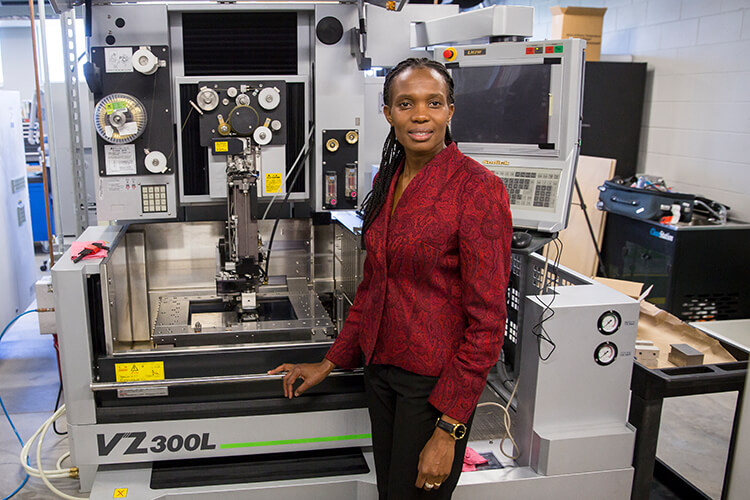
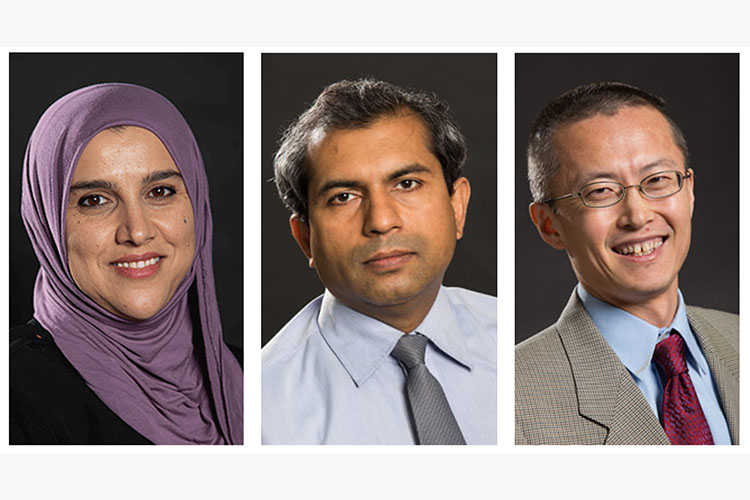
Kudos to Wilkistar Otieno, associate professor, industrial & manufacturing engineering, who was recognized as one of Wisconsin’s 32 most influential Black leaders of 2025 by Madison 365.com.
Madison365, a nonprofit online news publication, has published annual power lists recognizing Wisconsin leaders from different racial and ethnic groups since 2015. The purpose of the lists is to “highlight the beauty of the diversity across our state,” according to Henry Sanders, Jr., the co-founder and publisher of Madison365.com.
Otieno joins notables including UWM Provost and Vice Chancellor for Academic Affairs Andrew Daire, who was recognized on the 2024 list.
See the entire list of 2025 honorees on the news organization’s website.
Students recognized at national Foundry Educational Foundation conference
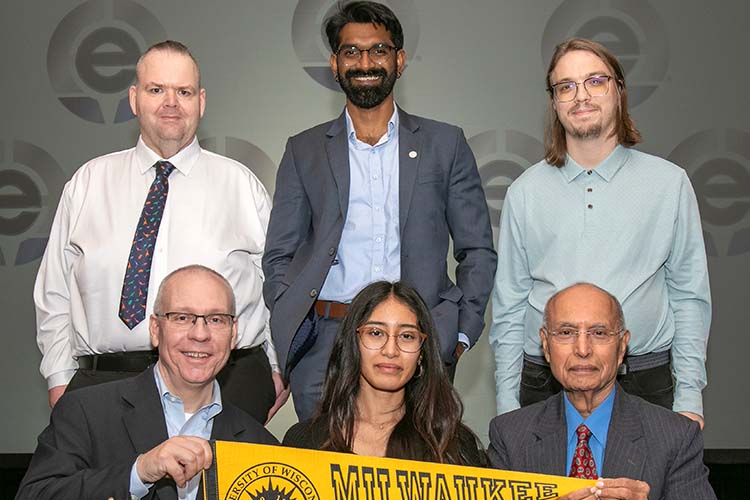
Four students and two faculty members from the materials science and engineering department attended the 2025 Foundry Educational Foundation College Industry Conference, held in Chicago in November. The annual conference is FEF’s flagship recruiting and networking event, bringing metal-casting companies together with top students from FEF schools for a career fair, technical sessions, and an awards luncheon where scholarships were presented.
UWM was represented by Key Professor Pradeep Rohatgi and Associate Professor Benjamin Church, along with students Owen Bellevage (PhD candidate), Aaron Macek (senior), Carol Martinez (senior), and Swaroop Behera (PhD dissertator).
Students met with dozens of metal-casting companies and professional societies.
More than $79,000 in scholarships were distributed to students. Behera received the MAGMA Scholarship honoring John Suoboda, and Martinez received the Carpenter Brothers Endowed Scholarship, each worth $2,500.
The conference also featured student networking workshops, and an evening reception that gave students additional informal time with employers.
Fall Senior Design teams face off
Senior Design courses provide experiential learning for students that includes team work, communication, and project management.
The winning teams – one each from five departments – will be recognized at the Order of the Engineer ceremony on Saturday, Dec. 20.
The college thanks GE HealthCare, which sponsors the Senior Design competition, and to all the companies who submitted projects. See details on all the team projects.
Winning teams and their challenges are:
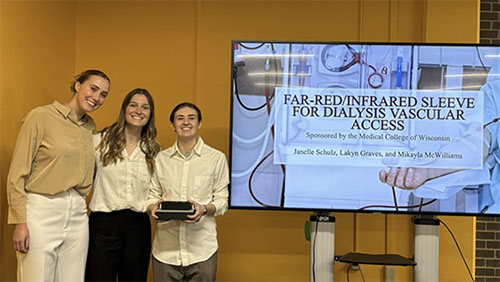
The winning biomedical engineering team designed a wearable infrared sleeve for vascular dialysis access that delivers far-red and infrared light to reduce clotting and stenosis.
Biomedical Engineering: “Wearable Infrared Sleeve for Vascular Dialysis Access.” Team Members:
Lakyn Graves
Mikayla McWilliams
Janelle Schultz
Advisor: Mohamed Yahiaoui Industry Mentor: Ashraf El-Meanawy, MCW
Civil & Environmental Engineering: “Elm Grove Pedestrian Bridge Project.” Team Members:
Caleb Castro
Jennifer Seerchen
Gabrielle Spitz
Advisors: Sarah Blackowski & Clayton Cloutier
Computer Science: “The OverCoded Project.” Team Members:
Zack Hawkins
Zenith Le
Ryan Nanney
Randall Sanders
Advisor: Ayesha Nipu
Electrical Engineering: “Automated Animal Feeder Project.” Team Members:
Ujjwal Dhunganam
Kayla Knudtson
An Le
Vedant Thakkar
Kristina Van Patten
Advisors: William Dussault & Jeff Kautzer
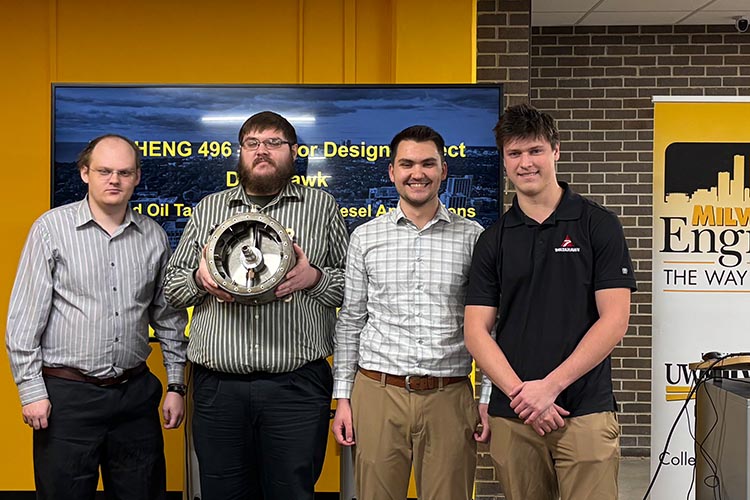
Mechanical Engineering: “Lightweight, Inverted Oil Tank for Aerobatic Diesel Applications.” Team Members:
Jeremy Anstedt
Keaton George
Peter Hanson
Advisor: Mohamed Yahiaoui Industry Mentor: Niklas Barrett, DeltaHawk
Undergrad’s first welding experience gives him a higher view
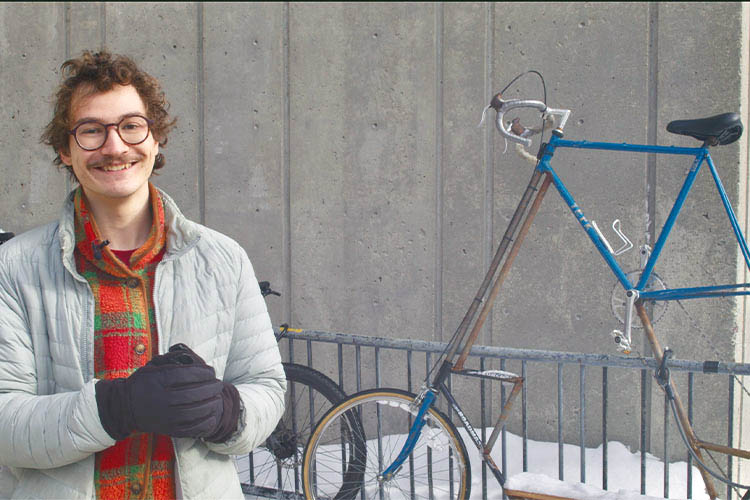
On any given school day, you might spot something unusual rolling across the EMS quad: a bicycle that looks like it missed a memo about gravity.
Perched high above everyone else, mechanical engineering senior Wynn Grame pedals to class on a homemade double-decker bike—two frames stacked into one towering ride that stops people mid-step and mid-scroll.
Getting onto the top seat is part mountaineer, part engineer, and all confidence. Grame starts by walking the bike forward, then steps onto a low wooden slat, grabs hold, and climbs the frame as the bike slowly moves forward.
Like most good engineering projects, the bike started as an idea that refused to go away.
“I saw an image of a double-decker bike like this and it just stuck in my head,” Grame said. And after friends donated one bike and then another, he said, “Then, I just had to do it.”
Grame used what he’s learned in engineering courses to take an idea to the next level. Experiential learning comes in many varieties.
Just jumping in
Inspiration was the easy part. Execution is where things got interesting. Before this project, Grame had never welded. Not once.
“I used a friend’s borrowed welder to learn a new skill and make some mistakes,” he said.
He worked on the bike over the summer, squeezing in shop time after returning from his internship at HellermannTyton and on weekends. From cutting up the bikes to riding the finished product, the whole build took less than six weeks.
At HellermannTyton, a cable tie manufacturer, Grame worked on customer drawings and some design work with parts. Outside of class and work, he’s also an avid rock climber (surprised?) and a program assistant at Outdoor Pursuits for their bike shop.
His curiosity-driven mindset is what pulled him into engineering in the first place.
More than a conversation-starter
The bike-creation is a rolling example of UWM’s hands-on approach to engineering education—where students don’t just learn problem-solving in theory, they put it into practice.
Grame applied concepts straight from his mechanical engineering coursework, including bending analysis to determine the right tubing thickness. He analyzed bending and deflection, then ran finite element analysis on the frame design to verify that it was sound.
The frame is made entirely of mild steel. While modern bike frames often use aluminum–which is lighter but much harder to weld. Steel is common in older bikes and much more forgiving for someone learning the craft. It’s heavier, sure, but also strong, durable, and reliable.
And there are benefits to riding a bike like this, beyond pure cool factor, he added.
“It also offers excellent visibility on the road,” he said, “because cars can see you immediately and so they are very cautious around you.”
Grame knows of at least four other tall bikes in Milwaukee, but this one is the only one cruising UWM’s campus.
For Grame, the bike isn’t just transportation. It’s proof of concept – for learning by doing. Sometimes, experiential learning looks like a lab or an internship. But sometimes, it looks like a double-decker bike.
A computer scientist discusses the complexities of communicating with computers
Artificial intelligence (AI) has transformed dramatically over the past few decades, but for Professor Susan McRoy, its defining feature has always been change. A longtime faculty member and chair of the Department of Computer Science, McRoy has seen large language models (LLMs) evolve into today’s massive, data-driven models that can quickly judge what is meant in context.
LLMs are a specific kind of AI that is language- and text-focused, compared to other kinds of AI used for image classification, fraud detection, predictive analytics, and decision making. Both LLM and other kinds of AI encompass machine learning, where computers learn from data and identify patterns without being explicitly programmed.
McRoy has been interested in communication between people and computers on matters of health, where nuances in the language can pose a particular obstacle to understanding. She is also interested in developing explanations for machine learning models which help people trust them and verify that they are working properly.
In this Q&A, McRoy reflects on the field’s rapid transformation, how students are encountering AI today, and why language remains one of the most intriguing challenges in computing. (Interested in related courses to get started? See the listing at the end.)
AI seems to have spread everywhere in what seems like a short time. What happened? The recent rise of AI came from a convergence of rapid computing abilities because of graphical processing unit (GPU) advances and the explosion of internet data – conditions that allowed researchers to revisit old problems with new architectures.
AI is very good at memorizing and reproducing common patterns. If a task repeats often, AI can capture it – similar to how programmers save useful pieces of code so they can reuse them instead of starting from scratch. But its strength is not universal; it depends heavily on training data.
How do you explain the difference between computer science and AI? Computer science is the broader field. AI sits inside it and has always been the more experimental path. Some applications require strong guarantees that systems work correctly; AI hasn’t always offered that provability. As it becomes more capable, it still inherits that experimental nature.
How did you first get interested in computer science? What drew me in was the idea of getting computers to do things people do – an inherently evolving challenge. When I was starting college, my father found an article predicting that computer science would be the future. It was a field that felt completely new at the time—there were no high-school classes then, and computers were very primitive.
Why did you choose natural language processing (NLP) as your research area? Language provides the most direct window into how people think. Early AI researchers used logic and text to model reasoning. My work focused on interactive communication – how people misunderstand each other, how systems can detect inconsistencies, and how to repair misunderstandings in real time. These challenges are still with us today.
How do today’s large language models relate to that early work? Early systems combined grammar, meaning, and context using hand-written rules and tiny training sets. Modern models do something similar but automatically and at massive scale. They’re trained on everything online – both good and bad – which shapes their output.
How should students use AI? They can use it to support—not replace – critical thinking. Ask AI to help you evaluate ideas or identify related work so you don’t duplicate existing research. Let it broaden your understanding, fuel new questions – not do the thinking for you.
How has the field changed during your career? The problems haven’t changed much, but the methods have changed completely. Change is the defining feature of AI, so faculty who’ve been here a long time have had to continually adapt.
Three introductory AI or ML courses for CEAS students
COMPSCI 290, “Introductory Topics in Computer Science: Trending and Trustworthy Artificial Intelligence.” No prerequisites, but students must be in the college.
COMPSCI 411, “Machine Learning and Applications.” Freshman must have at least one programming class.
COMPSCI 422, Introduction to Artificial Intelligence.” Prerequisites COMPSCI 317 and 351.
The college’s EnQuest program and industry partner ATC featured in Milwaukee magazine
A story in Milwaukee magazine in December featured the partnership between the college and ATC to put on the annual EnQuest Engineering Camp, which aims to spark an interest in STEM fields for high school students.
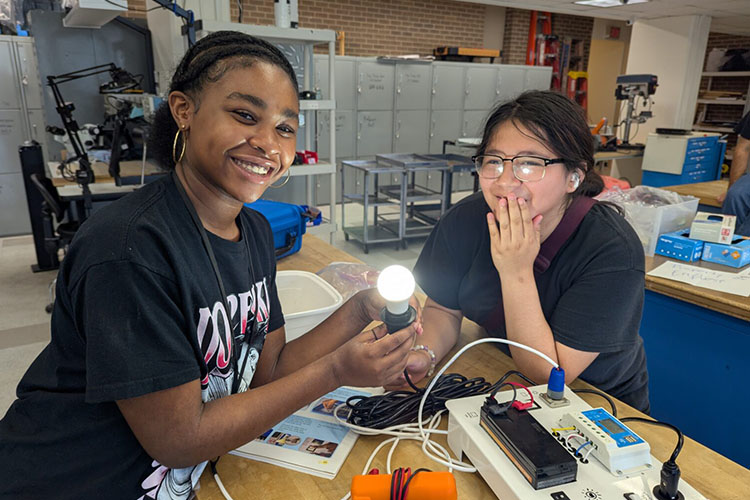
EnQuest has immersed youth in projects like designing solar-powered phone chargers or running biomedical simulations with advanced software. In the last 12 years, the program has introduced hundreds of students to real-world engineering projects.
Several engineers at ATC, including one alum, said their involvement gives them the opportunity to inspire the next generation of engineers. And it’s working: 75% of participants go on to pursue engineering or STEM careers.
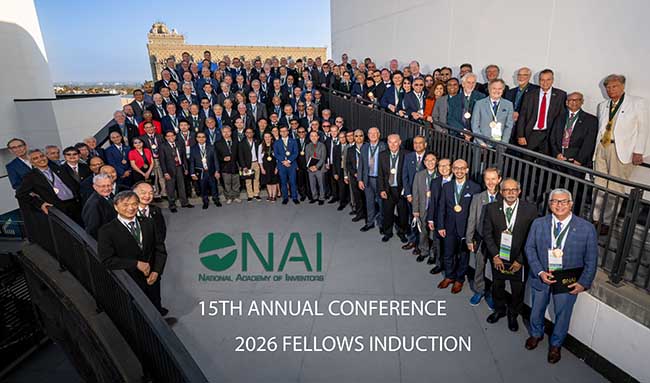
Engineering professor named a Fellow of the National Academy of Inventors in a cohort of only 185 worldwide
Alex Yasha Yi, a professor of electrical engineering and Director of Research at UWM’s Connected Systems Institute, has been elected a Fellow of the National Academy of Inventors—one of the highest honors an academic inventor can receive.
During his career, Yi has secured 34 issued patents, including 18 in the U.S. Many of these inventions have been licensed by major international energy companies, generating more than $300 million in revenue. He is also a Fellow of the Optical Society of America.
Yi is one of 185 inventors worldwide who were named as new fellows.
It’s a distinction reserved for people whose ideas don’t just live in labs and journals—they turn into technologies that reshape industries, improve lives, and spark economic growth. Yi’s career does exactly that.
Yi joins a cohort of only 2,253 Fellows worldwide, representing more than 300 prestigious universities and governmental and nonprofit research institutes.
His research spans intelligent electronics, devices that power artificial intelligence, and next-generation optoelectronic technologies designed to make energy systems smarter and more efficient.
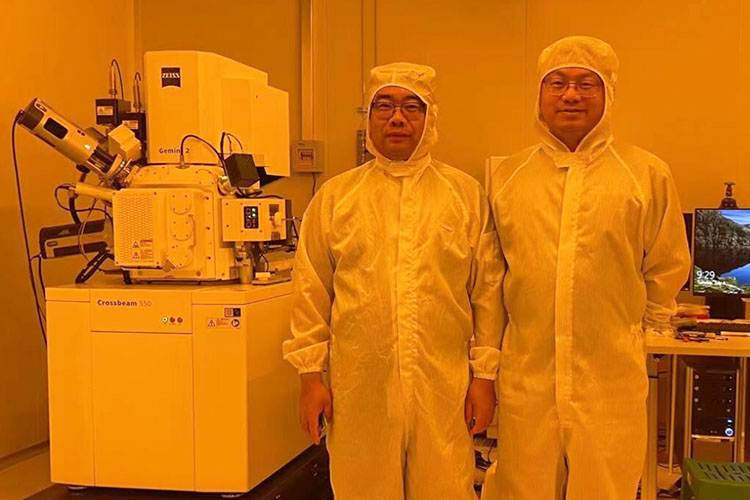
In February, he received sponsorship from Invictus Innovation EV Technology to conduct research that could advance a new kind of computer microchip that moves information with light, rather than electricity. Michigan-based Invictus specializes in semiconductor chip manufacturing and advanced technology for electric vehicles (EVs).
Nominators say Yi’s inventions have the potential to transform multiple fields. Among them:
Ultrasensitive sensors capable of detecting particles as tiny as those found in air pollution—opening the door to better environmental monitoring and AI-powered sensing.
Advanced optoelectronic crystals that make it possible to build thinner, more efficient solar panels and other renewable energy technologies.
Super-thin, light-controlling lenses, recognized by MIT Technology Review as a breakthrough technology with major implications for the future of semiconductor manufacturing.
Chip-scale LiDAR systems now being tested at Mcity, the world’s first proving ground for connected and autonomous vehicles. This kind of LiDAR system features ultra-compact, Light Detection and Ranging sensors that put all data onto single silicon chips, making them much smaller, cheaper, more robust and perfect for consumer electronics.
Yi joins three other faculty members in the college who were previously named NAI fellows: Brian Armstrong, professor, mechanical engineering (also named a Senior Member of NAI in 2019); Pradeep Rohatgi, professor, materials science & engineering; and Junhong Chen (now Crown Family Professor of Molecular Engineering in the University of Chicago).
This article was updated June 12, 2026.
CEAS employees named by students as international student advocates
Congratulations to Hana’a Alqam, lecturer, mechanical engineering; Krishna Pillai, professor, mechanical engineering; and Jian Zhao, professor, civil & environmental engineering, who were among the 47 faculty and staff receiving 2025 International Advocate Awards from the UWM Center for International Education. All were chosen by students who called out these individuals for the exceptional support and guidance they provided. Read the campus story here.
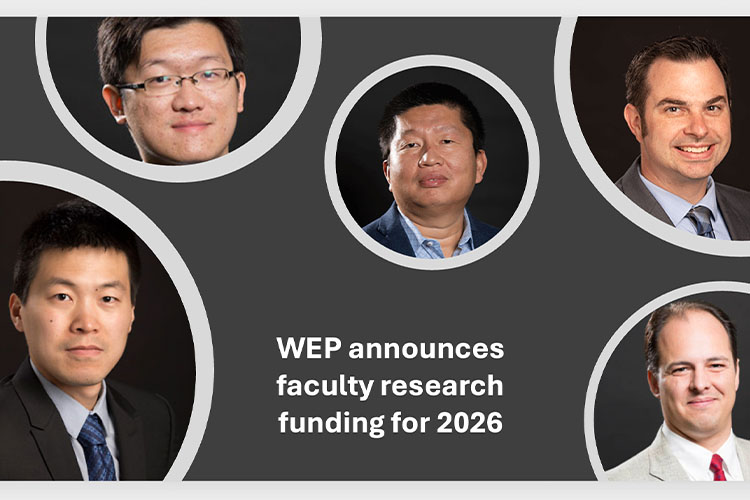
WEP awards nearly $450,000 to six research projects, five from the college
Faculty in the college have received new funding from the Water Equipment and Policy Center (WEP) for 2026. The center awarded nearly $450,000 to five UWM research projects, one of which includes researchers from both UWM and Marquette University. A sixth project was funded at Marquette.
WEP is a university-industry research collaboration, developing industry solutions through research at both UWM and Marquette. Backed by the National Science Foundation, WEP focuses on creating new sensors and devices, novel materials, and innovative systems to help the world manage its stressed water resources.
The five all or partial UWM projects are:
Xiaoli Ma with Yin Wang, Florian Bender, and Fabien Josse (Marquette), $50,000 “Development of Adsorptive Membrane Filters for the Co-Removal of Hardness and Contaminants.” (new)
Xiaoli Ma with Yin Wang,and Shangping Xu (UWM geosciences), $49,999 “Development of Adsorptive Membrane Filters for the Co-Removal of Hardness and Contaminants.” (new)
William Musinski, $100,000 “Accurate Modeling of Long-Term Corrosion and Cracking in Brass Alloys.” (continuing)
Junjie Niu, $99,998 “Designing an electrochemical sensor for PFAS detection in water.” (continuing)
Nathan Salowitz, $75,000 “Embedded Ultrasonic Inspection and Sensing of Water-Filled Equipment.” (continuing)
CBS 58 and Spectrum News feature Qu’s work on recycling rechargeable batteries
Two local media outlets recently interviewed Professor Deyang Qu and scientist Xiaoxiao Zhang, mechanical engineering, for stories about research in extracting material from retired rechargeable batteries to use in making lower-cost, high-demand fertilizer in the U.S.
“Fertilizer is a very critical product especially for state like Wisconsin where it’s an agriculture state,” Qu said on the CBS segment. “So, if we can convert the [battery] waste into a value-added fertilizer, that is good for our economy.”
Qu’s goal is to make enough of the fertilizer to enable the USDA to test it with tomato crops.