Undergrad’s first welding experience gives him a higher view

A young man with dark brown hair, a colorful shirt and a gray jacket and black gloves looks at the camera with a view of his double-decker bike off to one side.

On any given school day, you might spot something unusual rolling across the EMS quad: a bicycle that looks like it missed a memo about gravity.

Perched high above everyone else, mechanical engineering senior Wynn Grame pedals to class on a homemade double-decker bike—two frames stacked into one towering ride that stops people mid-step and mid-scroll.

Getting onto the top seat is part mountaineer, part engineer, and all confidence. Grame starts by walking the bike forward, then steps onto a low wooden slat, grabs hold, and climbs the frame as the bike slowly moves forward.

Like most good engineering projects, the bike started as an idea that refused to go away.

“I saw an image of a double-decker bike like this and it just stuck in my head,” Grame said. And after friends donated one bike and then another, he said, “Then, I just had to do it.”  

Grame used what he’s learned in engineering courses to take an idea to the next level. Experiential learning comes in many varieties.

Just jumping in

Inspiration was the easy part. Execution is where things got interesting. Before this project, Grame had never welded. Not once.

“I used a friend’s borrowed welder to learn a new skill and make some mistakes,” he said.

He worked on the bike over the summer, squeezing in shop time after returning from his internship at HellermannTyton and on weekends. From cutting up the bikes to riding the finished product, the whole build took less than six weeks.

At HellermannTyton, a cable tie manufacturer, Grame worked on customer drawings and some design work with parts. Outside of class and work, he’s also an avid rock climber (surprised?) and a program assistant at Outdoor Pursuits for their bike shop.

His curiosity-driven mindset is what pulled him into engineering in the first place.

More than a conversation-starter

The bike-creation is a rolling example of UWM’s hands-on approach to engineering education—where students don’t just learn problem-solving in theory, they put it into practice.

Grame applied concepts straight from his mechanical engineering coursework, including bending analysis to determine the right tubing thickness. He analyzed bending and deflection, then ran finite element analysis on the frame design to verify that it was sound.

The frame is made entirely of mild steel. While modern bike frames often use aluminum–which is lighter but much harder to weld. Steel is common in older bikes and much more forgiving for someone learning the craft. It’s heavier, sure, but also strong, durable, and reliable.

And there are benefits to riding a bike like this, beyond pure cool factor, he added.

“It also offers excellent visibility on the road,” he said, “because cars can see you immediately and so they are very cautious around you.”

Grame knows of at least four other tall bikes in Milwaukee, but this one is the only one cruising UWM’s campus.

For Grame, the bike isn’t just transportation. It’s proof of concept – for learning by doing. Sometimes, experiential learning looks like a lab or an internship. But sometimes, it looks like a double-decker bike.

A computer scientist discusses the complexities of communicating with computers

A female professor and a female student share small robots that can communicate. One robot is white and red and the other white and blue.

Artificial intelligence (AI) has transformed dramatically over the past few decades, but for Professor Susan McRoy, its defining feature has always been change. A longtime faculty member and chair of the Department of Computer Science, McRoy has seen large language models (LLMs) evolve into today’s massive, data-driven models that can quickly judge what is meant in context.

LLMs are a specific kind of AI that is language- and text-focused, compared to other kinds of AI used for image classification, fraud detection, predictive analytics, and decision making. Both LLM and other kinds of AI encompass machine learning, where computers learn from data and identify patterns without being explicitly programmed.

McRoy has been interested in communication between people and computers on matters of health, where nuances in the language can pose a particular obstacle to understanding. She is also interested in developing explanations for machine learning models which help people trust them and verify that they are working properly.

In this Q&A, McRoy reflects on the field’s rapid transformation, how students are encountering AI today, and why language remains one of the most intriguing challenges in computing. (Interested in related courses to get started? See the listing at the end.)

AI seems to have spread everywhere in what seems like a short time. What happened?
The recent rise of AI came from a convergence of rapid computing abilities because of graphical processing unit (GPU) advances and the explosion of internet data – conditions that allowed researchers to revisit old problems with new architectures.

AI is very good at memorizing and reproducing common patterns. If a task repeats often, AI can capture it – similar to how programmers save useful pieces of code so they can reuse them instead of starting from scratch. But its strength is not universal; it depends heavily on training data.

How do you explain the difference between computer science and AI?
Computer science is the broader field. AI sits inside it and has always been the more experimental path. Some applications require strong guarantees that systems work correctly; AI hasn’t always offered that provability. As it becomes more capable, it still inherits that experimental nature.

How did you first get interested in computer science?
What drew me in was the idea of getting computers to do things people do – an inherently evolving challenge. When I was starting college, my father found an article predicting that computer science would be the future. It was a field that felt completely new at the time—there were no high-school classes then, and computers were very primitive.

Why did you choose natural language processing (NLP) as your research area?
Language provides the most direct window into how people think. Early AI researchers used logic and text to model reasoning. My work focused on interactive communication – how people misunderstand each other, how systems can detect inconsistencies, and how to repair misunderstandings in real time. These challenges are still with us today.

How do today’s large language models relate to that early work?
Early systems combined grammar, meaning, and context using hand-written rules and tiny training sets. Modern models do something similar but automatically and at massive scale. They’re trained on everything online – both good and bad – which shapes their output.

How should students use AI?
They can use it to support—not replace – critical thinking. Ask AI to help you evaluate ideas or identify related work so you don’t duplicate existing research. Let it broaden your understanding, fuel new questions – not do the thinking for you.

How has the field changed during your career?
The problems haven’t changed much, but the methods have changed completely. Change is the defining feature of AI, so faculty who’ve been here a long time have had to continually adapt.

Three introductory AI or ML courses for CEAS students

  • COMPSCI 290, “Introductory Topics in Computer Science: Trending and Trustworthy Artificial Intelligence.” No prerequisites, but students must be in the college.
  • COMPSCI 411, “Machine Learning and Applications.” Freshman must have at least one programming class.
  • COMPSCI 422, Introduction to Artificial Intelligence.” Prerequisites COMPSCI 317 and 351.

The college’s EnQuest program and industry partner ATC featured in Milwaukee magazine

Image of two female students participating in the EnQuest camp who learned how to build a solar powered light.

A story in Milwaukee magazine in December featured the partnership between the college and ATC to put on the annual EnQuest Engineering Camp, which aims to spark an interest in STEM fields for high school students.

EnQuest has immersed youth in projects like designing solar-powered phone chargers or running biomedical simulations with advanced software. In the last 12 years, the program has introduced hundreds of students to real-world engineering projects.

Several engineers at ATC, including one alum, said their involvement gives them the opportunity to inspire the next generation of engineers. And it’s working: 75% of participants go on to pursue engineering or STEM careers.

Read the whole article here.

Yi is the latest UWM faculty member to be named a Fellow of the National Academy of Inventors

Two men in white suits pose in a orange-tinted clean room. Both are wearing glasses.

Alex Yasha Yi, a professor of electrical engineering and Director of Research at UWM’s Connected Systems Institute, has been elected a Fellow of the National Academy of Inventors—one of the highest honors an academic inventor can receive.

It’s a distinction reserved for people whose ideas don’t just live in labs and journals—they turn into technologies that reshape industries, improve lives, and spark economic growth. Yi’s career does exactly that.

Yi joins a cohort of only 2,253 Fellows worldwide, representing more than 300 prestigious universities and governmental and nonprofit research institutes.

His research spans intelligent electronics, devices that power artificial intelligence, and next-generation optoelectronic technologies designed to make energy systems smarter and more efficient.

During his career, Yi has secured 34 issued patents, including 18 in the U.S. Many of these inventions have been licensed by major international energy companies, generating more than $300 million in revenue. He is also a Fellow of the Optical Society of America.

An environmental sensor, a small black disk with irridescence reflections.
This visually striking wafer showcases the future of AI hardware—a photonic compute platform built with next-generation nanofabrication and advanced packaging technologies. The vivid diffraction patterns come from thousands of integrated optical phased arrays and metasurface elements, highlighting the density and sophistication of the chip-scale photonic architecture.

Nominators say Yi’s inventions have the potential to transform multiple fields. Among them:

  • Ultrasensitive sensors capable of detecting particles as tiny as those found in air pollution—opening the door to better environmental monitoring and AI-powered sensing.
  • Advanced optoelectronic crystals that make it possible to build thinner, more efficient solar panels and other renewable energy technologies.
  • Super-thin, light-controlling lenses, recognized by MIT Technology Review as a breakthrough technology with major implications for the future of semiconductor manufacturing.
  • Chip-scale LiDAR systems now being tested at Mcity, the world’s first proving ground for connected and autonomous vehicles. This kind of LiDAR system features ultra-compact, Light Detection and Ranging sensors that put all data onto single silicon chips, making them much smaller, cheaper, more robust and perfect for consumer electronics.

Yi joins three other faculty members in the college who were previously named NAI fellows: Brian Armstrong, professor, mechanical engineering (also named a Senior Member of NAI in 2019); Pradeep Rohatgi, professor, materials science & engineering; and Junhong Chen (now Crown Family Professor of Molecular Engineering in the University of Chicago).

He will formally be inducted at the 15th annual NAI conference, which will take place in June in Los Angeles.

CEAS employees named by students as international student advocates

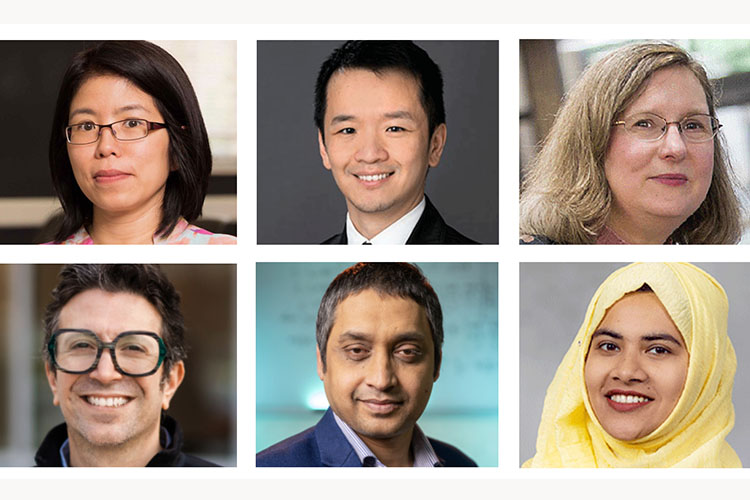
Three headshots in a row. The first one is a woman in a headscarf and the other two are men in shirts and ties.

Congratulations to Hana’a Alqam, lecturer, mechanical engineering; Krishna Pillai, professor, mechanical engineering; and Jian Zhao, professor, civil & environmental engineering, who were among the 47 faculty and staff receiving 2025 International Advocate Awards from the UWM Center for International Education. All were chosen by students who called out these individuals for the exceptional support and guidance they provided. Read the campus story here.

WEP awards nearly $450,000 to six research projects, five from the college

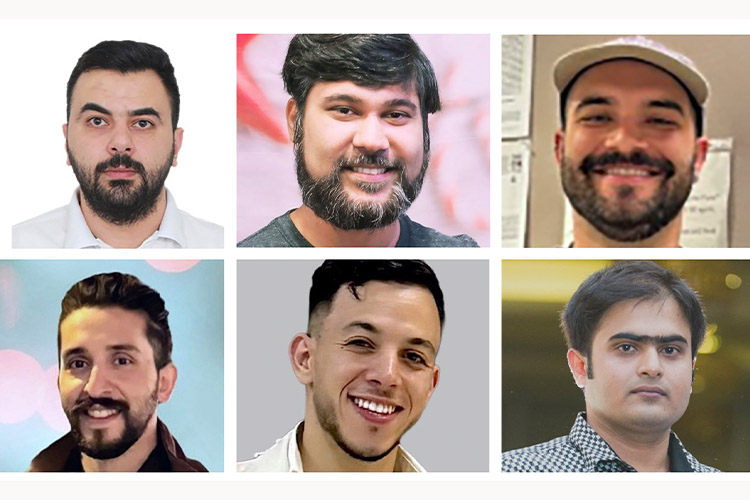
a graphic montage of five head shots, all men, on a dark background

Faculty in the college have received new funding from the Water Equipment and Policy Center (WEP) for 2026. The center awarded nearly $450,000 to five UWM research projects, one of which includes researchers from both UWM and Marquette University. A sixth project was funded at Marquette.

WEP is a university-industry research collaboration, developing industry solutions through research at both UWM and Marquette. Backed by the National Science Foundation, WEP focuses on creating new sensors and devices, novel materials, and innovative systems to help the world manage its stressed water resources.

The five all- or partial UWM projects are:

  • Xiaoli Ma with Yin Wang, Florian Bender, and Fabien Josse (Marquette), $50,000
    “Development of Adsorptive Membrane Filters for the Co-Removal of Hardness and Contaminants.” (new)
  • Xiaoli Ma with Yin Wang, and Shangping Xu (UWM geosciences), $49,999
    “Development of Adsorptive Membrane Filters for the Co-Removal of Hardness and Contaminants.” (new)
  • William Musinski, $100,000
    “Accurate Modeling of Long-Term Corrosion and Cracking in Brass Alloys.” (continuing)
  • Junjie Niu, $99,998
    “Designing an electrochemical sensor for PFAS detection in water.” (continuing)
  • Nathan Salowitz, $75,000
    “Embedded Ultrasonic Inspection and Sensing of Water-Filled Equipment.” (continuing)

CBS 58 and Spectrum News feature Qu’s work on recycling rechargeable batteries

A middle-age Asian man speaks with a news reporter who is not visible.

Two local media outlets recently interviewed Professor Deyang Qu and scientist Xiaoxiao Zhang, mechanical engineering, for stories about research in extracting material from retired rechargeable batteries to use in making lower-cost, high-demand fertilizer in the U.S.

“Fertilizer is a very critical product especially for state like Wisconsin where it’s an agriculture state,” Qu said on the CBS segment. “So, if we can convert the [battery] waste into a value-added fertilizer, that is good for our economy.”

Qu’s goal is to make enough of the fertilizer to enable the USDA to test it with tomato crops.

Watch the report on CBS 58. Watch the Spectrum News segment.

Schreiner supports undergraduates from day one through the Success Center

When Richard Schreiner (MS ’82, computer science) thinks about what helps engineering and computer science students succeed, he remembers how tough those first semesters can be.

That’s why, in 2021, he helped establish a fund that supports a Student Success Center in the college. Students can get peer tutoring, build confidence in math and computer science, and find a community that supports them.

His latest gift of $10,000 will help keep that momentum going.

A headshot of a white older man with glasses and blonde-gray hair, slicked up.

The center has had a remarkable impact, especially for students who are the first in their families to attend college – which is one-third of undergraduates in the college. Some arrive under-prepared for calculus-based engineering coursework. The Success Center helps fill that gap.

Student response tells the story: usage jumped from 2,000 visits in 2022–23 to 3,000 in 2023–24. With freshman enrollment in the college up 34% this fall – and every new engineering freshman now taking at least one engineering course – the need for peer tutors and mentors has never been greater.

This marks Schreiner’s third gift to the fund, reflecting his steady belief in the importance of helping students persist and thrive.

His support also includes the “Richard C. Schreiner ’82 and Alison Graf Engineering Scholarship,” an endowed scholarship open to any undergraduate with financial need and strong academic promise.

A loyal UWM supporter since 1987, Schreiner has contributed to programs across campus – from WUWM-FM and OSHER Lifelong Learning to scholarships honoring beloved professors.

Are you interested in supporting the college? Please contact Jean Opitz at opitz@uwm.edu, or make a gift directly to the fund of your choice here.

New EMI facility will be latest of the college’s five testing and analysis facilities available to industry

A young man in a red plain shirt and a baseball cap stands in a an empty room lined with metallic tiles.

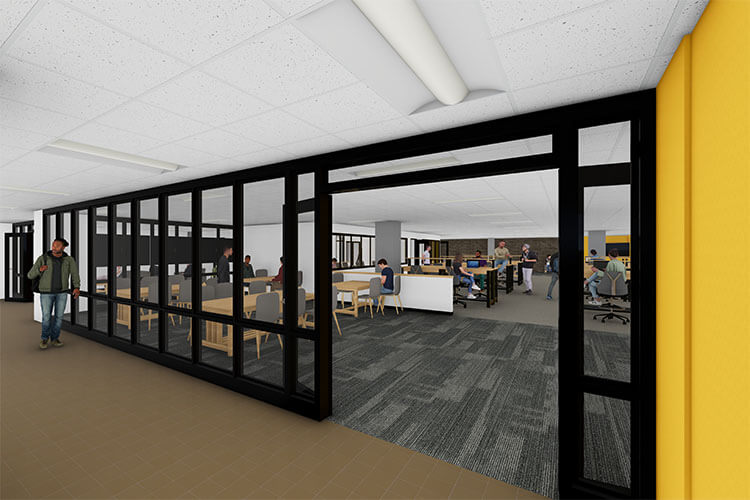
With support from a grant from the U.S. Economic Development Administration, the college is now completing the installation of a unique, full-service Electromagnetic Interference (EMI) testing facility that will be used for research and also available to industry.

Electronic equipment, wireless devices, and communication systems all generate electromagnetic waves that cause interference when placed near other electronic devices.

That disruption can happen through in air or through the wires of the device under test, said James Li, an electrical engineering postdoctoral researcher who is working on the facility. “This chamber allows us to measure and understand those effects,” Li said.

This facility, in the Century City Tower, 4201 N. 27th St., will offer a semi-anechoic or “EMI chamber” that measures noise that travels through the air. It is a shielded room that absorbs electromagnetic energy, creating a “quiet” environment needed to measure interference.

But the EMI chamber is just one part of the space. For power electronics, an equally important capability is measuring the noise that travels through the wires, said Rob Cuzner, professor, electrical engineering, whose lab is overseeing the improvements.

This new facility is designed to test how much unwanted electrical “noise” power electronics, like electric vehicle chargers or solar inverters, send back into the power grid through their wires.

Unique in the region

“Our facility is unique because it’s the only one in the region equipped to do both wired and airborne noise testing in one place,” Cuzner said.

As the demand for electricity climbs and new power electronics are needed to upgrade the aging grid, more Wisconsin companies will be interested in the capabilities of the facility. It also facilitates the development of advanced electric ships and planes, areas of UWM research, he said.

“We will be able to test how new metals and materials affect electronic devices,” Cuzner said. “This matters because newer power technologies, like wide-band gap semiconductors, can run faster and more efficiently – but only if we know how to prevent interference.”

UWM will match the EDA funds for the build-out with $350,000 in cost-share support, to be generated largely by offering testing services to regional industries.

Within six months, the chamber will be available for radiated EMI testing on battery-powered devices and equipment running on standard building power. When fully completed, the chamber will be able to conduct EMI emissions tests on equipment with voltage ratings up to 2,000V and power ratings up to 1.2MVA.

Plans also include developing an EMI technician training program in partnership with area technical colleges, helping meet growing workforce needs.

Four other UWM analysis and testing facilities available to industry

  • Advanced Analysis Facility
  • Full-Service Machine Shop
  • Industrial Training and Assessment Center
  • Structural Engineering Lab

Learn about all facilities and contacts.

Students in computer and data science attend the Grace Hopper Celebration

A group of 20 young women who major in computer science standing in front of a banner and looking at the camera.

In November, 19 students in the college traveled to the Grace Hopper Celebration, accompanied by faculty member Sadia Nowrin.

While at the conference, students attended technical talks and workshops and connected with other women in computing from across the country – including industry employers.

The trip was coordinated by Associate Professor Christine Cheng and Professor Susan McRoy.

Most of the undergraduate students who attended are pursuing degrees in computer science or computer engineering, with others majoring in data science and information science and technology. The group also included two master’s students in computer science and one PhD student in biomedical and health informatics.

UWM previously sent students to the Grace Hopper Celebration annually from 2014–2019 with support from private IT companies through the BRAID academic collaboration. This year’s trip was made possible by a generous gift from Paul McNally, UWM senior lecturer emeritus in the Department of Computer Science.

Participants had this to say about the experience:

  • “I met wonderful people from all over the world, got to sit with other women who look like me and share similar backgrounds. My favorite part was being able to sit in community groups and talk about technology in Spanish.”
  • “I had the opportunity to meet a senior software engineer from Google and participate in a very insightful discussion. It helped me better understand real-world applications of AI and research directions. I also attended several sessions that broadened my perspective on accessibility and responsible AI.”
  • “I emailed one of the speakers I really liked after a talk, and he set up a chat with me on Friday to talk one-on-one about his experience and I got really good advice!”

The Grace Hopper Celebration honors women in computing and is named for Grace Hopper – a pioneering computer scientist and U.S. Navy officer during World War II. She helped make computers more accessible by creating the first compiler, a tool that translates human-readable instructions into machine code, revolutionizing computer programming.