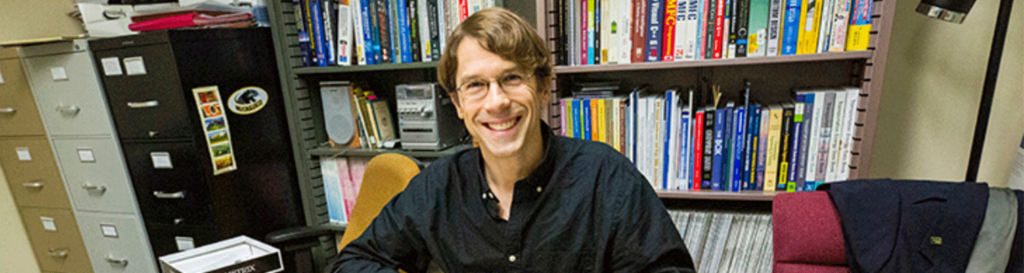
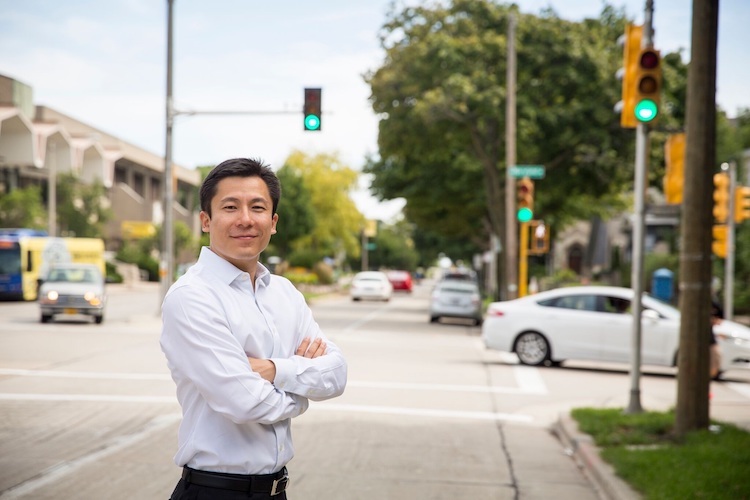
Shamar Webster, a computer science master’s student, was featured in a May 22 Spectrum News segment “UWM Connected Systems Institute seeks to move manufacturing forward.”
Spectrum News features UWM’s Connected Systems Institute


Shamar Webster, a computer science master’s student, was featured in a May 22 Spectrum News segment “UWM Connected Systems Institute seeks to move manufacturing forward.”

They are proud to be heading to college and setting examples for younger siblings. They play guitar, design clothing, volunteer at food pantries and perform improv comedy. They recognize the sacrifices made by their parents.
Meet the recent graduates from Milwaukee high schools who were awarded full-ride Nadella Scholarships to UWM to study computer science, data science and information technology. Their 10 scholarships are being funded through a gift from UWM alumnus and Microsoft Chairman and CEO Satya Nadella (’90 MS Computer Science) and his wife, Anu Nadella.
Eight of the Nadella Scholarship recipients intend to major in computer science. One intends to major in information science and technology and another in information technology management.
“It feels good for someone to invest in my future and give me a chance to better my life,” wrote Latrelle Jackson, Rufus King International High School. “It lets me know that I am doing right and that I should keep working.”
About the Nadella Scholarships
This is the second cohort to receive Nadella Scholarships, which are specifically for students who graduate from Milwaukee high schools.
The scholarships provide financial and academic support, and cover tuition, fees, room and board for up to five years at UWM. Each recipient is assigned a dedicated success coach, an academic advisor, and a peer mentor, and is provided additional tutoring and support opportunities to lead to successful student outcomes.

When UWM temporarily shuttered buildings in spring 2020 due to the COVID-19 pandemic, one team of researchers began their groundbreaking work on the empty campus.
That team has now completed their project, funded in April 2020 by a $198,326 National Science Foundation COVID-19 RAPID grant: they have developed an easily applied, spray-on coating that repels and deactivates COVID-19 droplets that land on surfaces.
The coating is called XPAC and it could improve our nation’s preparedness for future waves of COVID and other airborne pathogens, adding a way to break a virus’s chain of transmission, said Konstantin Sobolev, principal investigator and professor of civil and environmental engineering in UWM’s College of Engineering & Applied Science.
In addition to Sobolev, the XPAC research team consisted of Nikolai Kouklin, co-prinicipal investigator and professor, electrical engineering; Michael Nosonovsky, co-principal investigator and associate professor, mechanical engineering, and David Frick, professor, chemistry/biochemical.
The team was assisted by engineering doctoral student Filip Zemajtis, who recently wrote and successfully defended a dissertation on XPAC coatings.
XPAC’s 3 key features
XPAC can be applied to a variety of surfaces—including metals, concrete, ceramics, glass and wood—to help prevent the transmission of viral, bacterial, and other pathogens for a period of time ranging from several months to several years.
It offers three features: it is superhydrophobic, meaning contaminants sitting on top of its surface will wash away easily; it is photocatalytic –in the presence of light, it spurs pollutants to decompose; finally, it is anticorrosive and will slow deterioration of metals to which it is applied.
UWM’s results comes just as a new study, published in The Lancet Microbe, confirmed earlier studies that the SARS-CoV-2 virus can be spread by contaminated hands and surfaces. In addition, data obtained during the COVID-19 pandemic will provide a fast track to scale-up manufacturing and widespread deployment of the anti-viral coatings.
During their research, the team worked with NSF I-Corps and interviewed dozens of industry leaders to gauge potential markets. Sobolev notes that XPAC could find its place within retail, food and manufacturing industries.
A March 2021 UWM Report story—Spraying away the COVID-19 virus—documents the beginning of this research.

Congratulations to Genevieve Stollenwerk (’16 BS Civil Engineering), who received the American Public Works Association Wisconsin Chapter 2023 Outstanding New Member Impact Award.
Stollenwerk works at raSmith.
The award recognizes new or young APWA-WI members who have demonstrated an initial commitment to the profession and the association and show potential for future growth within the association.
More.

It’s not unusual for UWM students to graduate with a job in hand thanks to connections made through internships, field study placements and other practical experience. This gallery introduces you to just a few of the May 2023 graduates campuswide who have already accepted job offers, and some who have already started working.
Included are:
James Veltri (left), a materials engineering grad and U.S. Navy veteran who accepted a position at Lockheed Martin’s space division in Denver, working in failure analysis.
Chandler Baures (right), a civil engineering grad who accepted a position as a project engineer with Findorff, in Milwaukee.
Chanyeop Park, assistant professor, electrical engineering, is working with researchers at Georgia Institute of Technology to develop and test an environmentally neutral alternative to the substance currently used in high-voltage electrical distribution equipment.
As infrastructure ages, the substance—sulfur hexafluoride—is becoming a worrisome contributor to global warming.

In their senior year, all students at UWM’s College of Engineering & Applied Science team up and partner with industry representatives to solve real-world problems. These problems aren’t easy to solve, but UWM students have knocked it out of the park on more than one occasion. On all occasions, they’ve had a taste of professional life and become better prepared for successful careers.
You can get a sense of our senior design projects in this Spectrum News story about one student team that was tasked with solving a problem for Charter Steel: UW-Milwaukee engineering students turn $72 investment into $43,000 in savings for Milwaukee-area company.
Or read about another team of students that created an inventory solution for AAA Sales and Engineering that was met with praise by experienced machinists and management: UWM engineering students create solution that save a company $840,000 a year.
For full descriptions of all projects our students have tackled in the last couple of years, please read our Senior Design Project page.

UWM will award about 3,400 degrees at its 128th commencement on Sunday, May 21, at the UW-Milwaukee Panther Arena, 400 W. Kilbourn Ave.
Congratulations to the 293 College of Engineering & Computer Science students who will be awarded bachelor’s, master’s or doctoral degree! More.

UWM’s annual Student Excellence Awards—held this year on May 1—formally recognize students who have exhibited leadership and exceptional contributions to life at UWM.

Congratulations to the five student officers—Chandler Baures, Ashley Drzewiecki, Julie Gunkel, Joe Kraimer and Cayla Robinson—who led the Construction Leadership Council-UWM Student Chapter (CLC), which was nominated for the Outstanding Student Organization award.
Baures, CLC president, received the Student Organization Leader of the Year award.
CLC is a student-led organization that provides young professionals with an opportunity to observe and develop their skills with current industry leaders. This academic year, the CLC held several events for students including tours of The Couture, UWM’s new chemistry building, Milwaukee’s new convention center, and The Trade Hotel. They also held several networking events with industry professionals.
“Looking back at all of the events from the spring and fall semester,” Baures said, “we were able to accomplish a lot and gain a tremendous reputation throughout the construction industry.”

Congratulations to Bill Paczkowski (’22 Electrical Engineering), who won second prize and $5,000 in the La Macchia New Venture Business Plan Competition at UWM’s Lubar College of Business.
Paczkowski presented his plan for Smart Count, a high-tech solutions platform that uses the latest in AI technology to simplify the nutrition management process.
The entrepreneurial competition simulates the real-world process of soliciting start-up funds from early-stage investors and venture capital firms. It is open to UWM students and recent graduates. More.