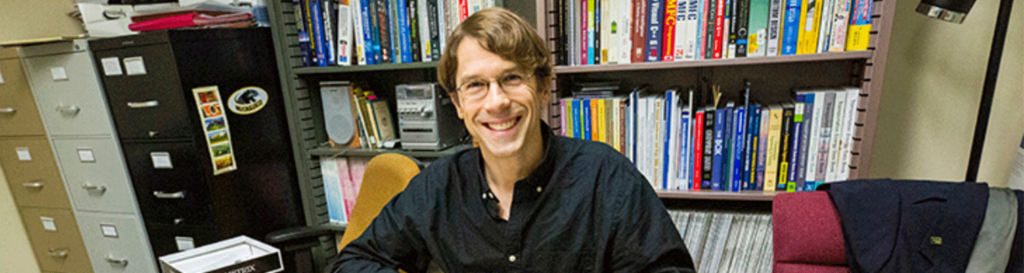
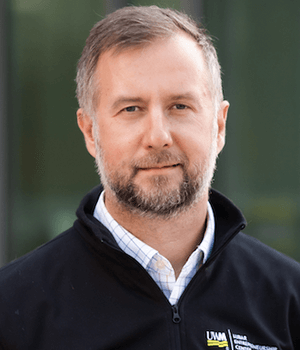
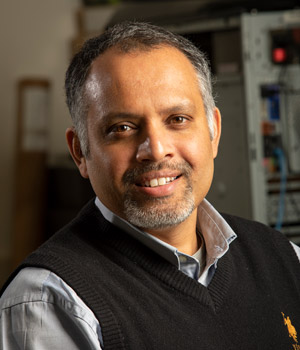
Industrial and manufacturing associate professor Matthew Petering uses his computer coding skills to solve complicated problems. Now, Petering has used that expertise to devise an algorithm he believes would take human bias out of the legislative redistricting process.
Congratulations to Jose Antonio Trujillo Parra, who is featured in the UWM slideshow of students with job offers before graduation. Trujillo is receiving a bachelor’s degree in electrical engineering. During his time at UWM, he worked as an undergraduate research assistant and served as a student ambassador for the College. Trujillo has been hired at the Johns Hopkins Applied Physics Laboratory, where he interned this year. Watch the video.
Cuzner lab partnership with local industry featured on WUWM
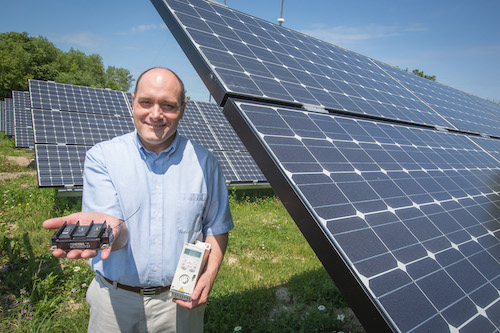
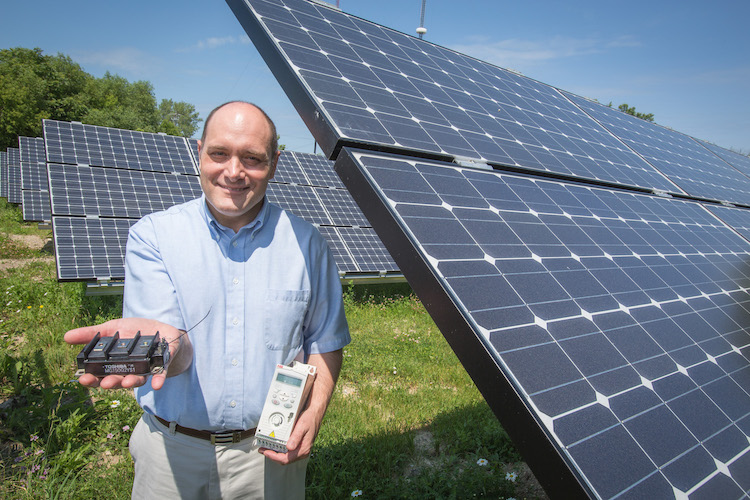
The College’s Center for Sustainable Electrical Energy Systems is teaming up with Badger Technologies Group, a Port Washington-based engineering firm, on a contract to produce and test a hybrid energy storage system for the Ellsworth Air Force Base in South Dakota. The system will make it easier to integrate renewable energy sources for the location, said Center Director Rob Cuzner, Richard and Joanne Grigg Associate Professor.
Satya Aditya Akundi honored with ASEE 2023 David Wells Service Award
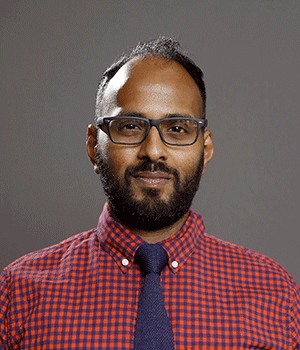
The American Society for Engineering Education Manufacturing Division honored Satya Aditya Akundi, Assistant Professor, Industrial & Manufacturing Engineering, with the 2023 David Wells Service Award. Akundi is the eighth person to receive this award since its 2017 inception.
The award is given annually in honor of Dr. David L. Wells (North Dakota State University), a founding member of the Manufacturing Division, who remained an active contributor throughout his lifetime. Honoring his engagement, awardees have supported and contributed to the manufacturing profession, education, and the ASEE Manufacturing Division management.
Sustainable electric energy expert Rob Cuzner discusses microgrids with Spectrum News
In November, Rob Cuzner, Richard and Joanne Grigg Associate Professor and Director of the Center for Sustainable Electrical Energy Systems at UWM, discussed his research on microgrids with Spectrum News.
Cuzner and his students shared the benefits of microgrids in helping the transition to renewable energy and their role in meeting demands for a technologically advanced energy workforce.
17 mechanical engineering grad students earn ME Graduate Research Achievement Awards
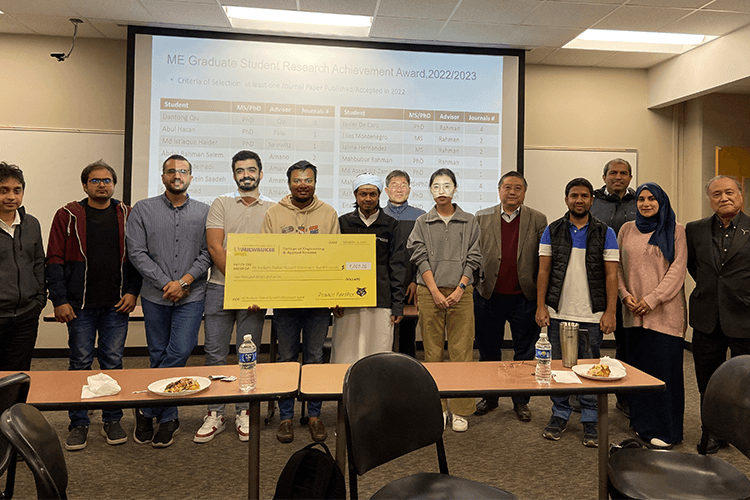
The Mechanical Engineering Department presented 17 students with Graduate Student Research Achievement Awards in November. The awards recognize students’ research accomplishments in 2022-2023, with publishing in journals being the main criterion.
Department Chair Deyang Qu praised the students’ accomplishments, stating, “Your hard work has played a significant role in helping UWM achieve and maintain its R1 research university ranking. Your commitment to research, disseminating knowledge through publications, and your support for your advisors with proposal writing have not gone unnoticed, and we genuinely appreciate your efforts.”
Congratulations to the following students and their advisors:
Asif Al Swapnil; PhD Student; Advisor: Habib Rahman
UWM support earns Association of Energy Engineers award
The Wisconsin Chapter of the Association of Energy Engineers (WAEE) received the National Division: Best Student Chapter Support Award during the Association of Energy Engineers (AEE) World Energy Conference and Expo held in Orlando, FL Oct. 24-27, 2023.
The AEE gives special recognition to chapters who have demonstrated notable contributions to the profession and exceptional service to the association. This award acknowledges the excellent support provided to UWM’s AEE student chapter.
The AEE student chapter at UWM was established in Fall 2022 with the help and support of WAEE. UWM was the first school in Wisconsin to earn an AEE student chapter charter post-Covid and is currently the only active student chapter in the Midwest. The student chapter plans to hold workshops related to renewable energy and energy efficiency solutions to increase awareness among UWM students.
Saif Al Hamad (left) accepted the award on behalf of WAEE from Bill Kent, AEE executive director.
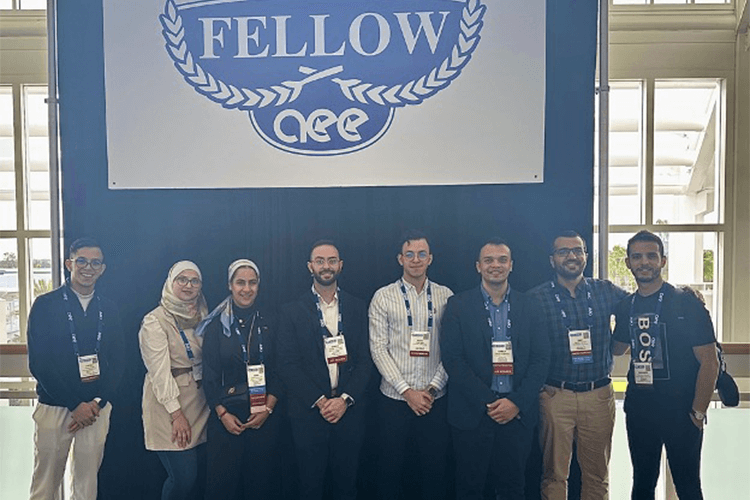
Six UWM students also participated in expo poster sessions during the event:
Effect of Winglet Direction and Cant Angle on the Performance of Small-Scale Horizontal Axis Wind Turbine Saif Al Hamad, PhD Candidate, Research Assistant and Energy Auditor at UWM’s Industrial Assessment Center
Towards Microgrids and Future Power Twins: Integrating Photovoltaic Innovation with Wastewater Treatment Plants (WWTP) Hamza Alnawafah, PhD Candidate
The Impact of Building Retrofits on Thermal Comfortability Areej Khalil, PhD Candidate, Mechanical Engineering
Biomass Energy Resources with Different Livestock Manures Cheikh Kada, PhD Candidate; Mohamed Maache, Graduate Student
Biomass Energy Resources with Different Livestock Manures Kada Kada, Graduate Research Student, UWM Industrial Assessment Center
Learn more about the UWM Association of Energy Engineers student organization and get involved here.
College celebrates renovated research spaces and researchers
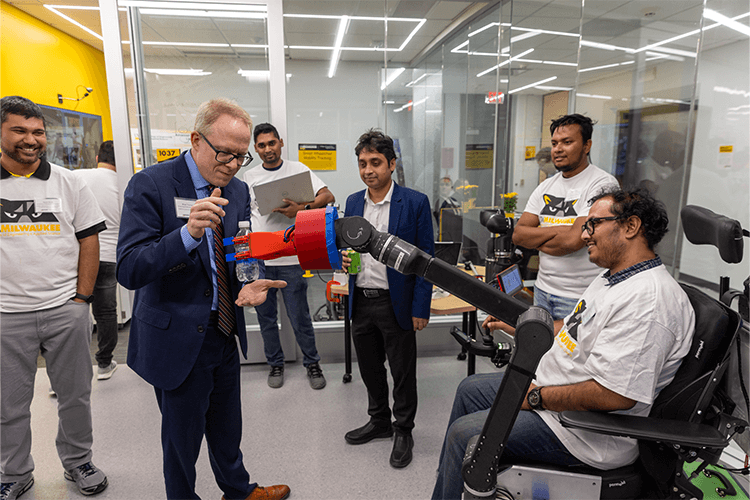
On Nov. 2 the College of Engineering & Applied Science showed off its newly renovated 9th and 10th floor research spaces to alumni, business and community partners. Dean Brett Peters noted that, in addition to sharing the incredible transformation of the space, the evening was also about highlighting the research and the work that faculty and students are doing in many different research focus areas and the collaboration these spaces foster. Close to 30 faculty and their students shared their research at the well-attended event.
Universities of Wisconsin President Jay Rothman attended the event as part of his OpportUWnity Tour, a statewide journey Rothman is making to each UW campus this fall. Chancellor Mark Mone also provided a welcome, thanking Rothman and the Universities of Wisconsin’s for the support and “fierce” advocacy on behalf of UWM, pointing to research as a major reason that businesses work with the university.
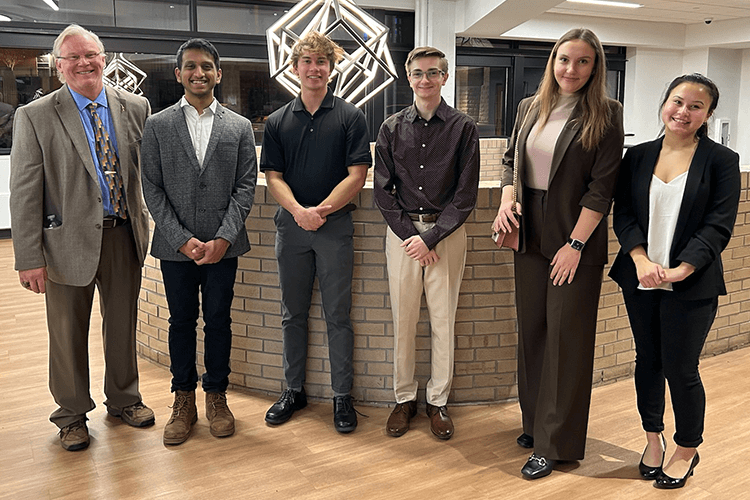
The UWM Chapter of Tau Beta Pi, Wisconsin Gamma, held their joint initiation ceremony with Marquette University and Milwaukee School of Engineering on Saturday, November 4, 2023 at MSOE.
Congratulations to the following College of Engineering & Applied Science students who were initiated into the engineering honor society, Tau Beta Pi, Wisconsin Gamma: Euxhena Cina, Joshua Harms, Elijah Kruse, and Hayley Singer. Officers include Abhi Tokala, President, Sydney Block, Secretary, and Noah Nettesheim, Treasurer.
The faculty advisor is Associate Professor Kevin J. Renken.
About Tau Beta Pi
Tau Beta Pi is the only engineering honor society representing the entire engineering profession. It is the nation’s second-oldest honor society, founded at Lehigh University in 1885 to mark in a fitting manner those who have conferred honor upon their alma mater by distinguished scholarship and exemplary character as students in engineering, or by their attainments as alumni in the field of engineering, and to foster a spirit of liberal culture in engineering colleges. There are 255 collegiate chapters at United States colleges and universities, 50 alumni chapters in 16 districts across the country, and a total initiated membership of over 632,650.
Congratulations to Ilya Avdeev and Roshan D’Souza, UWM Annual Fall Awards
The outstanding community-supporting and research efforts of two College of Engineering & Applied Science faculty members were honored at the UWM Fall Awards ceremony Oct. 25 at the Zelazo Center.
UWM Distinguished Public Service Award to Ilya Avdeev
Ilya Avdeev, Associate Professor, Mechanical Engineering, is director of innovation at the Lubar Entrepreneurship Center and cofounder of the I-Corps Site of Southeastern Wisconsin. He builds pathways for students, alumni and community members to engage in entrepreneurship.
He also uses his expertise in design thinking to spur innovation outside the boundaries of campus. The list of Avdeev’s contributions during his 14-year tenure at UWM includes his empowering Milwaukee Public School teachers become creative curriculum designers, helping neurodivergent K-12 students develop their skills and talents, and partnering with health care educators at the Medical College of Wisconsin’s Kern Institute to improve health care outcomes.
His recent collaborative work with MCW is a great example of the many community-facing projects involving critical issues that Avdeev has volunteered for or initiated. Under his leadership, more than 150 stakeholders participated in the design of a mobile clinic for underserved populations. UWM engineering students developed a full-scale clinic prototype that was used for multiple design sprints at UWM and MCW. The ideas generated will inform the build of the mobile clinic this year and next.
UWM Foundation Research Recognition Award to Roshan D’Souza
Roshan D’Souza, Associate Professor of Mechanical Engineering, leads groundbreaking research to enhance blood flow imaging, with the ultimate goal of deepening our understanding of hemodynamics and its impact on cardiovascular diseases. His team employs cutting-edge technologies, such as physics-informed neural networks, to improve MRI-based blood flow images for clinical use.
In 2016, D’Souza shifted his focus to medical image processing for cardiologic and neurologic vascular diseases, overcoming challenges to secure $1.4 million in recent National Science Foundation grants. Since joining UWM in 2009, he has received five NSF awards and served as a vital site principal investigator for an R01 grant from the National Institutes of Health.
Furthermore, D’Souza has established collaborations with esteemed institutions, including the University of Utah, Mayo Clinic, Harvard Medical School and the Medical College of Wisconsin, augmenting his impressive achievements.