Sung receives a $547,700 NIH grant to develop a next-generation, microscopic nuclear imaging technique

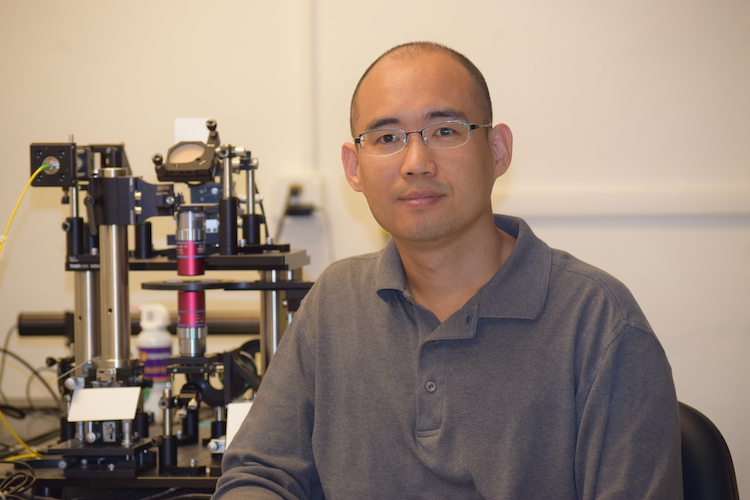
man looking at camera

Nuclear imaging, such as positron emission tomography (PET), provides superior sensitivity and specificity. That is why PET is widely used in hospitals to detect and stage different types of cancers in the body.

However, the resolution of PET images is limited. 

To overcome this, a group at Stanford University has developed a novel technique called radioluminescence microscopy (RLM) that also uses radioisotopes as tracers. But RLM can provide much higher resolution by directly detecting positrons, particles emitted by the radioisotopes, instead of annihilation gamma rays produced by the positrons.

RLM is the only technique that can measure the distribution of radioisotope uptake among single living cells, and it has led to many important discoveries.

The resolution of RLM, however, quickly drops as the sample thickness increases, which is common to microscopic imaging techniques detecting positrons. “That leaves scientists with no microscopic nuclear imaging technique with depth-resolving capability,” said Yongjin Sung, associate professor, mechanical and biomedical engineering.

Sung and his colleagues have been awarded a $547,700 grant from the National Institutes of Health to add the depth dimension to RLM.

Ultra-quick and ultra-tiny

In this grant, Sung is collaborating with Guillem Pratx, a professor at Stanford University who has pioneered advances in RLM, and Youngho Seo and Grant Gullberg, professors at the University of California-San Francisco who are PET imaging experts.

The idea enabling the innovation is to capture the 3D shapes of positron trails and track the positrons back to the radiotracers.

“The task is similar to taking a 3D picture of lightning at a microscopic scale,” Sung said.

“The positron trails disappear within tens of microseconds. However, using a method called snapshot optical tomography, we can capture their 3D shapes with a single snapshot.”

Living cells from a specific patient

RLM imaging takes place outside the human body and can be applied to the cells taken from a specific patient.

“With RLM, we can test all different types of radiopharmaceuticals and find the best therapy for that individual patient,” Sung said.

With the improved resolution and depth-sectioning capability, he said, the 3D RLM technique will open new doors to microscopic nuclear imaging and allow for testing new radiotracers using living, multi-cellular organisms before translating to small animals and human patients.
Five students inducted into Tau Beta Pi, the engineering honor society

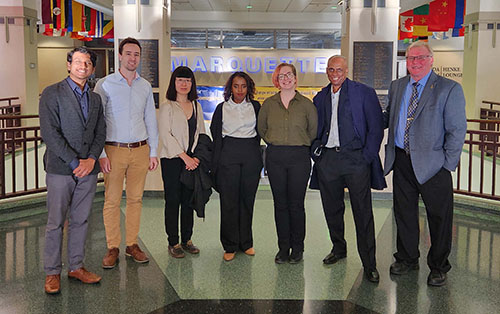
A group of 4 men and 3 women

Congratulations to the following students from the College who were initiated into Tau Beta Pi, the Engineering Honor Society: 

  • Cameron Abbey
  • Katherine Behlke
  • Byron Edwards
  • Shauna Gropp
  • Aurora Hope  

The UWM Chapter of Tau Bet Pi, Wisconsin Gamma, held its joint initiation ceremony with Marquette University and Milwaukee School of Engineering on Sunday, April 21.

Officers elected include Abhi Tokala, President; Elijah Jordan-Kruse, Vice-President; Kevin Monahan, Secretary; Joseph Netteshein and Grant Woodruff, Treasurer. The faculty advisor is Professor Kevin J. Renken.

Tau Beta Pi is the only engineering honor society representing the entire engineering profession. It is the nation’s second-oldest honor society, established to recognize student and alumni accomplishment in the field of engineering.

Undergraduate students in the top eighth of their engineering class in their next-to-last year or in the top fifth of their engineering class in their last college year are eligible for membership. Engineering graduate students in the top fifth of their class or whose high-quality work is attested to by a faculty member may be elected to membership.

Two alums honored in their work on behalf of sustainability by U.S. DOE

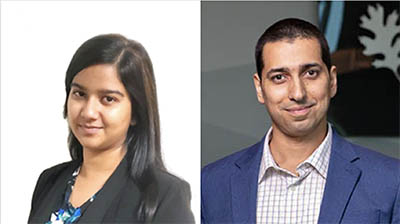
head shots of a woman, left and a man, right

Farah Nourin (’22 PhD, mechanical engineering) and Ahmad Abbas (’20 PhD, mechanical engineering) were among those recognized for outstanding achievement in energy engineering with an Industrial Assessment Center Alumni Award. 

While working on their degrees at UWM, Nourin and Abbas were members of UWM Department of Energy-sponsored Industrial Assessment Center (IAC), one of 37 around the U.S. They conducted energy assessments for small and medium-sized manufacturing plants to help companies increase efficiency and save money.

This award was established to recognize former IAC personnel for their outstanding accomplishments in promoting the practices and principles of energy engineering. 

Nourin is now working for Eaton Corporation as a senior product engineer. Abbas is currently senior manager for energy & sustainability with Walmart.

Amano’s hydro energy lab featured on Spectrum News

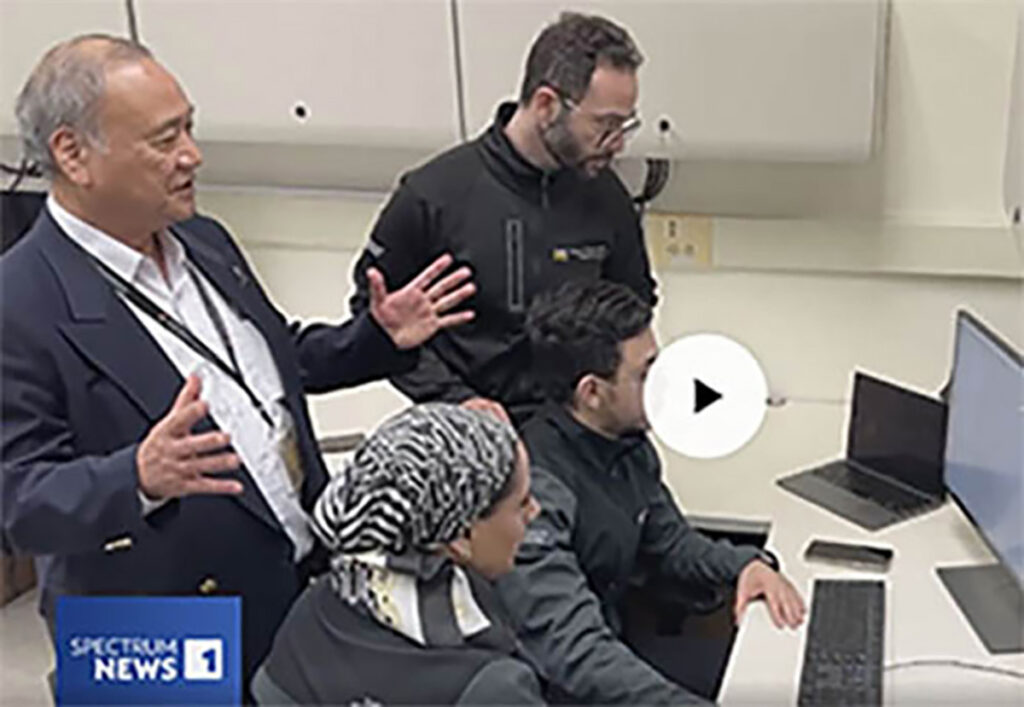
Three men and a woman looking at a computer screen.

Hydroelectric power accounts for about 6% of the total U.S. energy “pie.” But this renewable source isn’t as efficient as it could be. Some energy is lost because of a phenomenon called cavitation that damages the turbines. Researchers in Professor Ryo Amano’s lab are working on minimizing cavitation to squeeze out more energy and add to the lifespans of turbines.

Spectrum News recently featured three members of Amano’s lab in a broadcast report: Doctoral students Kada Kada and Asma Khasawneh, and postdoctoral researcher Ahmad Abdel Hadi showed reporter Phillip Boudreaux how they inject air into the working hydro turbines to keep the pressure high as the water passes through.

The goal is to reduce vibrations and the effect of bubbles that occur when they move from a liquid state to a vapor state. Then they use a high-speed camera to analyze the outcomes in real time. The researchers also are testing various designs of the turbine itself to address the problem. Watch the report.

Marks gives overview of student experiential learning at UWM

Laurie Marks, director of UWM’s Center for Student Experience and Talent (SET), will address members of the College at the April 12 faculty meeting to provide an overview of how internships, co-ops and other student real-life learning experiences are coordinated and how the reorganization affects the College.

She provides this description:

SET was established last year to provide a holistic approach to experiential learning and career development across campus, including the College of Engineering & Applied Science.  

There are four SET locations including Vogel Hall, the Student Union, Lubar College of Business and the College of Engineering & Applied Science.

The SET menu of services and programs includes:

  • Monday-Thursday walk-in career advising between 1-3 p.m. in addition to scheduled appointments.
  • Career communities based on a student’s intended field of work.
  • Career fairs and a more robust schedule of industry-based events.
  • Expanded internship opportunities.
  • Greater support for international student career development.
  • On-campus student employment experiences designed with professional growth in mind.

As part of this shift to centralization, there are new staff supporting engineering students.

Juli Pickering has taken on a new campuswide role as the Director of Employer Relations, Partnerships, and Events. A search will begin soon to fill Pickering’s previous position. However she will continue to work with the additional SET staff, Sean Lybeck-Smoak and Lauren Standish, who have been added to the support structure for engineering students.

If you have questions about SET or are interested in exploring a collaboration please contact Marks at lmarks@uwm.edu.

Multiple media outlets interview Tabatabai on Baltimore bridge collapse

Several media outlets featured comments from Habib Tabatabai, UWM professor of civil and environmental engineering, in their reporting of the collapse of the Baltimore bridge on March 26. Tabatabai is an expert in the structural safety and durability of bridges, particularly of cable-stayed bridges, the kind that the new bridge in Baltimore will likely be.

So, it isn’t surprising that Tabatabai has been interviewed by the media multiple times about the rebuilding of the Baltimore bridge.

In these stories, Tabatabai explained what distinguishes this kind of bridge. He also pointed out the widespread need to modernize physical infrastructure and the many considerations that go into deciding what kind of bridge to build at a particular site.

National Public Radio

WISC news, Madison

CBS 58 news, Milwaukee

Undergrad accepted to the prestigious GE Edison Engineering Development Program

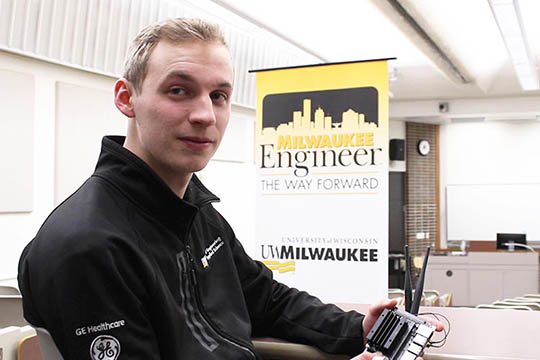
Nick Birschbach is a computer engineering major at UWM

Senior Nick Birschbach knew he wanted to study engineering and computing, but like many undergraduates, he wasn’t sure which of the many options to choose. To figure it out, he resolved to try as many experiences as possible in his journey to a UWM bachelor’s degree in computer engineering.

With his latest accomplishment, Birschbach gets to continue his “try it on” approach to career identification after graduation. He has been accepted into the two-year GE HealthCare Edison Engineering Development Program that will give him the opportunity to explore a variety of engineering roles in the company.

“I don’t really know what I want to do yet,” he said. “So, I’m hoping that, through this program and getting extra time to learn before setting myself on a specific career path, I can determine what I really want to focus on.”

William Dussault, teaching faculty in electrical engineering, describes the GE Edison program as the company’s nationwide talent search.

It consists of rotations, or eight-month stints, in various parts of the company, giving participants the chance to learn aspects of design and manufacturing, Dussault said. The program also includes coursework that will result in nine graduate credits for participants.

“They recruit from high-profile schools like MIT, Penn State, UW-Madison, Cornell and Georgia Tech,” Dussault said. “It’s a pretty big deal to get selected and Nick’s acceptance tells us that UWM produces the same caliber of engineers as those more expensive programs do.”

A desire to impact lives

Birschbach is excited about diving into the engineering behind GE HealthCare products, such as CT and MRI scanners, which produce highly detailed images of the inside of the body without invasive procedures.

“I’ve dealt with a lot of family members recently who were diagnosed with cancer and I think these machines are really important technologies that can save lives,” he said. “I’m excited to be able to use the skills I’ve learned here at UWM to pay it forward.”

Birschbach, who hails from Fond du Lac and graduates in May, completed two internships, conducted undergraduate research in assistant professor Roger Shen’s lab, was a campus ambassador from the College and joined a slew of student organizations. One of those was the UWM chapter of Engineers Without Borders that works to create potable water supplies for rural Guatemala.

Nick Birschbach lands a spot in GE HealthCare’s leadership training program.

Faculty and staff also opened doors

“UWM has helped me find my place in engineering in so many ways,” he said. “I’ve been able to be a part of many activities and also interact with so many amazing staff members, like those who gave me recommendations for the GE program, which really helped me get accepted.”

Adjunct Professor Jeffrey Kautzer is one of those staff who advised Birschbach. “As a student in electrical engineering, Nick was a clear standout with excellent technical design capabilities as well as polished communication skills,” said Kautzer, who is also chief electrical engineer at GE HealthCare. “We’re excited to have him on board and look forward to his future contributions.”

While the Edison Program promises some course credits toward a master’s degree, Birschbach has already gotten a jump-start on graduate school while still an undergraduate. He is enrolled in the College’s Accelerated Master’s (Integrated BS/MS) program which offers undergrads the chance to earn up to six credits toward a master’s degree without taking additional coursework.

“This is an amazing opportunity for UWM students,” Birschbach said, “because I get to take these master’s classes for the price of undergraduate courses.”

Gift from Dennis and Susan Webb supports engineering graduate students

UWM donors and alums

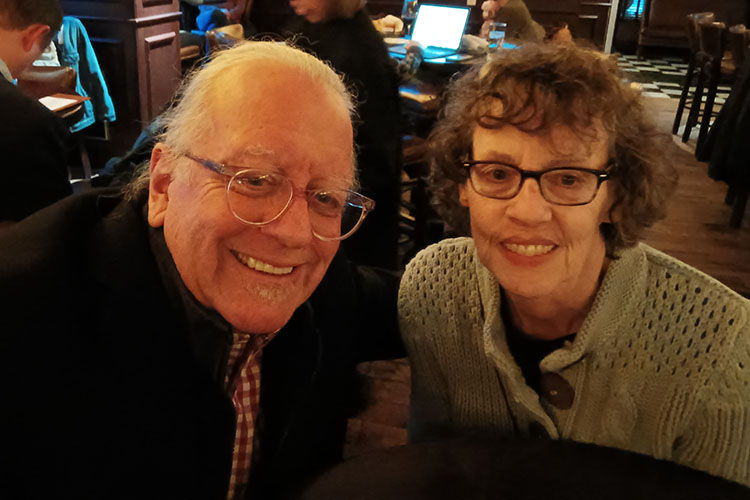
Alums Dennis and Susan Webb (’71 BS Materials Engineering and ’74 BA Art History, respectively) have made a generous gift that will provide financial support to graduate students enrolled in the College, with a preference for those pursuing a degree in materials engineering.

The $100,000 donation creates a fund that may be used for tuition, fellowships, assistantships, stipends, research, or any other purpose that furthers their education.

Making the gift was important to the Webbs, said Dennis, because of the couple’s love of the city and the particular needs of UWM students.

“It relates back to something Chancellor Mone said, that Milwaukee needs UWM,” Dennis said. “It’s a community college and a lot of students are either not able to finish their whole degree or, after they graduate, they can’t go on to graduate school because they don’t have the money.”

The Webbs have given to several other UWM causes, including support for the Panther Women’s and Men’s Basketball programs and backing for the UWM Research Foundation’s WEDC Bridge Program. That program benefits UWM’s entrepreneurs and their ventures with matching funds from the Wisconsin Economic Development Corporation.

As a board member of both the UWM Foundation and the UWM Research Foundation, Dennis Webb, who is also an entrepreneur, said he donated to the program with the aim of encouraging others to support it.

“I wondered if people understand that the WEDC is going to match gifts up to $100,000?” he said. “And so, I decided that I’d put my money where my mouth is.”

Dennis is president and owner of Sage-Water, LLC, and operates a lab at the UWM Innovation Campus Building, where he enjoys working with UWM engineering students on research.

Previously, he spent the majority of his career at Badger Meter, retiring as a senior executive.

For information on making a philanthropic donation, please contact Jean Opitz, director of advancement, at opitz@uwm.edu or (414) 229-5603.

Tabatabai interviewed by media about bridge collapse

man speaking to the camera

Two media outlets featured comments from Habib Tabatabai, professor in civil and environmental engineering, in their reporting of the collapse of the Baltimore bridge on March 26. Wisconsin ranks 23rd in the U.S. in a state’s percentage of bridges classified as structurally deficient, according to the American Road and Transportation Builders Association.

Tabatabai pointed out that the widespread need to modernize physical infrastructure, such as bridges, means the government has to prioritize the riskiest. Tabatabai is an expert in the structural safety and durability of bridges.

WISC news, Madison

CBS 58 news, Milwaukee

Engineers Week 2024 brought students together to eat, play and bond

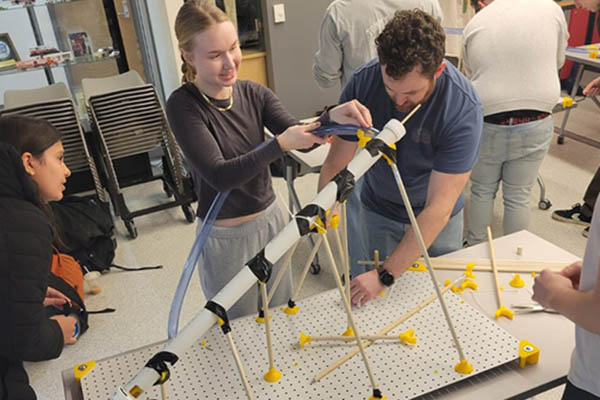
two women and one man working

Students participating in the College’s Engineers Week, held Feb. 19-28, came together to celebrate innovation and socialize.

They built marble runs with plastic tubing, used frosting and graham crackers to build an edible structure, browsed the numerous student organizations, and more than 300 students met employers at two different job fairs.

The just-over a week of activities culminated on Feb. 28, with the STEM Alumnight Networking Event, where multiple student organizations hosted a mixer for UWM alumni from STEM fields and current students to mingle and have fun.

At least one entire class, led by teaching faculty Madiha Ahmed in industrial engineering, took over the Modern Marbles activity one morning in the Kulwicki Garage. Mark Kiser, a sophomore in environmental engineering, enjoyed the experience.

“Participating in the marble activity really allowed me to interact with my classmates in a fun and engaging way, and really emphasized how important interpersonal cooperation and communication is,” Kiser said. “It was also a good place to start practically using the knowledge that we have been learning in our engineering courses, but in an informal way.”