Portfolio Management
In the first year, students are trained through writing research reports on stocks, stock and investment banking competitions, and in portfolio analysis. This is all to prepare them to manage the funds in the second year.
Second-year students in the Investment Management Certificate Program have a unique opportunity to learn by doing — through active management of real-money portfolios.
The students work on around $12 million of investment assets and actively manage over $6 million in assets for internal portfolios. This immersion into a well-constructed, real-life experience tests their skills and trains them to deal with the opportunities and challenges involved in managing a portfolio.
The students construct an investment policy and portfolio objectives for three portfolios that they present to a group of professional investors that are their “clients” early in the school year. They have sole discretion for the internal portfolios, subject to discussions at two more demanding meetings with their sophisticated clients later in the year and “doing their homework” on securities. At the meetings, each portfolio team must present its philosophy and process, investment strategy, portfolio performance and risk, portfolio evolution, and analysis of a security that reflects its approach to investing.
$6M in Internal Portfolios Under Active Management


Students work on four portfolios: Global Macro Fund, Milwaukee Growth Fund, and Panther Large-Cap Value Fund, and Panther Small-Cap Value Fund. Students choose which portfolio team will be their primary focus; however, all students have roles on the value portfolios for research, portfolio analysis, and/or client relations’ roles. Dana Investment Advisors uses the Panther Value Funds as models for its client portfolios (the Wisconsin Value Fund). Students in client relations roles are interns at Dana.
| Name | Rationale | Benchmark |
| Global Macro Fund | For students who love economics and want to learn about international investing and global economic cycles. | 1) 50% MSCI All Country World Index ex US (equity) 2) 50% Bloomberg US Aggregate Bond Index |
| Milwaukee Growth Fund | For investors who love to know about the latest trends. Over the long term, stocks rise with growth. | Russell 1000 Growth Index (mid and large US stocks) |
| Panther Large-Cap Value Fund | Many investors overlook what they pay for a company and only focus on growth. However, what you pay may be even more important. | Russell 1000 Value Index (mid and large US stocks) |
| Panther Small-Cap Value Fund | Small companies are often overlooked and mispriced. We dig deep to find opportunities. | Russell 2000 Value Index (small US stocks) |
Students develop economic-cycle models for the Global Macro Fund. These are passed down and enhanced each school year as they are quite sophisticated. The Growth Fund revises its philosophy and process each year to enhance the learning exercise. The Value Funds are consistent since this portfolio is brought to market through Dana. The best managers devise a robust and consistently apply investment approach year in and year out. Click here to review the Value Fund’s way of investing.
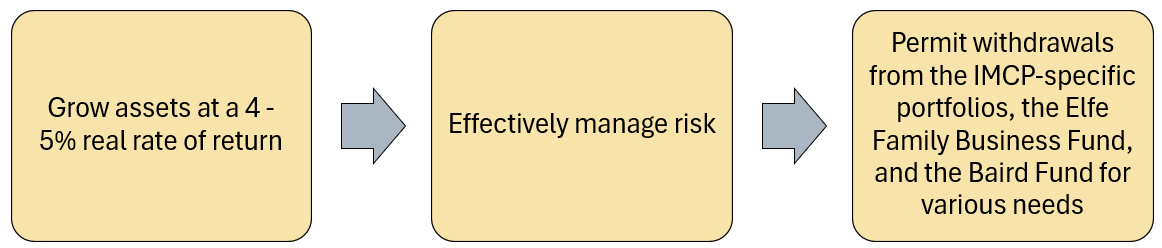
The total funds objectives are the grow assets at a real rate of 4-5% and effectively manage risks. We withdraw for various IMCP and other UWM Colleges and Schools’ needs (scholarships).
Partnership with Elmbrook Humane Society Endowment Fund
Since 2014, students in the Investment Management Certificate Program (IMCP) have worked on projects for Elmbrook Humane Society (EBHS) for its approximately $5 million+ portfolio. This is valuable work for an entity that cares for and about both animals and people. Thus, students learn while doing a good deed for society. The portfolio includes equity mutual funds and ETFs, bond mutual funds and ETFs, and individual stocks. The first project involved work on an investment policy statement, and multiple times most years, students meet with EBHS’s investment committee (the committee makes the investment decisions) to discuss positions, performance, risks, opportunities, and issues. Graduate students are required to participate in this work, but all IMCP students are welcome to help.