When someone is diagnosed with a neurological disorder like ALS or Huntington’s disease, life changes immediately — and not just for them.
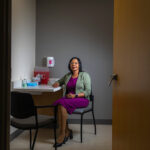
Caregiving often falls to immediate family members, even if they are still children. As a clinical social worker, Melinda S. Kavanaugh saw this firsthand while working with families affected by Huntington’s disease at the Washington University School of Medicine in St. Louis.
“A child was talking to me about the intricacies of disinfecting his dad’s feeding tube and how he needed to be so very careful,” Kavanaugh said. “It’s imprinted on my brain. I’ll never forget that.”
Now a professor of social work at UW-Milwaukee, Kavanaugh has spent her career conducting research and developing training and tools to help other young caregivers and their families.
Filling a gap for young caregivers
Kavanaugh already had years of experience as a social worker supporting families and young caregivers when she enrolled in UW-Madison’s doctoral program to study caregiving. She threw herself into research on the issue — and found very little.
“At the time, in the U.S., there really was one person doing any work in this area,” Kavanaugh recalled.
She spoke to many neurologists and other medical professionals who were surprised to learn that children and teens are the ones caring for their parents.
“There is sometimes a knee-jerk reaction that there’s something intrinsically wrong with a child providing care to a parent,” Kavanaugh said. “But being a child or youth caregiver is not a bad thing. So many of these kids get a sense of fulfillment by participating in care. It’s the continued isolation that makes it a problem.”
Her research and boots-on-the-ground clinical experiences led Kavanaugh to develop a wide range of resources for youth caregivers. Some are coloring books and graphic novels that speak to them directly. Other resources are for adults who may need to explain a complicated and stressful medical diagnosis. The materials have been translated into multiple languages to help youth caregivers and their families around the world.
Kavanaugh also created YCare, which teaches children and teens how to provide medical care in the home safely and confidently.
Her goal is to make youth caregivers feel supported, respected and seen. Because the federal government doesn’t recognize anyone under 18 as a caregiver, children and teens don’t have the same resources and support that adult caregivers receive, Kavanaugh said.
“They just need support,” she continued. “They need kids who understand it. They need peers who aren’t going to make them feel weird. They need adults who will surround them with kindness.”
Expanding reach through research and film
About 5.4 million children and teens provide care to family members in the United States, according to a study conducted by the National Alliance for Caregiving and AARP. The problem, as Kavanaugh sees it, is a lack of understanding of young caregivers’ needs and funding to support them.
She’s working hard to change that with several major research projects. One centers on young caregivers in military connected and veteran communities. Another project focused on Latino and African American youth caring for family members with Alzheimer’s disease.
Recently, Kavanaugh partnered with Global Neuro YCare and the ALS Association to produce a short film, LUKi & the Lights, which tells the story of a robot filled with lightbulbs who is diagnosed with ALS. The robot’s mobility slowly declines and lights go out as the disease progresses. The film has no dialogue, making it accessible in any language or geographic region. LUKi & the Lights won Best Animation US Short Film at the 2024 New York Animation Film Awards and was long listed for an Oscar in 2024.
But Kavanaugh isn’t chasing accolades. What she cares most about is the human impact of her research.
“To be able to do research outside of something you’ve read in a book, in an area that you’ve seen hands-on in a home, in a hospital — it gets in your soul,” Kavanaugh said. “And that’s what carries you through all the years and all the work.”