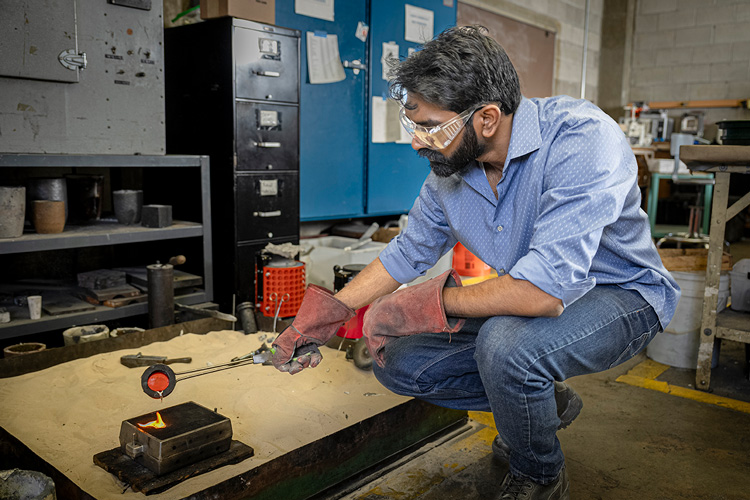
It’s a typical evening at the bar, glasses clinking and conversation humming, until an unusual sight warrants a double take. At a nearby table, a young man in a T-shirt and jeans — and safety goggles and gloves — appears to be casting metal. Tiny furnace burning and molten tin pouring, a curious crowd is forming fast. Once they realize they’re invited to join in, their surprise turns to excitement. This is definitely not your average Milwaukee happy hour.
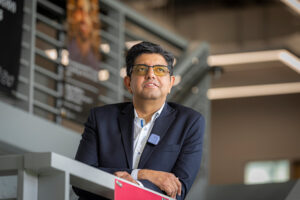
The man behind the metal is Swaroop Behera, a doctoral student in engineering at the University of Wisconsin-Milwaukee. He’s running Foundry in a Box, a portable outreach kit designed to give people a hands-on intro to metal casting. If you’re lucky enough to stumble across one of these pop-up events, you might walk away not only with a new appreciation for applications of materials science in engineering, but with a freshly cast metal keychain you made yourself.
Recasting Foundry in a Box
Behera has long been active in student organizations, from arts and cultural clubs during his undergraduate studies in India, to international student groups at UWM and, most recently, the student chapter of the American Foundry Society. Participation in the chapter had dwindled —until Behera stepped up as president. He revitalized the group with a new outreach focus, aimed at getting middle school, high school and even UWM undergraduate students excited about how studying metals could enhance their skills in a variety of engineering fields.
“A lot of students have never heard of it,” Behera said. “But so long as anyone is making something out of any metal, metal casting is going to be there.”
That’s where Foundry in a Box comes in. The ultra-portable demonstration allows anyone (even Milwaukee bar patrons) to create their own metal souvenirs using molten tin, showing the metal casting process in a tangible and engaging way. While the activity had existed for years, Behera expanded its reach at UWM, increasing participation from a handful of students each year to hundreds and building partnerships with local schools. In March, Behera co-presented on Foundry in a Box at a Wisconsin Technology Education Association conference —the session was so full that it was standing room only, he said.
“It’s a very simple tool for getting the creative juices flowing in students,” Behera said. “When they make something with their own hands, their mind and their heart attaches to it.”
The path ahead
The success of Behera and his fellow metal casting students hasn’t gone unnoticed. The Foundry Educational Foundation, a national organization dedicated to bridging the gap between universities and industry, was so impressed that it launched a new fellowship to support graduate students in UWM’s College of Engineering & Applied Science. Behera became its first recipient, earning three years of support for his studies and outreach initiatives.
Behera’s graduate research focuses on developing new aluminum alloys that could one day replace titanium in high-temperature applications. His work could have major implications for industries that rely on lightweight yet strong materials, from aerospace to manufacturing.
As he nears the completion of his PhD, Behera is weighing his next steps. While he loves teaching and outreach, he’s also drawn to industry, where academic innovations move from concept to reality.
“Science has gone really far ahead, and technology is playing catch-up — that’s where materials science comes in. You’re always trying to figure out and solve a specific problem for a given industry,” he says.
Regardless of where he ends up, one thing is certain: His passion for engineering and his commitment to inspiring the next generation will remain at the heart of his work.
“Whatever gives me the opportunity to continue spreading knowledge — I would love to continue doing that.”