The UWM Research Foundation has awarded more than $250,000 in Catalyst Grants to six research teams, whose projects range from cancer diagnostics and clean energy to rehabilitation robotics and tools that support equitable decision-making in regulated professions.
The Catalyst Grants Program, supported by the Lynde and Harry Bradley Foundation and Invenergy, is designed to support early-stage research in areas where UWM has the greatest potential to impact the regional economy through commercialization.
Each team is using the funding to develop new ideas that tackle urgent community needs and get them ready for real-world use. Projects include:
Precision cancer diagnostics
Ashwin Narasimhan, visiting assistant professor, and Priya Premnath, assistant professor, Biomedical Engineering
The researchers are developing a liquid biopsy platform to isolate rare circulating tumor cells with greater accuracy, improving early cancer detection and personalized treatment planning.
Next-Generation power conversion for energy storage
Feng Guo, assistant professor, Electrical Engineering
Guo is prototyping a novel power converter to improve the efficiency and cost-effectiveness of battery storage systems, enabling better integration of renewable energy.
Environmental monitoring and agrochemical development
Rebecca Klaper, dean and professor, Freshwater Sciences, and Eric Ostovich, postdoctoral researcher
Klaper and Ostovich are developing a novel algal-based assay that uses genetically engineered cells to detect how chemicals affect aquatic ecosystems. This technology offers a faster, more informative alternative to traditional toxicity tests.
Targeted cancer therapy
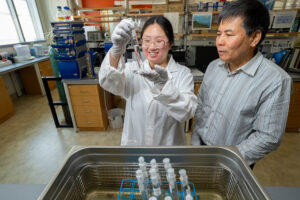
Xiaohua Peng, professor, Chemistry & Biochemistry, and Taufeeque Ali, research assistant, Chemistry & Biochemistry
Peng and Ali are developing a targeted cancer therapy that combines a novel prodrug with vitamin C to selectively kill cancer cells while sparing healthy tissue.
Rehabilitation robotics for bedridden patients
Habib Rahman, professor, Mechanical Engineering
Rahman is creating a portable, bed-attachable robotic exoskeleton to deliver early-stage lower-limb therapy, reducing caregiver burden and improving recovery outcomes.
Decision-support algorithm for nursing educators
Christopher Peters, assistant professor, Nursing
Peters is developing a decision-support algorithm to help nursing educators consistently and fairly evaluate student background checks. The algorithm reduces legal and ethical risks while supporting workforce development.