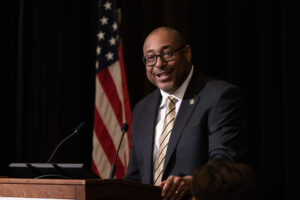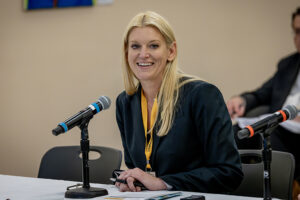
Several UW-Milwaukee administrators presented reports Thursday to the Universities of Wisconsin Board of Regents during the board’s meeting on UWM’s campus.
Report on campus infrastructure
The Board of Regents heard a report on UW-Milwaukee’s priorities for campus capital projects.
These projects include the next long-range planning process – which will launch this summer –the start of the Health Sciences building renovation this fall, and early stages of the Engineering and Neuroscience project, which is the next major priority for UWM, said Robin Van Harpen, senior vice chancellor for finance and administrative affairs.
The long-range planning process will involve a yearlong campus space inventory and study of the condition of all existing facilities, said Jen Francis, director of campus planning. The planning team will analyze that data, make recommendations and issue a final planning report. Campus stakeholders including students, faculty, and community partners will be consulted throughout the process, she said.
“We are also excited to work with the School of Architecture and Urban Planning, engaging planning and architecture students and conducting student-to-student engagement activities,” Francis added.
The previous long-range campus plan, completed in 2010, set in motion changes for the Northwest Quad, including the upcoming renovation of the Health Sciences building, as well as the Southwest Quad, which featured construction of the new Chemistry Building and demolition of the old Chemistry Building.
The Engineering & Neuroscience Project, a priority for the 2027-29 capital budget, will involve renovation of the Engineering & Mathematical Sciences Building to create new collaborative engineering, math and computer science spaces for students.
The current Physics Building also will be demolished and the UWM Planetarium relocated, said Melissa Spadanuda, associate vice chancellor of facilities, planning and management.
On the site currently occupied by the Physics building, UWM plans to construct a new STEM facility to house the Psychology-Neuroscience programs and shared interdisciplinary spaces.
“These programs have outgrown and evolved beyond the design of their current buildings,” Spadanuda said. “Lack of modern technology-rich engineering and neuroscience space is a competitive disadvantage for recruitment, enrollment, retention and research.”
Report on affordable course materials
Tina Freiburger, interim provost and vice chancellor of academic affairs, described to the regents’ Education Committee UWM’s efforts to make course materials affordable for students, noting that textbook costs are a barrier to student success.
“When students can fully participate in a course from the first day without worrying about whether they can afford required materials, they are better positioned to engage, persist and succeed,” Freiburger said.
The Midwest Higher Education Compact noted in its 2019 report that students budget more than $1,200 each year for course materials. Affordability is a priority for UWM as an access institution where 36% of students are eligible for Pell grants.
UWM has worked for more than a decade to make course materials less expensive for students, Frieburger said, through measures such as open educational resources textbooks, which are openly licensed and available for free.
Faculty members also are encouraged to develop curricula using high quality, low-cost materials, including instructor-made packets and texts available at UWM libraries. If the total cost for textbooks for a class is less than $25, instructors can include this information in the Schedule of Classes. Small grants also are available to students to cover textbook costs.
In 2024-2025, UWM Libraries saved students $1.7 million in course materials, benefiting more than 28,000 students in more than 350 courses and 600 sections, Freiburger said.
Athletics report
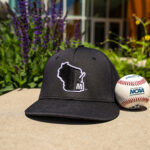
Director of Athletics Amanada Braun shared good news about athletic successes, most recently the baseball team’s exciting run in the NCAA Tournament.
The Panthers won the Horizon league title, sending the team to the NCAA tournament for the first time in 16 years, then won two tournament games for the first time in school history. But their success prompted excitement across the state of Wisconsin and in the UWM community. More importantly, it drew national attention to the university, including 3.3 million views on Instagram and 2.1 million impressions on X (formerly Twitter).
Baseball wasn’t the only successful team: UWM teams had 12 top three finishes in the Horizon League in the 2025-26 academic year. In addition, hurdler Natalie Block competed in Olympic trials last year and just missed making the NCAA Championships semifinals last week, as she wrapped up her stellar, record-setting college career.
UWM student-athletes have had consistent academic success as well. In Fall 2025, athletes had an overall GPA of 3.46. They also have had 51 consecutive semesters of GPAs of 3.0 or higher, with 22 consecutive semesters of 3.2 or higher.
Braun also noted that UWM athletes develop outside of sports and the classroom by engaging with the community. “We tell them if you’re going to be part of Milwaukee (the team), you’re going to be part of Milwaukee,” Braun said.