
Conversations, whether they’re about big ideas or personal convictions, are a central part of life on a college campus. But learning how to talk with others in an open, respectful way can be challenging. It takes work to truly listen to someone with a different perspective.
Last spring, UWM set up 10 dinner dialogues so students could practice exactly that. They gathered around dining room tables to listen to fresh points of view, offer up ideas and connect through conversations. These dinner dialogues, led by graduate students studying facilitation for peacebuilding, were part of a civil dialogue project funded by a grant from the Wisconsin Institute for Citizenship & Civil Dialogue (WICCD). Hear more from participating students and project leaders in this brief video.
A table that invites conversation
In addition to the dinner dialogues, the grant supported the construction of a “civil dialogue table,” which is designed to promote active listening and open conversation. The round-ish table is set up for six people in Room W119 in the Student Union. Students, faculty and staff can reserve the table to practice civil dialogues.
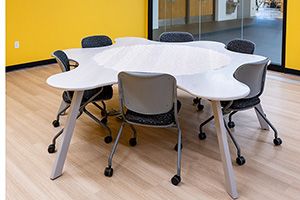
The table’s legs splay out and its top curves in and out around the chairs, enveloping each person as they’re seated around it. The center of the table features different textures — a design that’s intentional.
“This prevents people from placing objects at the center,” said Sergio Lopez-Pineiro, an assistant professor of architecture. “The space in front of you remains empty of objects, so the conversation remains more uninterrupted.”
This means no plopping down and mindlessly flipping open your laptop, which can block you off from others.
“The point is that the table visually welcomes people and is devised as a tool to define the space in a conversation of people,” Lopez-Pineiro said.
He and architecture master’s student Alec Regan designed the table as part of the WICCD grant-funded civil dialogue project at UWM.
Members of the campus community are welcome to reserve the civil dialogue table through the standard meeting room process in the Student Union. For same-day requests, visit the Event Services office on the third floor of the Student Union.
“The important thing isn’t the table; it’s just a device,” Lopez-Pineiro said. “The important thing is that people bring their own points of view.”
A new initiative this fall
UWM continues the work this fall with the Renewing Our Civic Culture initiative, which is intended to demonstrate how respectful dialogue across differing perspectives can help to bridge divides, reduce polarization and foster empathy. By encouraging deeper mutual understanding and highlighting common values and concerns, this effort aims to strengthen the fabric of UWM’s civic community.
“Across the country, we are witnessing a growing culture of incivility in both public and personal interactions. In response, we launched the Renewing Our Civil Culture initiative, recognizing that academic environments are uniquely positioned to cultivate civility,” said Chia Youyee Vang, vice chancellor for community empowerment and institutional inclusivity, and a history professor. “This effort goes beyond encouraging dialogue — it equips individuals with the tools for respectful, thoughtful conversation that enriches learning and empowers them to positively shape the communities they are part of.”
The campus is kicking off the initiative with the “Renewing Our Civic Culture Lecture and Dinner,” featuring Jed Atkins, dean of the School of Civic Life and Leadership at UNC-Chapel Hill, on Oct. 17 from 4-7:30 p.m. in the UWM Student Union Ballroom. Atkins’ lecture will be followed by a meal with facilitated dialogue at each table. The event is free to the public and is made possible by a grant from the Tommy G. Thompson Center on Public Leadership. Register at this webpage.
Students want to engage and learn
This fall’s initiative is a collaboration of several campus partners, led by the Divisions of Community Empowerment and Institutional Inclusivity and Student Affairs.
“We know that many students are drawn to UWM because they’re interested in learning from and engaging with individuals who have different ideas, backgrounds and experiences than they do,” said Kelly Haag, vice chancellor for student affairs. “So, providing spaces and events that encourage interactions like these is vital.”
In his lecture on Oct. 17, Atkins will explore how civil discourse can be taught and practiced on campus. He’ll draw from real-life stories in the classroom and beyond and demonstrate how higher education equips students to be full participants in our democracy.


