Maggie Armstrong loved spending childhood summers in northern Wisconsin on Big Fork Lake in the town of Three Lakes, where she and her family boated, swam and fished.
“The entire summer was basically built around the lakes,” she said.
So when the Waukesha native learned, in her first week of college, that it was possible to make a career as a freshwater lake scientist, “I never looked back,” Armstrong said.
After earning a bachelor’s degree in water resources at UW-Stevens Point, she wanted to deepen her knowledge. This led her to UW-Milwaukee for the master’s program at the School of Freshwater Sciences, where she focused on how humans influence the health of lakes. “We humans can be a problem, but we can also be a solution,” she said.

At UWM she took courses in science, environmental law, nonprofit grant-writing and communicating with the public about lake ecology. She completed a cross-cultural business course through the Lubar College of Business, where she and classmates participated in X-Culture, a program that grouped students from around the world in teams to tackle business challenges.
“It was good to try to optimize the range of skills and perspectives available to you when you have all these different people on a team,” she said.
Armstrong also completed a summer internship in Alaska, where she helped track fish movement and use environmental practices to halt shoreline erosion.
After she graduated from UWM in December 2016, Armstrong was ready to enter the field. “I thought, ‘Lakes are experiencing challenges and I want to be part of the solution.’” But over the holidays that year, her family began pushing her to dream bigger and apply to doctoral programs.
To get them all off her back, she applied to a single program, funded through the European Union’s Marie Skłodowska-Curie Actions. To her surprise, she received one of 12 spots for early career researchers studying freshwater lakes. Armstrong was selected for a PhD project with a strong social sciences element and felt her UWM degree was especially good preparation.
This program involved dividing her time between universities in the Netherlands and Spain and completing hands-on projects in both countries. Ultimately Armstrong received doctoral degrees from each of the two universities.
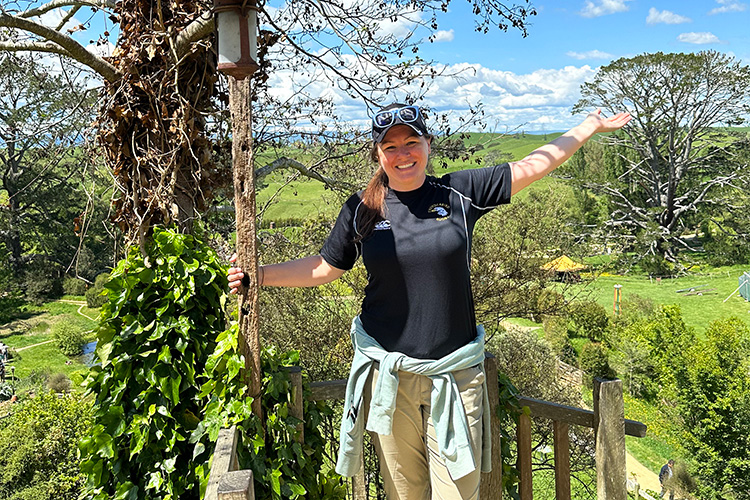
Next, Armstrong completed a three-year postdoc on the North Island of New Zealand, where her work included the use of computer models to predict how various factors affect lake health.
“If you had an influx of nutrients from shifting land uses or practices, for example, we could model how the lake would react,” Armstrong said.
She also led discussions with landowners about the challenges of balancing lake health with profits.
Her postdoc now complete, Armstrong is back where it all began, on Big Fork Lake. She is staying there while sending out applications for her next role and reflecting on how her life has surpassed her earliest dreams.
“That younger me grew up to get two PhDs in Europe, spend three years in New Zealand, and be part of an international network of scientists,” Armstrong said. “To be able to call up friends in China, the Netherlands, New Zealand or India and say, ‘Hey, how are you doing?’” I never imagined that.”
Story by Erin O’Donnell | Originally published by UWM News as part of the Always Dream Bigger series for Chancellor Gibson’s Inauguration