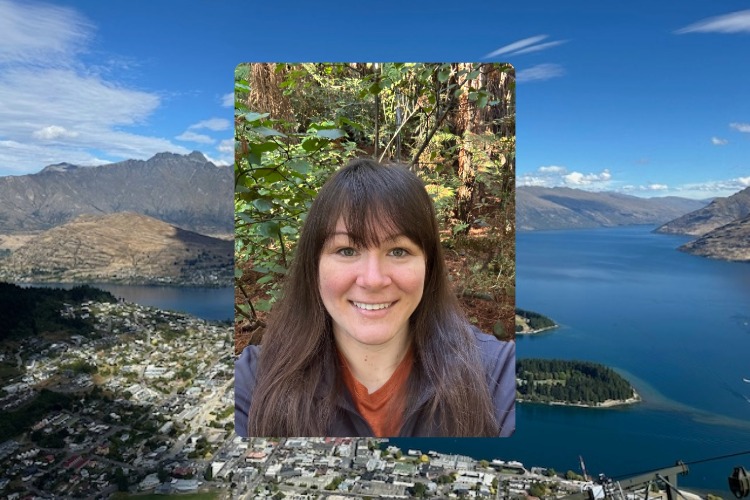
How one professional master’s alum turned her degree into a global science adventure.
From Wisconsin to New Zealand, professional master’s alum Maggie Armstrong has followed the current of freshwater science across continents. Her journey shows how curiosity — and saying “yes” to unexpected opportunities — can open doors to a global research career. We recently chatted with Maggie, despite varying time zones, to hear what she’s been up to!
Where are you from originally, and what first drew you to freshwater science?
Maggie: I’m a born-and-raised Wisconsinite from Waukesha. Growing up, I thought I wanted to be a veterinarian or a wildlife ecologist — I loved being outdoors and studying animals. I went to UW–Stevens Point for my bachelor’s degree and quickly realized there was an entire field dedicated to freshwater science. Having spent summers on northern Wisconsin lakes and living near Lake Michigan, that clicked instantly. From day one, I knew I wanted to work with water.
What led you to pursue your master’s at the School of Freshwater Sciences?
Maggie: I graduated from Stevens Point with a solid foundation in water resources but wanted to go further. The professional master’s program at UWM was perfect — it blended the technical science I loved with applied management and policy. I was especially drawn to courses like water law and economics, which opened my eyes to how science supports decision-making. I really appreciated that the program was flexible and had such a diverse cohort of students from different backgrounds.
After earning your master’s degree, how did your career take shape?
Maggie: I graduated in December 2016 and told myself I was ready for the workforce — no PhD for me! But family and friends kept suggesting it, so I decided to apply to just one program. I found this incredible European Union–funded network of PhD positions across Europe and applied mostly to prove I could. Months later, I was offered a position! Within a few weeks, I packed up and moved to the Netherlands.
My PhD focused on freshwater lake ecosystem services and how they function under extreme climate events. It took me across the Netherlands, Spain, and even through COVID lockdowns in Europe. That experience really shaped how I see the connection between research, management, and communities.
And now you’re working in New Zealand — tell us about that!
Maggie: Yes! My postdoc brought me here a couple of years ago. I’m working on modeling projects that look at how to manage lakes under changing environmental conditions. Modeling was a skill I hadn’t developed during my PhD — thanks to COVID — so this role has helped fill that gap. I’ve also been mentoring students and collaborating with researchers around the world through the Global Lake Ecological Observatory Network (GLEON).
You’ve lived and worked in several countries. What’s been the most impactful part of those international experiences?
Maggie: Everywhere I’ve worked has a unique approach to science and water management — but at the core, the goals are the same. In the Netherlands, for example, they’re incredibly inventive because much of the country is below sea level. In New Zealand, the Māori iwi (tribal groups) are deeply connected to their lakes and rivers and serve as guardians of those systems. Collaborating with them has been incredibly meaningful — it’s a model for how science and culture can work hand in hand.
What aspects of the professional master’s program prepared you most for your research career?
Maggie: The biggest thing was learning to think beyond the lab. Science doesn’t stop at publishing papers — it needs to reach decision-makers and communities. The program really emphasized applied science and management. Courses in economics, communication, and even business gave me perspective on how different disciplines intersect. I even joined a business competition on a cruise from Miami to Mexico! I was definitely the only scientist there, but it taught me how to collaborate across worlds.
What kinds of research questions or projects excite you most now?
Maggie: I’m passionate about transdisciplinary work — bringing together scientists, policymakers, and the public to solve freshwater challenges. During my PhD, I co-created a game to help people understand how lakes respond to climate impacts. It started as an open-day activity, then became one of my thesis chapters. We also surveyed lake managers to learn how they use scientific research in decision-making. Whether it’s games, modeling, or social surveys, I love finding new ways to connect science with people.
Is there a project you’re especially proud of?
Maggie: Definitely that game project! It showed how fun and collaborative science can be. It turned complex ecological processes into something visual and interactive. Seeing people engage and learn from it — that was the moment I thought, “Yes, this is what science can be.”
What advice would you give to students considering the PSM or studying freshwater sciences?
Maggie: Take the opportunities. Say yes to things that interest you, even if they seem outside your comfort zone. During the PSM, I got involved with outreach, classroom visits, and extra projects that shaped who I am as a scientist. You might start with a clear idea of what you want to do, but freshwater science touches everything — there’s a whole world of perspectives and possibilities.
You’ve had such a global career already — what’s next?
Maggie: I’m still figuring that out! My postdoc wraps up in about nine months, and I’ve started the job search early this time. I’m not done wandering the world yet, but ideally, I’d like to continue working internationally — maybe back in Europe or in Canada. Wherever I go next, I want to keep bridging science and management to make real-world impact.
Curious about our professional master’s program? Learn more on our website. You can also fill our form to request more information and get connected to our academics team.