Howdy, BugFans,
What an awesome beetle – thanks to BugFan Dave for sharing it!
There’s not a whole lot of information out there about this species, and there’s some misinformation (more about that in a sec), so let’s sneak up on it, taxonomically. Tri-colored harp ground beetles are in the Ground beetle family Carabidae, a huge (34,000 species), cosmopolitan (found ‘round the world) family of often metallic or dark and shiny, mostly nocturnal (except for the wonderful, diurnal Tiger beetles and a few others), carnivorous beetles whose eggs, larvae, and adults tend to live under debris or in crevices on/near the ground. (The BugLady wouldn’t want to diagram that sentence.) Most insects have a one-year life span and spend more than three-quarters of it in the larval, nymphal, or naiad stage, but Ground beetles may live two or three years as adults.
Tri-colored harp ground beetles are in the subfamily Harpalinae, the Harp ground beetles, which, with about 6,400 species worldwide (1,230 in North America) is the largest subfamily of Ground beetles. Lots of species, lots of variety, and lots of lifestyles, and some species are considered biological controls for nuisance insects. Like other Ground beetles, Harp ground beetles defend themselves chemically with noxious or odorous secretions from pygidial glands located toward the rear of the abdomen. According to Wikipedia, the members of another Carabid subfamily, the Anthini, “can mechanically squirt their defensive secretions for considerable distances and are able to aim with a startling degree of accuracy; in Afrikaans, they are known as oogpisters (“eye-pissers).“
Members of the genus Chlaenius are called “Vivid Metallic Ground Beetles.” Chlaeri comes from a Greek word for “cloak” and refers to the pubescence (fine hairs) on the dorsal side of the elytra (wing covers). The pubescence that may wear off as the beetle moves through its world. Here are some close relatives:
- https://bugguide.net/node/view/1516694/bgimage,
- https://bugguide.net/node/view/2506203/bgimage,
- https://bugguide.net/node/view/2044112/bgimage,
- https://bugguide.net/node/view/891445/bgimage.
A really, big Chlaenius beetle would approach an inch in length.
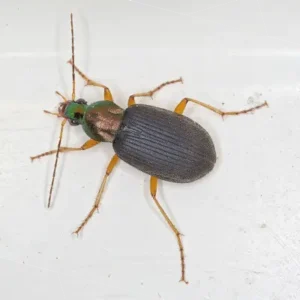
Tri-colored Harp Ground Beetles (Chlaenius tricolor) aka Yellow and Green Harp Ground Beetles, are divided into two subspecies. One (Chlaenius tricolor tricolor) is found east of the Rockies from Canada south to Georgia, and the other one (Chlaenius tricolor vigilans) lives west of the Rockies from Canada to Guatemala. They’re found under leaf litter or logs in damp areas and shores of rivers and bottomlands. They go through life at a run.
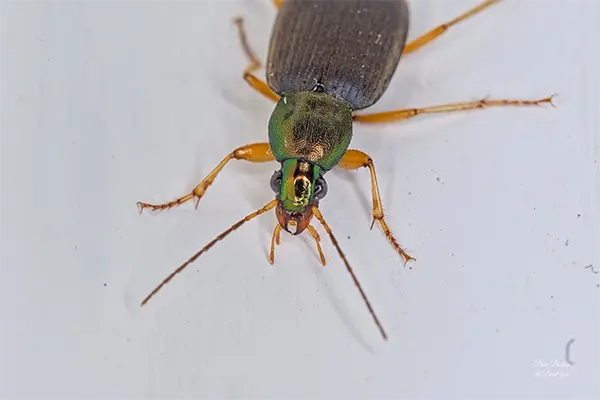
They’re about a half-inch long and iridescent, and one source speculated about the need for/use of iridescence in a nocturnal beetle, noting that their bodies reflect moonlight, but drawing no conclusions about it.
In their “Guess the Pest” feature (the spirit of which the BugLady objects to on principle), the University of Delaware Cooperative Extension calls TCHGBs “a beneficial predator of slugs and caterpillars.” Their diet also includes a variety of insects including Japanese beetles and some corn borers and armyworms.
The beetles overwinter as adults and breed in spring. Females place their eggs in mud cells that they attach to vegetation.
The BugLady has trust issues—she tries to get her information from sources she knows are reliable, and she rarely looks at the AI summary that tops all her search results. In the case of the TCHGB, AI presented a long and very generic (but well-organized) collection of information about the Ground beetle family, disguised as a write-up about TCHGBs, along with the tiny disclaimer “AI responses may include mistakes.” Another site, “Picture Insect” (an “Entomologist in your pocket“), one that doesn’t pop up often in her searches and that seems to have been AI’s primary source (and that spelled “Tricolored” the British way) stated that the “Tricoloured harp ground beetle can emit a bright, bioluminescent glow from its abdomen, a rare trait within its family not primarily known for light production.” Just the kind of tidbit that the BugLady lives for, except that she couldn’t find any other sources to back that up. She searched online for “ground beetle bioluminescence” with no results.
Caveat emptor! A motto for our times.
The BugLady