Howdy, BugFans,
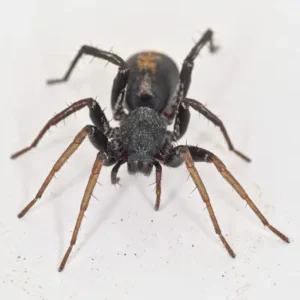
In mid-summer, BugFan Dave shared these dynamite pictures of a pretty spiffy little spider that the BugLady has never seen—the (unhyphenated) Redspotted antmimic spider (Castianeira descripta). Thanks, Dave!
Antmimic spiders used to be in the “catchall” Sac spider family Clubionidae, but now they’re found in the family Corinnidae, the Corinnid sac spiders. Antmimic spiders don’t spin trap webs, they pursue their prey on foot. But they do use silk to encase their eggs and to spin retreats in sheltered places. They tend to be drab, fast-moving spiders.
REDSPOTTED ANTMIMICS can be found in forests, grasslands, and suburbs, on the ground, on sandy shores, and on low vegetation, and under logs and leaf litter, (and sometimes in buildings) across our northern regions and in an odd, checkerboard distribution south of Canada. Considering their size and their habitat preferences, they’re probably found in a bunch of the in-between spaces, too.
They are sexually dimorphic. Males are about ¼” long while females are a tad larger, and females tend to have more variable patterns of red. Southern and western individuals have larger red patches.
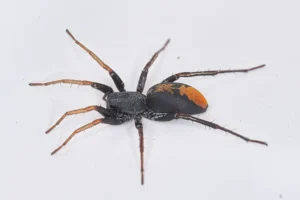
The ant-mimic thing may be a “twofer.” Because they look (and behave) like ants, some predators may give them a pass. Ants, armed with jaws at one end and a stinger at the other end that may be fortified with formic acid, are not predator-friendly. In addition, the disguise may allow them to get closer to their prey (aggressive mimicry). According to the “Spiderzrule” website, “These spiders walk about slowly the way ants do and then only move fast when disturbed. Castianeira descripta, the red spotted ant mimic spider only walks with six legs, like an ant. As they walk, their front two legs are raised in the air and quiver quickly up and down like antennae. They also quiver them briefly after they stop walking. They do this to emulate ant antennae and spiders that imitate ant antennae frequently have conspicuous front legs.” In addition, the pale/translucent front legs may mimic wasp wings.
Members of the genus Castianeira appear to be mimics of larger species of ants like carpenter ants and velvet ants, which are actually a kind of flightless, female wasp. In Spiders of the North Woods, Larry Weber writes that antmimics “often occupy the habitat of their mimic model.”
Though they don’t make trap webs, females tend to be relative homebodies, and wandering males must seek them out. Females use saliva to attach disc-like egg sacs to rocks or debris, and the spiderlings hatch in spring. One source said that the female protects the egg sac.
Besides ants, Redspotted antmimics eat tiny invertebrates like mites and aphids that they find on or near the ground. According to Weber, they are “active hunters at night. They sometimes run with groups of carpenter ants (Camponotus species)………” They spin their tube-shaped retreats where ants can be found.
The BugLady