Greetings, BugFans,
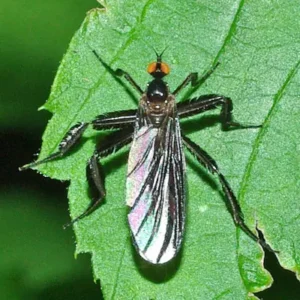
This is a revision of a story from 2009 about one of the BugLady’s favorite little (less than ½”) flies, the Long-tailed dance fly (some new words and pictures). It appears in moist, dappled shade in the month of June, and most of the BugLady’s pictures of it end up on the cutting room floor. As Matt Pelikan says in his wonderful Nature column in the Martha’s Vineyard Times, “as I develop the knack for noticing them, I’m finding them to be quite common on the Vineyard, though fiendishly difficult to photograph successfully.”
Dance flies are members of the Order Diptera (“two-wings”). Flies come in an amazing variety of species (some 17,000 different kinds grace North America), and sizes (from barely visible to crane-fly-size), colors, and shapes (long and leggy to short and chunky). Despite all that variety, these carnivores/herbivores/scavengers have been issued only two types of mouthparts – piercing-sucking (think deer fly) or sponging (think horse fly).
Dance flies, aka Balloon flies and Dagger flies (some species have sharp mouthparts), in the family Empididae, get their name from the habit of males and females of some species to gather in large, same-sex groups (leks) at dusk and dance up and down side-by-side in the air, in the hopes of attracting a mate long tail dance fly – Rhamphomyia longicauda – BugGuide.Net.
They can be found hunting for small insects (bugs, Hymenopterans, caddisflies, mayflies, beetles, springtails) on and under vegetation Soldier fly? – Rhamphomyia longicauda – BugGuide.Net in shady areas, and on front porches at night. Dance flies are very effective mosquito-predators, but in some species, both genders may also eat nectar. The larvae are carnivores.
The BugLady thinks these are LONG-TAILED DANCE FLIES (Rhamphomyia longicauda). The males’ red eyes cover their heads like helmets, and their reproductive organs, located at the tip of their abdomen, are often conspicuous Fly – Rhamphomyia longicauda – BugGuide.Net. The red eyes of the female do not meet in the middle, and she has feathery fringes (scales) on her legs.
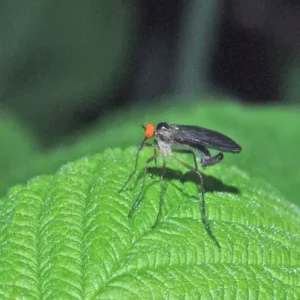
Male Long-tailed dance flies give their sweeties a nuptial gift to eat while they mate (midges and mosquitoes are favored prey), sometimes bringing it to the mating dance. As Pelikan says, “Observing such a swarm, it would be easy to assume that the insects are simply percolating at random, with little interaction among individuals. But in fact, researchers have shown, these ‘dances’ are highly structured, and highly evolved behavior takes place within them.” Females of some species, including the Long-tailed Dance Fly, do not feed as adults but depend completely on their suitors for food. The gift is thought to enable her to complete the development of her eggs. Males may wrap their gifts in balloons of silk or spit – the male Long-tailed dance fly covers his offerings with silk that he produces in glands on his legs.
But Dance flies are known for practicing little deceptions on each other. The balloon presented by some kinds of dance flies may be an empty one. Other species traditionally bring inedible plant parts. Males are more likely to present food to females that look fertile (like they’re carrying mature eggs), and so, to further enhance their desirability, females inflate air sacs located along the sides of their abdomen more dance flies – Rhamphomyia longicauda – BugGuide.Net. Although this makes the female look “egg-laden” to the male (an apparent turn-on), the air sacs may be yet another deception. The fringed legs of the female are thought to make her look like the insect version of a wide-hipped fertility goddess (though one researcher said that males may also be attracted to burs). If two females look equally “eggy,” the one with the scalier legs wins.
In the animal world, it’s more common for males to “advertise.”
The BugLady
P.S. Several BugFans (you know who you are) have expressed doubt as to whether the BugLady really has milk snakes, house centipedes and false bombardier beetles in her bathtub (not necessarily at the same time); camel crickets in the basement; long-bellied cellar spiders gracing every corner; ladybugs, leaf-footed bugs and box elder bugs freeloading throughout the winter; ants, earwigs and jumping spiders inhabiting the mailbox; and earwigs dropping out of the garage door opener keypad. Is she engaging in a bit of hyperbole in her accounts of her personal experiences with insects? In a word – No. While the BugLady does confess to being Irish and has, in fact, kissed the Blarney Stone, the accounts presented in BOTW are gospel. Thirty-two years ago, when the realtor said “I found the perfect house for you,” he was right.
The BugLady