Greetings, BugFans,
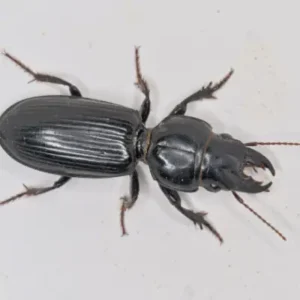
BugFan Dave shared these spectacular pictures of a very cool beetle that he found last summer – a ground beetle in the family Carabidae, a huge family with 40,000+ species. It’s in the subfamily Scaritinae, the “Pedunculate ground beetles,” so-named for the constriction – peduncle – between the wider thorax and abdomen. The wonderful “MOBugs” blogspot (“Missouri’s Majority”) suggests that they should be called “Scary pincher ground beetles.” It’s in the genus Scarites (skar-EYE-tees), a genus that numbers about 190 species worldwide with seven or eight (or nine) species in North America, most of them with very small, very southern ranges.
More about the ID of this beetle in a sec.
SCARITES – THE GENUS
Scarites beetles are often found under loose rocks and bark, boards, mulch, leaf litter, and debris, on forest floors, on or burrowing into moist, sandy soil, in gardens, in residential areas, and at the edge of agricultural fields. They’re common, though, alas, the BugLady’s never seen one – she needs to turn over more logs. Their mandibles and general air of invincibility cause some people to mistake them for stag beetles Memphis Bioblitz 2016 Platycerus – Platycerus quercus – BugGuide.Net, which are in a different family.
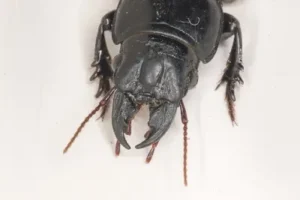
They are shiny and black, with spiky legs and an armored-looking head. The elytra (hard wing covers) are ridged/grooved, and a couple of “creases” on the shield that covers the thorax form a “T.” Males tend to be larger and “toothier” than females, with a slightly more bulging head. Some sources describe the larvae as looking like “fast-moving millipedes with large jaws” beetle larva – Scarites – BugGuide.Net.
Like many ground beetles, they are fierce and speedy predators that shelter during the day and hunt at night. Pedunculate ground beetles – La mère, le père et les enfants – eat a variety of surface and soil-dwelling invertebrates like earthworms, slugs and snails, caterpillars, maggots, ants, etc. It’s also reported that they eat insect eggs and that they scavenge on dead insects, including dead Scarites, and that they may eat some plant material. They’re considered beneficial around gardens and agricultural fields, though they don’t discriminate between pest and non-pest prey. At an inch-or-so long, they’re big enough so that researchers have attached transmitters to their abdomens to track their activities in agricultural fields! Some ground-foraging songbirds eat them.
In fact, several Extension publications offered tips about attracting Scarites beetles to your garden, creating a refuge by leaving a portion of lawn bare and/or un-mowed and/or brushy (all of which benefits solitary wasps, too), and, as always, by limiting/eliminating pesticides.
The BugLady couldn’t find much about their biographies other than the fact they overwinter as both larvae or adults, and the fact that when they’re alarmed, they will fall over, pull in their antennae and legs, stiffen, and play dead. One blogger reported a strange, but not unpleasant odor when he handled a “dead” one. The mandibles appear to be Defense Option B.
There’s a video of a Scarites beetle on the “All Bugs Go to Kevin” blog All Bugs Go to Kevin | Scarites ground beetles (north western Illinois) | Facebook, and one of a larva at the original Bug of the Week site An unusual but not unpleasant home invasion by a beneficial beetle: Big-headed ground beetle, Scarites subterraneus — Bug of the Week, where Professor Raup reports seeing them in his garden, “On several occasions I have seen Scarites larvae dashing across patios and walkways as they move from one planting bed to the next.”
So – which Scarites is this?
THE LONG-JAWED PEDUNCULATE GROUND BEETLE (Probably)
The two most common, most widely-distributed genus members in North America are the Big-headed/Pedunculate ground beetle (Scarites subterraneus) Scarites subterraneus – BugGuide.Net and Scarites vicinus Scarites vicinus – BugGuide.Net, which most sources said has no common name but that one source called the Long-jawed pedunculate ground beetle. The two are tough to tell apart, even by experts. The BugLady is going to take her usual taxonomic leap and say that this is Scarites vicinus, based on her reading of the shape of the three antennal segments (antennomeres) – slightly elongated vs round Scarites subterraneus vs. “quadriceps” – Scarites – BugGuide.Net. Scarites vicinus is also larger than Scarites subterraneus, with a broader head, and the shield on the thorax is “rounder.” All of which can be somewhat subjective – the eye of the beholder. There’s more information available about the Big-headed ground beetle than there is about the Long-jawed pedunculate ground beetle.
They’re found in a few mid-Atlantic states, a couple of Gulf states, and some Great Lakes states – and South Dakota.
Thanks, Dave.
The BugLady