Howdy, BugFans,
Today’s bug is a world traveler, and the pictures shared by BugFan Freda were taken far from our shores. Thanks, Freda!
So, no guesswork about the geographical origin of the European Wool Carder Bee (Anthidium manicatum) (in the Old World, it’s also found in Western Asia and Africa). The EWCB was first recorded in North America in 1963, near Ithaca, NY (three years before the BugLady got there), was seen in California in 2007, and is now established in a large chunk of the US and Canada. Its nesting habits make it eminently portable, and it has also made its way to parts of South America, New Zealand (2006), and more Map of Anthidium manicatum — Discover Life.
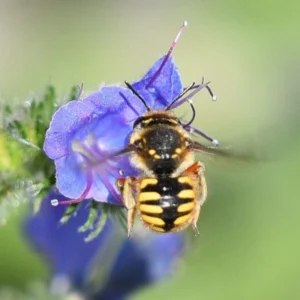
Look for it in grasslands, road edges, and gardens, where it often visits flowers of European origin, especially if they’re blue.
EWCBs are in the family Megachilidae, the Leafcutter, Resin, Mortar, Sharptail, Mason, and Woolcarder bees. Not all woolcarder bees come from elsewhere – there are a total of 170 WCB species in the genus Anthidium worldwide, including 29 in North America. “Carder?” Females harvest hairs (trichomes) from fuzzy plants to use in the construction of egg chambers – more about that in a sec.
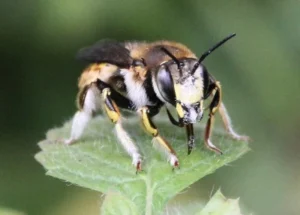
These are chunky, hairy, honey bee-sized bees that are colored like yellowjackets and that can hover like Syrphid/flower/hover flies. Males are larger than females, and the last two segments of the males’ abdomen have a spine on each side, plus a fifth spine at the very tip. Like other members of the family, their pollen-carrying hairs (scopae) are under their abdomen rather than on their legs Anthidium – Anthidium manicatum – BugGuide.Net. Much of the face is yellow, and there are variable yellow bands on the abdomen, a few yellow spots around the edges of the thorax, and yellow patches on the legs.
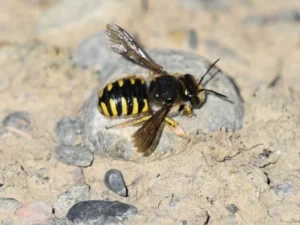
One source said that most bees can’t be ID’d on flower tops at a glance, but this one can. The moral of that story is, as always, that the BugLady needs to pay way more attention to the bees she sees.
They feed on pollen from a wide variety of often blue, often hairy, often “long-throated,” often sun-loving, and often non-native flowers (the BugLady is trying to picture the Venn diagram). In New Zealand, non-native flowers are their top choices. Their generalist feeding habits explain their success in establishing themselves around the world.
Males are territorial and aggressive, staking out patches of flowers and defending them against other WCBs and just about any flying insects, including bumble bees – plus hummingbirds and even humans. With rival bees they take the direct approach, flying up to them and trying to knock them off the flower. The encounter may escalate, with the territorial male chasing the intruder, biting it, and even using the spines on his abdomen to get the message across. Although they are equipped to do damage to rival males, competitions generally end with the territory owner routing the intruder, not harming it. One source wrote that males may have 70 hostile encounters in an hour; thus, they’ve earned the name “Bossy/Bully bee.”
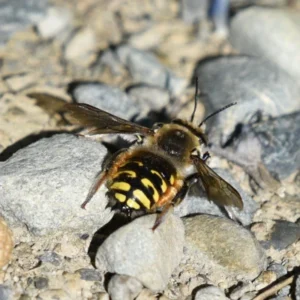
The system selects for larger males – larger males tend to hold territories and to win territorial disputes, and females prefer them. Itinerant males tend to be smaller.
If a female enters his territory to forage, she is expected to mate with him if she wants access to pollen (convenience polyandry). As a result, both males and females mate multiple times.
These are solitary rather than colonial bees. Females locate a preexisting, above-ground cavity to house their nest – a crack in a wall or foundation, rotting wood, a knothole, a plant stem, a bee hotel (which can be great fun, but strict hygiene must be maintained). Then they visit fuzzy plants Anthidium manicatum – European Woolcarder – Anthidium manicatum – BugGuide.Net, scrape hairs off of leaves or stems with their toothed mandibles, and form it into balls. They carry it under their bodies to the nest, where they use the hairs to fashion the walls and partitions of brood cells Wool Carder Bee – nest building – Anthidium manicatum – BugGuide.Net.
Some of the hairs she collects are “hydrophobic” – that is, they resist water, which helps keep the chambers (and their inhabitants) dry and microbe-resistant. Some trichomes are glandular, and as she collects the plant hairs, her legs are exposed to their secretions. These she rubs onto the cells as she builds (but the BugLady was unable to discover the benefits of doing so). She may also incorporate mud, leaves, or resin.
Each egg cell contains pollen and nectar (usually from mints like Salvia and Stachys), and the female lays an egg on the food pile in each cell before she seals it. When she has made enough cells in a cavity, she closes it with a plug. When the eggs hatch, the larvae consume the food Mom has left, pupate, and emerge later in summer. If there are two generations per year, the second generation overwinters as dormant larvae in the cell, to resume growth and emerge in late spring.
A plant that’s mentioned frequently with EWCBs is Lamb’s ear (Stachys byzantina), a common flower garden plant. Researchers found that, like many plants, Lamb’s ear releases volatile organic compounds (VOCs) when its vegetation is disturbed – in this case, when its trichomes are harvested, and these VOCs are different than the VOC bouquet emitted by the intact leaves. The bees sense the VOCs, but instead of avoiding plants where hairs had already been harvested, the VOCs attracted them to trim more. It was suggested that these VOCs acted to help EWCBs to identify target plants more easily.
Opinions are mixed about their impact on native bees, and some people list them as invasive. Yes, EWCBs are great pollinators, but they use the same nest sites as native bees, and they’re competing aggressively with them for the same flowers. And they may be pollinating the “wrong” plants.
The BugLady