Greetings, BugFans,
Dragonflies! But not soon enough!
Quick and dirty dragonfly phenology (phenology – the study of Mother Nature’s calendar. Cliff notes version – things appear/bloom/disappear/migrate in pretty much the same order every year, we just can’t predict the start date). Common Green Darners lead the parade, their arrival from the south governed by temperature and by the same weather fronts that bring migratory birds north (coinciding, hopefully, with the emergence of some insect prey for both). Migrating Variegated Meadowhawks show up in early May – or they don’t. The next tier, usually airborne by mid-May, includes Common Baskettails, Common Whitetails, Chalk-fronted Corporals, Four-spotted Skimmers, and the aptly-named Springtime Darners.
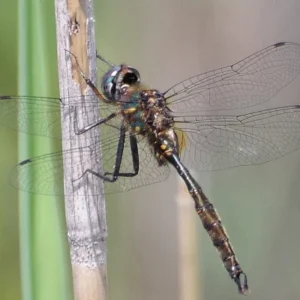
Brush-tipped Emeralds (Somatochlora walshii) are summer dragonflies.
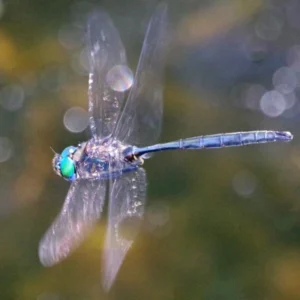
They’re in the Emerald family (Corduliidae), represented in Wisconsin by the baskettails, shadowdragons, boghaunters, a couple of smaller emeralds (Racket-tailed and American), and thirteen members of the genus Somatochlora, the Striped or Green-eyed Emeralds (Wisconsin Odonata Survey). Somatochlora comes from the Greek for “green body.” Emeralds are called emeralds because in many species, the adults, especially the adult males, have emerald-green eyes. The BugLady can testify that when you’re walking down the trail with the sun at your back and you encounter an emerald that’s flying toward you, the glow of those eyes is a religious experience Dragonfly – Somatochlora walshii – BugGuide.Net! The most famous emerald here in God’s Country is the Federally Endangered Hine’s Emerald Hine’s Emerald Dragonfly—the Backstory – Field Station.
The Striped emeralds are, as the Wisconsin Odonata Survey website points out “uncommonly seen, but this may be largely due to their secretive nature.” It goes on to say that “the medium-sized, dark brown striped emeralds have some pale markings on the thorax and abdomen, black legs, clear wings and brilliant green eyes. The thorax has a metallic bronze-green sheen and the abdomen is dark metallic black-green.” While some species live in the South, many are dragonflies of the North country, even living above the treeline.
Look for Brush-tipped Emeralds near bogs, fens, marshes, and lake outlets, near slow streams, and over meadows and at the edges of coniferous woods in Canada and across the northern tier of the US (though small populations are found at higher elevations in the Appalachians).
Emerald species are hard to tell apart in flight, but male Brush-tipped Emeralds have, well, a brushy tip Brush-tipped Emerald, male cerci and epiproct – Somatochlora walshii – BugGuide.Net that can be imagined as it flies by – as Kurt Mead says in Dragonflies of the North Woods, “the whiskered tips of the male Brush-tipped’s abdominal appendages are unlike those of any other North American species” of Somatochlora “ (though the appendages of other species are not hairless). If they sit still long enough, you can see that the metallic-green abdomen has pale yellow spots Brush-tipped Emerald – Somatochlora walshii – BugGuide.Net that can help narrow down the identification. Adult Brush-tipped Emeralds are about two inches long; males have short abdomens and females have proportionately longer abdomens than males.
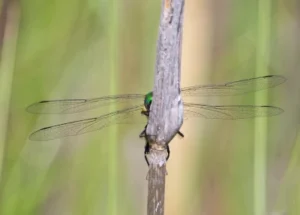
Males are strong flyers, patrolling territories by flying low (less than three feet off the ground) along the edges of cool-water wetlands, abdomen arched, putting on aerial displays, chasing rivals, and looking for females. Females lack the kind of ovipositor that would allow them to insert eggs into a plant stem, so they locate an area with lots of floating-leaved and submerged aquatic plants and they fly slowly, close to the water’s surface, dipping into or tapping it with the tip of their abdomen to release eggs (200 to 500 in all). When the eggs hatch, the naiads hide in the vegetation. They sometimes oviposit into muck or wet moss.
The BugLady got some Hail Mary shots of a female Brush-tipped Emerald (probably) who was considering a small lake inlet for ovipositing.
Adults hawk small, soft-bodied, easy-to-eat insects from the air (including mosquitoes) and consume them in flight. Females fly above small woody clearings and along roads and trails. They may forage for food away from water, but they remain attached to their natal wetland. The naiads ambush any aquatic critters they can, including tiny tadpoles and fish, and they’re preyed on by bigger aquatic insects, fish, and frogs. Spiders and birds catch the adults.
The BugLady