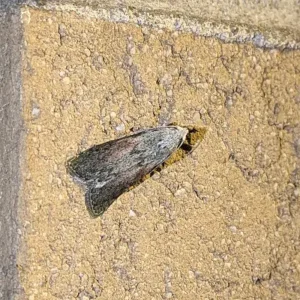
Greetings, BugFans,
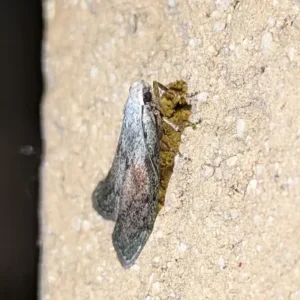
BugFan Danielle sent these shots and wondered if the moth might be a Bee moth (Aphomia sociella) (the Bee moth is not to be mistaken for the amazing little Moth fly, of previous BOTW fame -? – Clogmia albipunctata – BugGuide.Net). The BugLady agreed that it could very well be, but she emphasized that if there is a secret handshake for moth identification, she hasn’t learned it yet.
Bee moths are in the family Pyralidae, the Grass or Snout moths (the family Crambidae shares the name “Snout moths,” and for the same reason – because the sensory mouthparts (labial palps) of some members are prominent and protruding Micro Moth – Cacotherapia – BugGuide.Net). This is the BugLady’s favorite Pyralid moth must be Galasa nigrinodis ? – Galasa nigrinodis – BugGuide.Net.
Pyralids are mostly small, drab moths, some of which, like the Bee moth, take a toll on economically important plants or pollinators, some of which control unwanted plants, some of which are bred commercially as pet foods and bait, and many of which simply live out their lives under our radar. Pyralid moths may hold their wings flat at rest or may roll them (Pyralidae, lateral – BugGuide.Net) or may hold them out to the sides. They have tymbals (hearing organs), presumably so they can detect bats’ echolocation signals and dodge them. Their larvae live concealed lives in stems, fruits, or seeds, within tied leaf shelters, in the soil, or in nests of bees and wasps and sometimes mice.
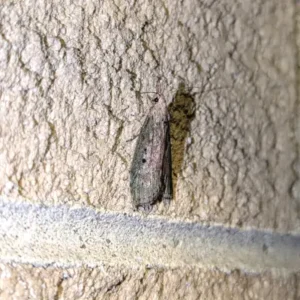
BEE MOTHS, also called Bumble bee wax moths, aren’t from around here. They were first reported in North America in 1864, and like the BugLady’s ancestors, they came over on the boat from Europe. They’re found in the northeastern quadrant of North America from Tennessee, north (plus Mississippi), and in a few western states and British Columbia.
Their wingspan is listed as about 0.70 to 1.50 inches, which is quite a range in a species this size, especially since females are not much larger than males. They may be tan, reddish Aphomia sociella? – Aphomia sociella – BugGuide.Net, or greenish Unknown Moth – Aphomia sociella – BugGuide.Net. Males are more intensely-colored and patterned, and females have a dark spot in the middle of each fore (top) wing. They seem to have a little iridescence going on.
Courtship is complicated, involving wing-fanning and the deployment of pheromones by both females and males (whose scents may also repel competitors, but if that doesn’t work, fisticuffs may ensue). Males also produce ultrasonic sounds (songs). One source suggested that the pheromones are biosynthesized from the Aspergillus fungus eaten by the larvae in nests and hives. Using her sense of smell, a female locates exposed, above-ground nests of some social bees and wasps like honey bees, bumble bees, German yellowjackets, and bald-faced hornets and lays as many as 100 eggs there. She arrives in early summer, before the hive/nest population peaks and the hosts’ defenses strengthen.
Several sources labeled the small, yellow larvae as “inquilines,” feeding on the nest detritus, waste, dead bodies, pollen and honey, wax, and fungus from within a tough tent of silk. But they’re not just harmless guests – they cross the line by damaging the nest structure with their tunneling and later with their dense webs and galleries Waxmoth larvae safe behind their tough silken blanket video | nurturing nature, and as they get older, by eating the eggs, larvae, and pupae of their hosts (unusual because most moth larvae are vegetarians). In some cases, the larvae may end up relegated to a small section of a nest as it expands. They exit the nest in fall, overwinter as larvae, and pupate in spring. They are not welcome in commercial bee operations, and they seem more able to get a foothold in honey bee hives that are already compromised.
The feeding tent may protect larvae in case their hosts discover them; adult moths play possum when alarmed, which may serve them both outside and inside the host’s nest.
Sources danced around the severity of the impact that Bee moths might have on honey bees. They’re obviously a potential problem in commercial bee operations, but they’re not listed among the major offenders – various mites and lice and the larvae of another alien Pyralid called the Wax moth – and the internet didn’t light up with Bee moth Wanted posters. A blog from Yorkshire, England stated that “They are not a pest of honey bees.” An interesting point was made in one research paper about the connection between nearby commercial honey bee operations and the health of wild bumble bee nests. Researchers noted that competition with honey bees – sharing food resources – stresses bumble bees, and that having honey bees as close neighbors increases the risk of transferring disease organisms and parasites (like Bee moths) from honey bee hives to bumble bee nests, where their impact may be greater.
Thanks, Danielle!
The BugLady